Citrine 2026: Natural vs Heat-Treated and Why It Trends
Key Takeaway: Citrine is the second most-searched crystal of 2026 behind amethyst, driven by manifestation TikTok and a sustained spike in interest in solar-energy stones. Most "citrine" sold in the U.S. is heat-treated amethyst, which is chemically identical but visually distinct. Natural citrine is paler, often slightly smoky, and significantly more expensive. Here is what to look for, what to avoid, and why the distinction matters.
Citrine has been quietly building search volume for two years, and 2026 is the year it broke through. According to retail data from major crystal suppliers, citrine is now the second-most-purchased single crystal in the U.S. (behind amethyst), and the gap is closing. Pinterest saves on citrine content are up 40% year over year. The TikTok manifestation community has effectively adopted citrine as the default "money and abundance" stone.
Most of what is being sold as citrine is not naturally formed citrine. It is heat-treated amethyst that has been processed to shift the color from purple to golden-yellow. Chemically, the two are identical. Visually, they are distinguishable. The price difference is roughly 5-15x.
Here is what citrine actually is, the natural-versus-treated distinction that drives most of the value question, and what to look for when buying.
What Citrine Is, Geologically
Citrine is a variety of quartz (silicon dioxide, SiO₂) colored yellow to golden-orange by trace iron and the specific arrangement of color centers in the crystal lattice. The color forms when natural amethyst is heated by surrounding rock to about 300-400°C, which alters the Fe³⁺ ions and produces the yellow color we associate with citrine.
This natural process is rare. Most amethyst deposits never reach the conditions needed to convert to citrine. Genuine natural citrine is mined from a small number of deposits worldwide, with the most significant being:
- Brazil (Rio Grande do Sul) - small amount of natural citrine, large amount of amethyst that gets heat-treated.
- Bolivia (Anahi mine) - source of natural ametrine, the citrine-amethyst hybrid stone.
- Madagascar - some natural citrine deposits.
- Russia (Ural Mountains) - historical natural citrine.
- Spain, Scotland, France - small historical sources.
The Brazilian heat-treatment industry takes amethyst (which is abundant) and bakes it in industrial ovens to produce the saturated golden-orange "citrine" most consumers know. The process is exactly what nature does, just on a 6-week schedule instead of millions of years.
Natural vs Heat-Treated: Why It Matters
Crystal traditions are split on whether the distinction matters energetically. Some practitioners say heat-treated material is functionally identical to natural citrine because the chemistry is the same. Others insist that the slow, geological formation of natural citrine produces an energetic signature that artificial heat treatment does not replicate.
What is not disputed:
- Visual distinction. Natural citrine is paler, often a smoky-yellow, and rarely shows the saturated golden-orange of treated material. Heat-treated citrine often has a reddish or burnt-orange color near the tip of the crystal.
- Price distinction. Natural citrine retails at 5-15x the price of heat-treated citrine of comparable size and quality.
- Crystal habit. Natural citrine forms in single-terminated points or geode interiors, often paler and with smoky tones. Heat-treated citrine is usually sold as cathedral clusters or geode caves with the iconic golden-orange interior. If you see a dramatic large geode with vibrant orange points, it is almost certainly heat-treated amethyst.
How to Tell Natural from Heat-Treated
Some practical indicators:
- Color tone. Natural citrine is yellow with smoky or olive undertones. Heat-treated has reddish, orange, or "burnt" tones, especially at the tips.
- Color saturation. Natural is paler and more uniform. Heat-treated is often saturated and uneven, with dark zones near the tips.
- Price. A quality natural citrine point at 2-3 inches typically retails at $80-$300. Heat-treated material at the same size sits at $15-$60. If a 4-inch "citrine cathedral" is selling for $80, it is heat-treated.
- Origin disclosure. Reputable dealers will tell you whether material is natural or heat-treated. If a vendor cannot or will not specify, treat as heat-treated.
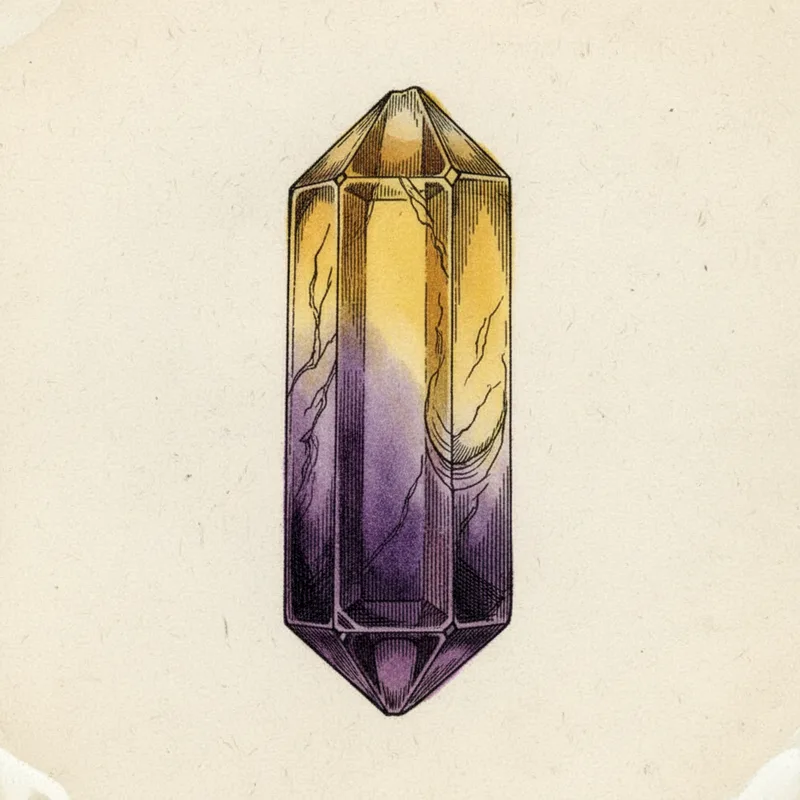
- The "ametrine" tell. If you see a single crystal that is half purple amethyst and half golden citrine, you are looking at natural ametrine, which forms only in a few specific deposits and is essentially never artificial.
What Citrine Has Traditionally Been Used For
Across multiple traditions, citrine appears as a sun stone, a manifestation stone, and a "merchant's stone." The threads:
- Mental clarity and creativity. Citrine's yellow tone and quartz family connection link it to mental energy in modern crystal traditions.
- Solar plexus chakra work. In modern energy systems, citrine is the most-recommended yellow stone for solar plexus practices.
- Manifestation and abundance. The "merchant's stone" tradition (a citrine in the cash register or business space to attract wealth) shows up in old-world European folklore and persists in modern manifestation practice.
- Self-cleansing. Most traditional sources describe citrine as a stone that does not require cleansing or charging in the same way other crystals do. The reasoning varies; the practical effect is that citrine is one of the easier stones for beginners to maintain.
What Citrine Cannot Do
The honest version that most marketing pages skip:
- It does not generate income.
- It does not change financial outcomes through any mechanism science can detect.
- The placebo and intentional-attention effects are real (focusing on a goal daily produces real action), but the stone is the prompt, not the cause.
Crystal traditions are most useful when treated as structured habits of attention. A citrine on your desk is a daily reminder of a financial or creative goal. The reminder produces action. The action produces results.
Why Citrine Is Trending in 2026
A few factors:
- Manifestation TikTok. The 2024-2025 explosion of "lucky girl syndrome" and manifestation content reframed citrine as a symbol of intentional optimism. Search volume tracks the trend.
- Visual appeal in a saturated market. Yellow and orange stones photograph well against neutral backgrounds. The Pinterest aesthetic of "warm minimalism" pairs naturally with citrine.
- Crossover into home decor. Citrine geodes have become a staple of "maximalist mineral" decor styling in 2025-2026. Pinterest interior boards saving "crystal corner" content has driven retail demand at the home-decor end of the market.
- Manifestation pairings with selenite and clear quartz. TikTok's "manifestation grid" content pairs citrine with selenite plates and clear quartz points. This three-stone combination has been the most-replicated crystal arrangement of 2026.
Buying Guide for 2026
If you want a citrine, here is what to look for at each price point:
- $10-$30: A small (1-2 inch) heat-treated tumbled stone or chip. Honest, useful, and clearly not a collector specimen. Great for first crystal or daily-carry pocket stone.
- $30-$80: A 2-3 inch heat-treated point or small cluster. Visually striking, usable for grids and altars, no pretense of natural origin.
- $80-$300: A small natural citrine point (1-2 inches) from Brazil or Madagascar. Paler color, smoky tones, real geological history.
- $300-$1,500: A larger natural citrine specimen, ametrine, or specialty piece (Russian Smoky Citrine, Kongsberg specimen). Collector territory.
- $1,500+: Museum-grade natural citrine or ametrine. Rare, traceable, often with provenance documentation.
Care and Display
Citrine is a quartz (Mohs hardness 7), which means it is durable for everyday handling. The one important note: citrine fades in prolonged direct sunlight. The same UV that bleaches amethyst will pale citrine over months of exposure on a sunny windowsill. If you are using citrine on a desk or display shelf, indirect light is fine; direct south-facing window light over months will slowly fade the color.
For our full guide on protecting crystals from summer sun and heat, see protect crystals from summer heat and sunlight.
The Bottom Line
Citrine in 2026 is having its biggest moment as a popular stone. Most of what is being sold is heat-treated amethyst, which is chemically identical and visually distinct. The price difference between natural and treated material is real (5-15x), and most consumers should buy the heat-treated version unless they specifically want natural citrine for collector or geological reasons.
The cultural moment that put citrine into the mainstream is also producing more low-quality material than ever. Buy from dealers who disclose origin. Pay attention to color tone (natural is paler and smokier; treated is saturated and orange-red). And keep your citrine out of prolonged direct sun if you want the color to last.
Related:
Metaphysical and “healing” associations mentioned here are cultural traditions, not medical advice or scientific fact. Crystals are not a substitute for professional medical care. Full disclaimer.
Crystals in This Article
Keep Reading
Newsletter
Something shiny, now and then
A stone worth knowing, or a fake worth spotting, every so often. No spam.