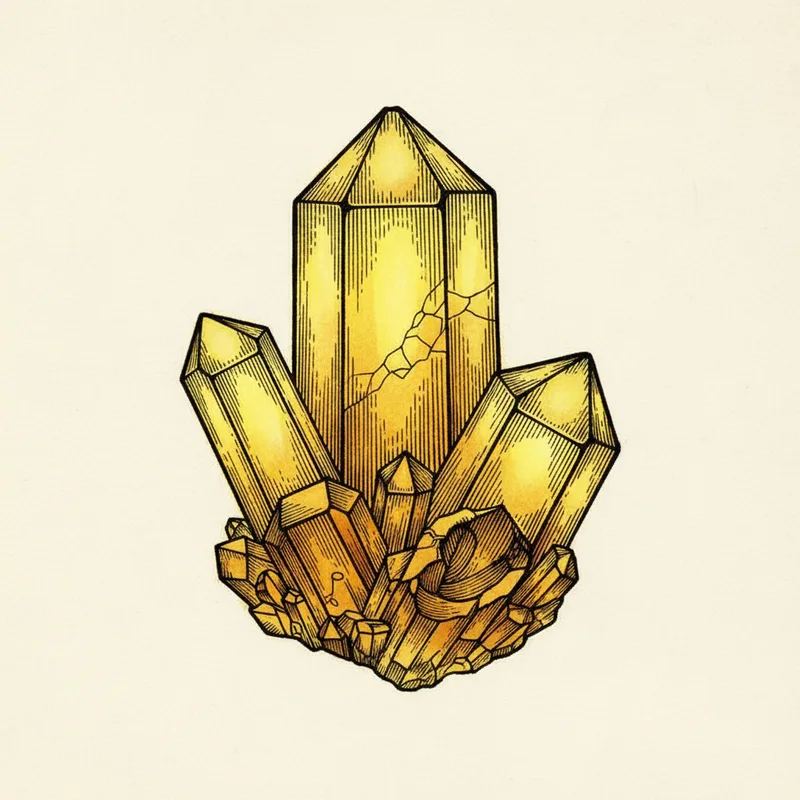
Citrine
The Merchant's Stone
Affiliate links. We may earn a commission, at no cost to you.
Quick Facts
Formation & Origin
Citrine is the yellow to golden variety of quartz, the crystalline form of silicon dioxide (SiO₂), colored by trace amounts of iron. Natural citrine is one of the rarest members of the quartz family. It forms when trace amounts of iron (Fe³⁺) are incorporated into the quartz crystal structure during growth, and the specific oxidation state of those iron atoms produces a yellow to golden color rather than the purple of amethyst.
The geological conditions required are narrow - the iron must be in the right oxidation state, the growth temperature must be within a specific range, and the crystal must avoid the natural irradiation that would push it toward smoky quartz. This is why genuine citrine is far less common than amethyst, even though both are colored by iron.
The vast majority of citrine sold commercially is actually heat-treated amethyst. When amethyst is heated to 470-560 degrees Celsius, the iron impurities change oxidation state, shifting the color from purple to yellow-orange. This treatment is permanent and stable, but the resulting color tends toward a deeper, more orange-burnt tone that differs from natural citrine's typically softer, champagne-like hue.
Identification Guide
Natural citrine ranges from pale champagne yellow to a warm golden honey color. It often shows subtle color zoning and may have a slight smoky quality. The key diagnostic challenge is distinguishing natural citrine from heat-treated amethyst.
Heat-treated stones tend to show a more saturated orange-brown color, often with a reddish tint, and may display white opaque streaks (remnants of the amethyst's original inclusions that didn't survive the heating process). Natural citrine almost never reaches the deep burnt-orange color that heated material achieves. At Mohs 7, citrine is hard and durable. It has no cleavage and fractures conchoidally, just like all quartz varieties.
Spotting Fakes
The most reliable tell is color saturation versus price: natural citrine is pale, subtle, and relatively rare, so deeply saturated, burnt-orange 'citrine' at low prices is almost certainly heat-treated amethyst.
- Heated amethyst runs deep orange-brown, often with a reddish tint; natural citrine stays pale and golden.
- Dyed quartz shows color concentrated in surface cracks.
The biggest issue in the citrine market isn't glass fakes, it's heated amethyst sold as natural citrine at natural-citrine prices. This isn't fraud per se (the treatment is industry-standard and disclosed by reputable dealers), but the price should reflect it.
Some links in this post go to Amazon and Etsy. Crystal Almanac earns a commission from qualifying purchases at no extra cost to you. Tools recommended here are ones we would use ourselves to run the tests described - the recommendation comes first, the link is downstream of it.
Cultural & Metaphysical Traditions
Presented as cultural traditions, not scientific evidence
Known historically as the 'merchant's stone,' citrine was kept in cash registers and wallets by shopkeepers who believed it attracted prosperity. Scottish Highlanders used citrine-adorned daggers and brooches as early as the 17th century. In Feng Shui, citrine is placed in the 'wealth corner' of a space. Modern practitioners associate it with confidence, creativity, and personal power.
Metaphysical and “healing” associations are cultural traditions, not medical advice or scientific fact. Crystals are not a substitute for professional medical care.
Where It's Found
Most commercial citrine is heat-treated amethyst from here
Natural citrine with distinctive smoky undertones
True natural citrine, highly prized by collectors
Natural golden specimens, often gem quality
Price Guide
Good to Know
Scratch test: At hardness 7, Citrine can scratch glass and steel. It's durable enough for any type of jewelry.
Global supply: Found in 4 notable locations worldwide, from Brazil to Madagascar.
Heft test: Citrine has average mineral density (2.65). It feels about as heavy as you'd expect from a stone its size.
Common Questions
What is the chemical formula of Citrine?
The chemical formula of Citrine is SiO₂.
What is Citrine's Mohs hardness?
Citrine has a Mohs hardness of 7 on the 1 to 10 Mohs scale, hard enough to scratch glass and stand up to daily wear.
Is Citrine a mineral?
Yes. Citrine is a naturally occurring mineral (Quartz Family) with a definite chemical composition and an ordered crystal structure.
Care & Safety
The water, salt, and sunlight questions people actually ask before cleansing or displaying citrine, answered from its hardness (Mohs 7) and chemistry (SiO₂).
Can Citrine go in water?
Yes. Citrine is hard (Mohs 7) and chemically stable, so a rinse or a quick wash with mild soap is no problem, cleanse it in water freely if that is your practice. A long soak does nothing for it either way, so skip that, and dry the stone afterward.
Can Citrine go in salt water?
Not recommended, even though citrine itself is hard and not water-soluble. Salt is both corrosive and mildly abrasive: it can dull a polished surface, attack metal settings, and crystallize inside small fractures as the stone dries. A quick dip will not destroy citrine, but rinse it with fresh water afterward and dry it. For routine cleaning, plain water is the kinder choice.
Does Citrine fade in sunlight?
It can. Natural citrine's color is sensitive to ultraviolet light, and much commercial citrine is heat-treated amethyst whose color is also not fully stable. Prolonged direct sunlight can gradually pale the yellow. Daily handling in daylight is fine; a permanent sunny windowsill is not.
Sources & References
The mineralogical and gemological data on this page is drawn from and can be cross-checked against these external references.
- WikipediaCitrine on Wikipedia
- WebmineralQuartz mineral data (Webmineral)
- Handbook of MineralogyQuartz (Handbook of Mineralogy, PDF)
- GIACitrine in the GIA Gem Encyclopedia
Explore More
Quartz & Chalcedony
The Creative Collection
Called 'the merchant's stone.' Associated with both creative vision and the ability to manifest ideas into reality.
The Abundance Collection
Called 'the merchant's stone.' Shopkeepers historically placed citrine in cash registers. Associated with abundance and manifestation.
The Manifestation Collection
The original merchant's stone. Shopkeepers placed citrine in cash registers across Europe. Its solar yellow color and association with abundance make it the classic manifestation crystal.
The Confidence Collection
The solar stone. Its yellow-to-orange color carries the warming, expansive energy of the sun. Associated with personal power, optimism, and the confidence that comes from clarity of purpose.
The Beginner's Collection
Yellow quartz colored by iron in a different oxidation state than amethyst. Most commercial citrine is heat-treated amethyst - learning to tell the difference is your first fake-spotting exercise.
The Workplace Collection
The merchant's stone on every trader's desk. Associated with abundance, positive energy, and clear thinking about practical problems. One of the most popular workspace crystals.
Scorpio Season Crystals 2026: Stones for Transformation
Lion's Gate Portal 2026: Crystals for August 8
Citrine 2026: Natural vs Heat-Treated and Why It Trends
Mohs Hardness Scale
See where Citrine sits on the scale
Crystal Care Guide
Water safety, sunlight, and handling tips
Save This Stone

Keep this citrine reference handy. Save the card to a Pinterest board and the profile is one tap away.
Save to PinterestNewsletter
Something shiny, now and then
A stone worth knowing, or a fake worth spotting, every so often. No spam.