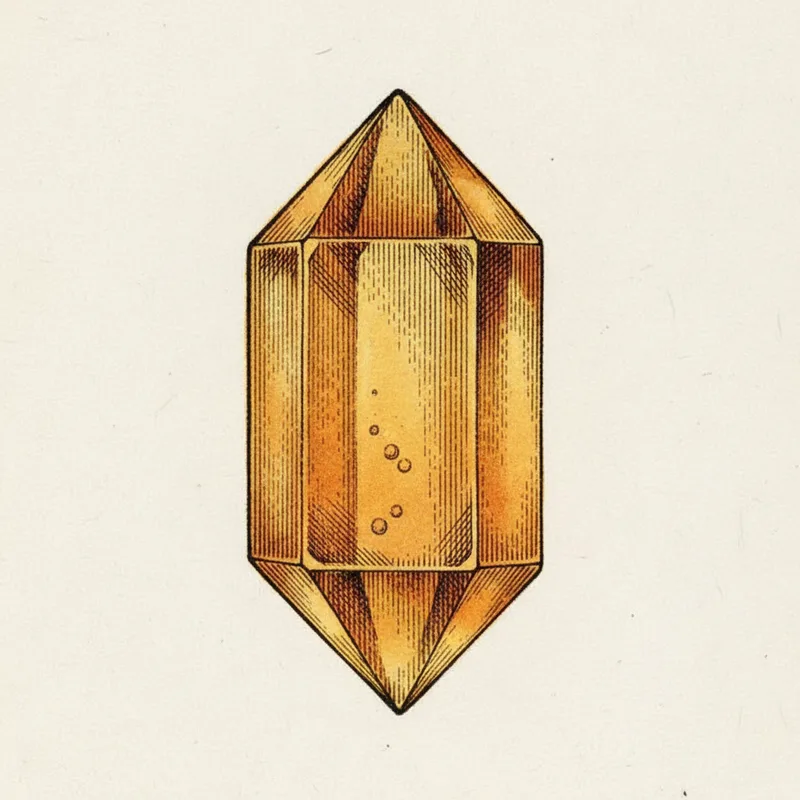
Topaz
The Stone of Clarity
Affiliate links. We may earn a commission, at no cost to you.
Quick Facts
Formation & Origin
Topaz is an aluminum silicate mineral containing fluorine and hydroxyl, Al₂SiO₄(F,OH)₂, that crystallizes in the late stages of granitic magma cooling. Topaz forms in the final stages of granitic magma cooling, when fluorine-rich gases and fluids penetrate the surrounding rock. It crystallizes in pegmatites, high-temperature quartz veins, and vugs (cavities) within granite and rhyolite. The fluorine content in topaz's chemistry is what distinguishes it from other aluminum silicates.
The most valued variety - imperial topaz - comes almost exclusively from Ouro Preto in Brazil's Minas Gerais state. These orange to pinkish-orange stones get their color from chromium, and the specific geological conditions at Ouro Preto have never been replicated elsewhere. Natural pink topaz is also extremely rare and is found primarily in Pakistan and Russia.
Almost all blue topaz on the market is irradiated and heated colorless topaz. Natural blue topaz exists but is extremely pale. The vivid 'Swiss Blue' and deep 'London Blue' commercial varieties are 100% treated. This is universally disclosed and accepted in the gem trade.
Identification Guide
Topaz has perfect basal cleavage in one direction - it splits cleanly into flat sheets. This is its most diagnostic physical property and also its biggest vulnerability (topaz can crack if dropped on a hard surface). At hardness 8, it's harder than quartz.
Distinguish from citrine (lower hardness at 7, no cleavage), aquamarine (lower SG, different crystal habit), and blue glass (no cleavage, may have bubbles). The combination of hardness 8 plus perfect basal cleavage is essentially unique to topaz among common gems.
Spotting Fakes
The biggest 'fake' in the topaz market is naming fraud. 'Smoky topaz' is smoky quartz. 'Madeira topaz' is usually citrine. These are completely different minerals being marketed with topaz's name to justify higher prices. True topaz is denser and harder than quartz. For blue topaz, the treatment is universal and legitimate, but sellers should disclose it. Imperial topaz from Brazil is sometimes simulated with coated colorless topaz - the coating can wear off over time.
Some links in this post go to Amazon and Etsy. Crystal Almanac earns a commission from qualifying purchases at no extra cost to you. Tools recommended here are ones we would use ourselves to run the tests described - the recommendation comes first, the link is downstream of it.
Cultural & Metaphysical Traditions
Presented as cultural traditions, not scientific evidence
Ancient Egyptians associated topaz with the sun god Ra. Romans believed it could improve eyesight. In medieval European tradition, topaz was thought to break spells and dispel anger. The name may derive from the Sanskrit 'tapas' meaning fire, or from Topazios, an island in the Red Sea (though the stones found there were likely peridot, not topaz). Blue topaz became the December birthstone alternative and Texas state gem.
Metaphysical and “healing” associations are cultural traditions, not medical advice or scientific fact. Crystals are not a substitute for professional medical care.
Where It's Found
Imperial topaz, the most valuable variety
Fine pink and sherry topaz crystals
Historic source, pink topaz named 'imperial'
Major source of blue topaz rough for treatment
Price Guide
Good to Know
Scratch test: At hardness 8, Topaz can scratch glass and steel. It's durable enough for any type of jewelry.
Global supply: Found in 4 notable locations worldwide, from Brazil to Nigeria.
Heft test: Topaz has a specific gravity of 3.53 - noticeably heavier than quartz. You'll feel the density when you pick it up.
Common Questions
What is the chemical formula of Topaz?
The chemical formula of Topaz is Al₂SiO₄(F,OH)₂.
What is Topaz's Mohs hardness?
Topaz has a Mohs hardness of 8 on the 1 to 10 Mohs scale, hard enough to scratch glass and stand up to daily wear.
Is Topaz a mineral?
Yes. Topaz is a naturally occurring mineral (Silicate Group) with a definite chemical composition and an ordered crystal structure.
Care & Safety
The water, salt, and sunlight questions people actually ask before cleansing or displaying topaz, answered from its hardness (Mohs 8) and chemistry (Al₂SiO₄(F,OH)₂).
Can Topaz go in water?
Yes. Topaz is hard (Mohs 8) and chemically stable, so a rinse or a quick wash with mild soap is no problem, cleanse it in water freely if that is your practice. A long soak does nothing for it either way, so skip that, and dry the stone afterward.
Can Topaz go in salt water?
Not recommended, even though topaz itself is hard and not water-soluble. Salt is both corrosive and mildly abrasive: it can dull a polished surface, attack metal settings, and crystallize inside small fractures as the stone dries. A quick dip will not destroy topaz, but rinse it with fresh water afterward and dry it. For routine cleaning, plain water is the kinder choice.
Does Topaz fade in sunlight?
Some topaz does. Yellow-to-brown sherry-colored topaz can fade from extended exposure to sunlight, a change documented in stones from several localities. Blue and colorless topaz are generally stable. If your topaz is golden or brown, keep it out of prolonged direct sun.
Famous Topaz Specimens
Individual topazs with documented histories - verified provenance, ownership timelines, and where each stone sits today.
The full Famous Stones catalogue →Sources & References
The mineralogical and gemological data on this page is drawn from and can be cross-checked against these external references.
- WikipediaTopaz on Wikipedia
- WebmineralTopaz mineral data (Webmineral)
- Handbook of MineralogyTopaz (Handbook of Mineralogy, PDF)
- GIATopaz in the GIA Gem Encyclopedia
Explore More
Other Silicates & Gems
Scorpio Season Crystals 2026: Stones for Transformation
Citrine 2026: Natural vs Heat-Treated and Why It Trends
How to Protect Crystals from Summer Heat and Sunlight
Mohs Hardness Scale
See where Topaz sits on the scale
Crystal Care Guide
Water safety, sunlight, and handling tips
Save This Stone

Keep this topaz reference handy. Save the card to a Pinterest board and the profile is one tap away.
Save to PinterestNewsletter
Something shiny, now and then
A stone worth knowing, or a fake worth spotting, every so often. No spam.