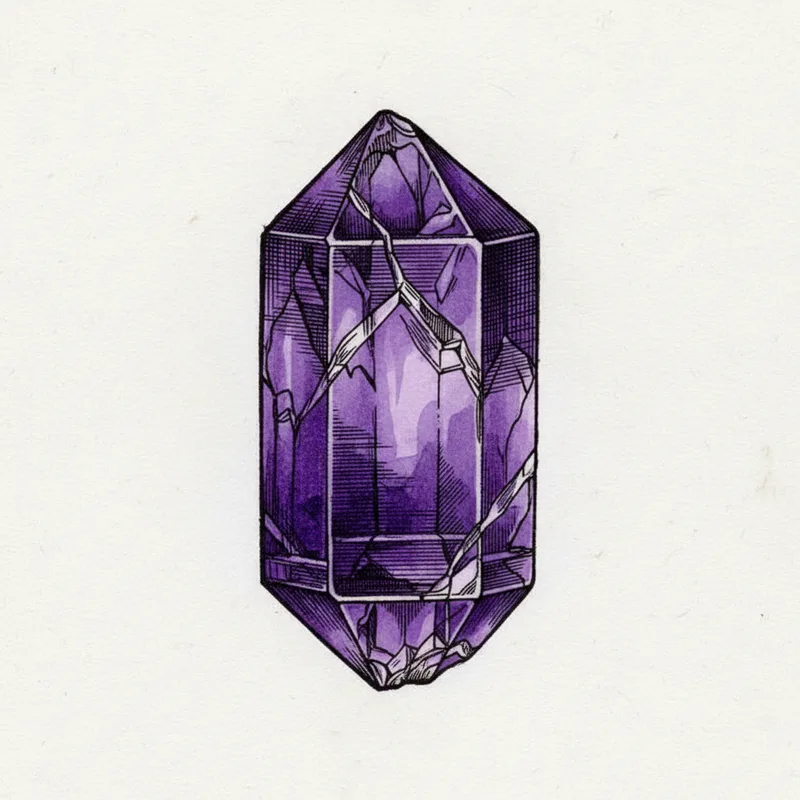
Amethyst
The Stone of Spiritual Wisdom
Affiliate links. We may earn a commission, at no cost to you.
Quick Facts
Formation & Origin
Amethyst is the purple variety of quartz, the crystalline form of silicon dioxide (SiO₂), tinted by trace iron and natural irradiation. Amethyst forms in volcanic rock cavities called geodes. When silica-rich groundwater seeps through volcanic rock, it slowly deposits layers of quartz crystals over millions of years. The purple color comes from trace amounts of iron (Fe³⁺) and natural irradiation within the Earth's crust. The intensity of the color depends on the concentration of iron and the amount of radiation the crystal receives during formation.
Cathedral geodes from Uruguay can reach over two meters tall, their interiors lined with deep violet crystals that took tens of millions of years to grow. In Brazil's Rio Grande do Sul, entire basalt flows contain hollow cavities that became crystal-lined chambers, some large enough to stand inside.
Identification Guide
Amethyst is relatively easy to identify by its distinctive purple color and hexagonal crystal habit. It has a Mohs hardness of 7, meaning it cannot be scratched by a steel knife. The color ranges from pale lavender to deep royal purple, often with color zoning visible as angular bands within the crystal.
Unlike purple fluorite (which it's sometimes confused with), amethyst has no cleavage and breaks with a conchoidal fracture. Under UV light, some amethyst specimens will fluoresce a weak blue-green. It's also significantly harder than fluorite (7 vs 4 on the Mohs scale).
Spotting Fakes
The single most reliable check is the temperature test against glass: real quartz stays cool to the touch while glass imitations feel warm, so a piece that warms quickly in your hand is glass, not amethyst.
- Heat-treated citrine sold as 'burnt amethyst' shows an unnatural orange-yellow color and lacks color zoning.
- Synthetic amethyst tends to have more uniform color, without the banding seen in natural specimens.
- Glass imitations feel warm to the touch; real quartz stays cool.
If a dealer claims an amethyst is from a high-value locality, ask for provenance documentation.
Some links in this post go to Amazon and Etsy. Crystal Almanac earns a commission from qualifying purchases at no extra cost to you. Tools recommended here are ones we would use ourselves to run the tests described - the recommendation comes first, the link is downstream of it.
Cultural & Metaphysical Traditions
Presented as cultural traditions, not scientific evidence
Revered since antiquity. The ancient Greeks believed amethyst could prevent intoxication (the name derives from 'amethystos,' meaning 'not drunk'). Medieval European soldiers wore amethyst amulets for protection in battle. In Tibetan Buddhist tradition, amethyst rosaries are considered aids to meditation. Contemporary crystal practitioners associate it with mental clarity, emotional balance, and restful sleep.
Metaphysical and “healing” associations are cultural traditions, not medical advice or scientific fact. Crystals are not a substitute for professional medical care.
Where It's Found
World's largest producer of amethyst geodes
Deep saturated color, cathedral geodes
Exceptional clarity and gem-grade material
Fine druzy specimens with delicate crystal points
Price Guide
Good to Know
Scratch test: At hardness 7, Amethyst can scratch glass and steel. It's durable enough for any type of jewelry.
Global supply: Found in 4 notable locations worldwide, from Brazil to South Korea.
Heft test: Amethyst has average mineral density (2.65). It feels about as heavy as you'd expect from a stone its size.
Common Questions
What is the chemical formula of Amethyst?
The chemical formula of Amethyst is SiO₂.
What is Amethyst's Mohs hardness?
Amethyst has a Mohs hardness of 7 on the 1 to 10 Mohs scale, hard enough to scratch glass and stand up to daily wear.
Is Amethyst a mineral?
Yes. Amethyst is a naturally occurring mineral (Quartz Family) with a definite chemical composition and an ordered crystal structure.
Care & Safety
The water, salt, and sunlight questions people actually ask before cleansing or displaying amethyst, answered from its hardness (Mohs 7) and chemistry (SiO₂).
Can Amethyst go in water?
Yes. Amethyst is hard (Mohs 7) and chemically stable, so a rinse or a quick wash with mild soap is no problem, cleanse it in water freely if that is your practice. A long soak does nothing for it either way, so skip that, and dry the stone afterward.
Can Amethyst go in salt water?
Not recommended, even though amethyst itself is hard and not water-soluble. Salt is both corrosive and mildly abrasive: it can dull a polished surface, attack metal settings, and crystallize inside small fractures as the stone dries. A quick dip will not destroy amethyst, but rinse it with fresh water afterward and dry it. For routine cleaning, plain water is the kinder choice.
Does Amethyst fade in sunlight?
Yes, it can. Amethyst's purple comes from irradiation-induced color centers around trace iron in the quartz lattice, and overexposure to strong light fades the color in tone. The fading is gradual and permanent. Display amethyst away from direct sun and it will hold its color indefinitely.
Sources & References
The mineralogical and gemological data on this page is drawn from and can be cross-checked against these external references.
- WikipediaAmethyst on Wikipedia
- WebmineralQuartz mineral data (Webmineral)
- Handbook of MineralogyQuartz (Handbook of Mineralogy, PDF)
- GIAAmethyst in the GIA Gem Encyclopedia
Explore More
Quartz & Chalcedony
The Calming Collection
The ancient Greeks' anti-anxiety stone. Its name literally means 'not intoxicated' - they believed it calmed the mind.
The Protection Collection
Medieval European soldiers wore amethyst amulets for protection in battle. The stone has been associated with sobriety and clear-headedness since antiquity.
The Meditation Collection
Tibetan Buddhist tradition uses amethyst rosaries for meditation. Its purple color and accessible price make it the most widely used meditation crystal.
The Sleep Collection
The most popular sleep crystal worldwide. Medieval Europeans placed it under pillows. Tibetan tradition uses it in sleep-adjacent meditation. Its purple color and calming associations make it the default choice for the bedside.
The Beginner's Collection
The perfect first crystal. Purple quartz colored by iron and natural radiation - real geology you can see. Widely available for $3-15, instantly recognizable, and represents the entire quartz family.
The Healing Collection
Greek physicians prescribed amethyst for sobriety and clear thinking. Medieval healers used it for pain relief and as an antidote to poison. The most historically documented healing crystal in the Western tradition.
The Travel Collection
Medieval European travelers carried amethyst as protection against intoxication and poor judgment - practical concerns on long journeys through inns and markets.
The Grief Collection
Medieval healing traditions used amethyst specifically for grief. Its calming properties and association with spiritual protection made it the standard stone for the bereaved in European tradition.
Libra Season Crystals 2026: Stones for Balance
Virgo Season Crystals 2026: Stones for Clarity
Lion's Gate Portal 2026: Crystals for August 8
Mohs Hardness Scale
See where Amethyst sits on the scale
Crystal Care Guide
Water safety, sunlight, and handling tips
Save This Stone

Keep this amethyst reference handy. Save the card to a Pinterest board and the profile is one tap away.
Save to PinterestStay in the loop
From the Almanac
Updates from Crystal Almanac, when there’s something worth sharing.