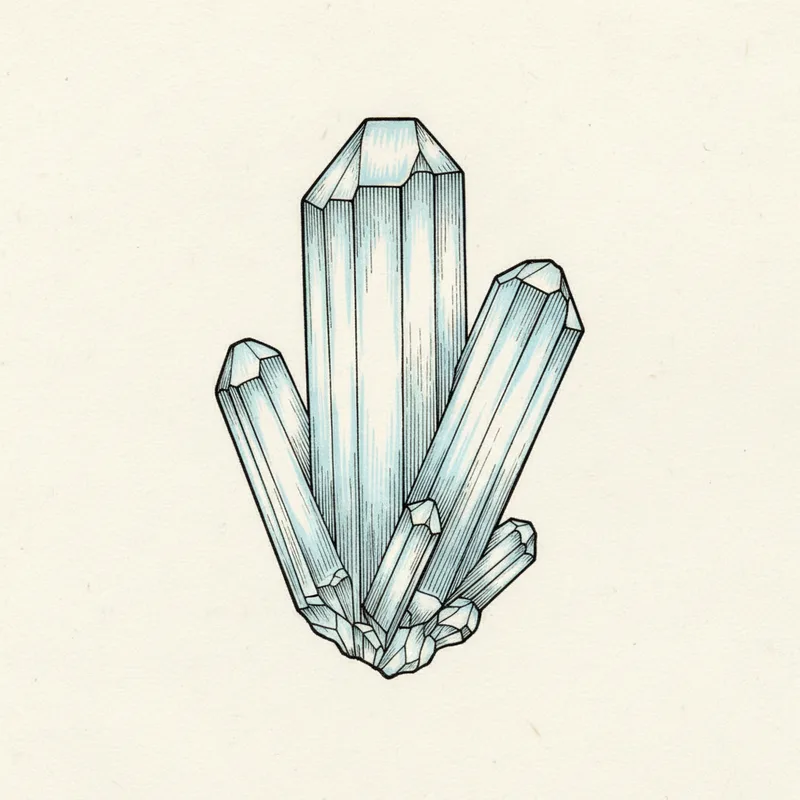
Selenite
The Liquid Light
Affiliate links. We may earn a commission, at no cost to you.
Quick Facts
Formation & Origin
Selenite is a crystalline variety of gypsum that forms through the evaporation of calcium sulfate-rich water. In its most dramatic expression, this process created the Giant Crystal Cave (Cueva de los Cristales) in Naica, Mexico, where selenite crystals grew to 12 meters long and weighed up to 55 tons - the largest crystals ever discovered on Earth.
The Naica crystals grew over approximately 500,000 years in a cave filled with mineral-rich water heated to about 58 degrees Celsius by underlying magma. At this precise temperature, gypsum is barely soluble - meaning crystals could grow extremely slowly, adding only a few atomic layers per year. This glacial growth rate, combined with perfectly stable conditions over millennia, produced crystals of extraordinary size and perfection.
Desert rose selenite forms through a different process - gypsum crystallizes within sand in arid environments, incorporating sand grains as it grows and forming rosette-shaped clusters. Oklahoma's hourglass selenite contains an internal hourglass-shaped pattern of brown sand trapped during growth, visible when the crystal is held up to light.
Identification Guide
Selenite is instantly recognizable by its extreme softness. At Mohs 2, you can scratch it with your fingernail. It's one of the softest minerals you'll commonly encounter. Transparent selenite transmits light beautifully and has a distinctive pearly to vitreous luster.
The crystal habit is typically bladed (flat, sword-like crystals) or tabular. Selenite has perfect cleavage in one direction, meaning thin sheets can be peeled off with a fingernail. A critical property to know: selenite is water-soluble. Never clean selenite with water or it will slowly dissolve and lose its polish. This same property means selenite left outdoors will deteriorate.
Spotting Fakes
The fingernail test settles it immediately: selenite is dramatically softer than quartz (2 vs 7), so anything your fingernail can't scratch isn't selenite.
- Selenite is too inexpensive and abundant to be commonly faked; the real issue is confusion with other white or clear minerals.
- Polished selenite marketed as 'satin spar' or 'liquid light' at inflated prices is genuine selenite/gypsum, just not rare.
The 'charging' and 'cleansing' claims in the wellness market are cultural beliefs, not properties of the mineral. Selenite has no special ability to clean other crystals.
Some links in this post go to Amazon and Etsy. Crystal Almanac earns a commission from qualifying purchases at no extra cost to you. Tools recommended here are ones we would use ourselves to run the tests described - the recommendation comes first, the link is downstream of it.
Cultural & Metaphysical Traditions
Presented as cultural traditions, not scientific evidence
Named after Selene, the Greek goddess of the moon, for its lunar glow. Ancient Greeks used transparent selenite as window glass. In Mexican folk tradition, selenite from the caves of Chihuahua is considered a connection to the underworld. Modern crystal practitioners consider selenite a 'high vibration' stone associated with mental clarity, spiritual connection, and energy cleansing - it's one of the most popular crystals in the wellness market.
Metaphysical and “healing” associations are cultural traditions, not medical advice or scientific fact. Crystals are not a substitute for professional medical care.
Where It's Found
Giant Crystal Cave - selenite crystals up to 12 meters long
Desert rose formations and bladed crystals
Hourglass selenite with unique brown sand inclusions
Large transparent blade crystals
Price Guide
Good to Know
Scratch test: At hardness 2, Selenite can be scratched with a fingernail. This is a display specimen, not a wearable stone.
Global supply: Found in 4 notable locations worldwide, from Mexico to Australia.
Heft test: With a specific gravity of 2.32, Selenite feels lighter than most minerals. This lightness can help identify it.
Common Questions
What is the chemical formula of Selenite?
The chemical formula of Selenite is CaSO₄·2H₂O.
What is Selenite's Mohs hardness?
Selenite has a Mohs hardness of 2 on the 1 to 10 Mohs scale, soft enough to scratch with a fingernail.
Is Selenite a mineral?
Yes. Selenite is a naturally occurring mineral (Sulfate Group) with a definite chemical composition and an ordered crystal structure.
Care & Safety
The water, salt, and sunlight questions people actually ask before cleansing or displaying selenite, answered from its hardness (Mohs 2) and chemistry (CaSO₄·2H₂O).
Can Selenite go in water?
No, never. Dissolves in water. Selenite is a form of gypsum (CaSO₄·2H₂O), which is water-soluble. Even brief contact can etch the surface.
Can Selenite go in salt water?
No, never. Selenite is water-soluble gypsum (CaSO₄·2H₂O), so salt water attacks it just as fresh water does, and the salt left behind as it dries abrades the soft surface further. Keep selenite completely dry.
Sources & References
The mineralogical and gemological data on this page is drawn from and can be cross-checked against these external references.
- WikipediaSelenite (gypsum) on Wikipedia
- WebmineralGypsum mineral data (Webmineral)
- Handbook of MineralogyGypsum (Handbook of Mineralogy, PDF)
Related Minerals
Sand-included selenite in rosette formations
Fibrous variety of gypsum, silky luster
Massive fine-grained gypsum, used for carving
Dehydrated form of gypsum
Explore More
Sulfate Minerals
The Meditation Collection
Named after Selene, Greek moon goddess. Its translucent, luminous quality creates a calming visual focus in low light.
The Sleep Collection
Named for Selene, the Greek moon goddess. Its translucent, luminous quality creates a soft visual anchor in low light. Often placed on nightstands as a gentle, light-catching presence.
The Beginner's Collection
Gypsum (CaSO₄·2H₂O) in its transparent form. Dramatically soft (hardness 2) and will scratch with a fingernail. Teaches hardness scale better than any textbook explanation.
Lion's Gate Portal 2026: Crystals for August 8
Citrine 2026: Natural vs Heat-Treated and Why It Trends
How to Protect Crystals from Summer Heat and Sunlight
Mohs Hardness Scale
See where Selenite sits on the scale
Crystal Care Guide
Water safety, sunlight, and handling tips
Save This Stone

Keep this selenite reference handy. Save the card to a Pinterest board and the profile is one tap away.
Save to PinterestNewsletter
Something shiny, now and then
A stone worth knowing, or a fake worth spotting, every so often. No spam.