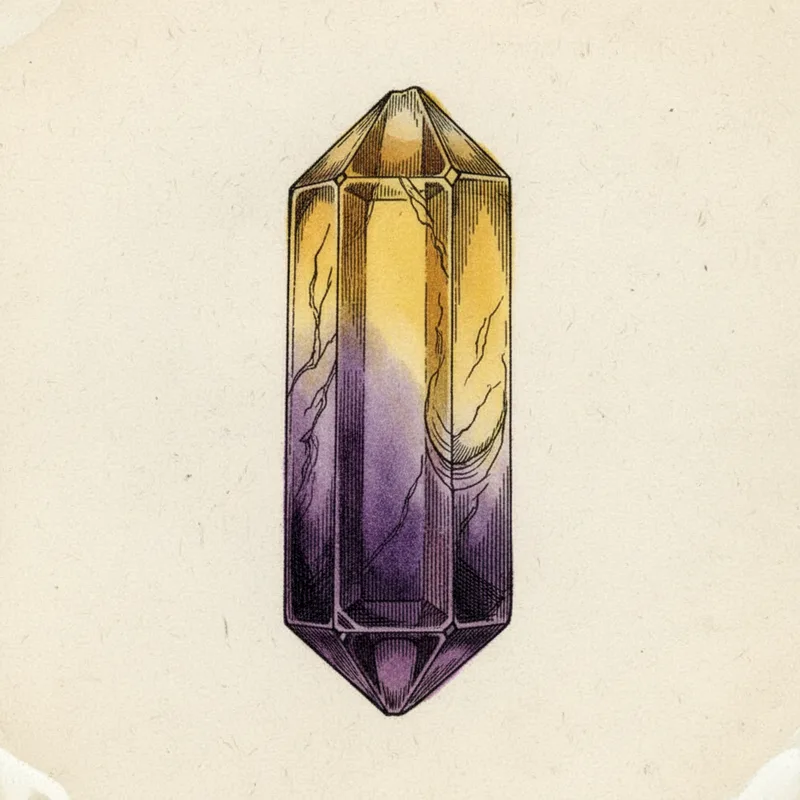
Ametrine
The Two-Toned Gem
Affiliate links. We may earn a commission, at no cost to you.
Quick Facts
Formation & Origin
Ametrine is a naturally bicolored quartz that displays both amethyst (purple) and citrine (yellow) colors in the same crystal. It's one of the most visually striking members of the quartz family, and the science behind its two-toned appearance is elegant.
Both colors come from iron, but in different oxidation states. In the purple zones, iron is in the Fe³⁺ state and has been affected by natural gamma radiation to create amethyst color centers. In the yellow zones, the iron is in a different oxidation state that produces the citrine color. The boundary between the two zones can be sharp or gradational.
The Anahi Mine in eastern Bolivia is essentially the world's only commercial source. According to local legend, the mine was given to a Spanish conquistador as a dowry when he married a princess of the Ayoreos tribe named Anahi. The mine was lost for centuries before being rediscovered in the 1960s.
The color distribution in ametrine follows the underlying crystal symmetry - the boundaries between purple and yellow zones align with specific crystallographic directions, which is why skilled gem cutters can orient the stone to show a clean, dramatic color split.
Identification Guide
Ametrine is identified by its distinctive bicolor appearance - purple and yellow in the same transparent stone. At hardness 7, it's durable and takes an excellent polish. The color boundary may be sharp (most desirable for gems) or gradual.
Distinguish from synthetic ametrine (exists but requires lab testing), color-zoned amethyst (may show pale-to-dark purple zoning but not yellow), and glass (no color zoning follows crystal symmetry, may have bubbles). The way the color boundary follows crystallographic planes is diagnostic of natural material.
Spotting Fakes
Synthetic ametrine produced by diffusion treatment (heating amethyst with a chemical gradient) exists and can be difficult to distinguish from natural. The key indicator: in natural ametrine, the color boundary is typically along a specific crystallographic plane. In synthetics, the boundary may be irregular or follow the outer surface of the crystal. Lab reports from GIA or similar labs can confirm natural origin. Given that natural ametrine is not extremely expensive, the cost of a lab report is proportionally higher - but worth it for larger stones.
Some links in this post go to Amazon and Etsy. Crystal Almanac earns a commission from qualifying purchases at no extra cost to you. Tools recommended here are ones we would use ourselves to run the tests described - the recommendation comes first, the link is downstream of it.
Cultural & Metaphysical Traditions
Presented as cultural traditions, not scientific evidence
Ametrine's dual nature - combining amethyst's purple with citrine's gold - has led crystal practitioners to associate it with balance and integration of opposing forces. In Bolivian folk tradition, ametrine is connected to the love story of Anahi and her Spanish husband, symbolizing the union of two cultures. Modern practitioners use it for balancing creative and analytical thinking, and as a stone of decision-making.
Metaphysical and “healing” associations are cultural traditions, not medical advice or scientific fact. Crystals are not a substitute for professional medical care.
Where It's Found
The only commercially significant source
Price Guide
Good to Know
Scratch test: At hardness 7, Ametrine can scratch glass and steel. It's durable enough for any type of jewelry.
Global supply: Found at only one location on Earth - Bolivia. Supply is inherently limited.
Heft test: Ametrine has average mineral density (2.65). It feels about as heavy as you'd expect from a stone its size.
Common Questions
What is the chemical formula of Ametrine?
The chemical formula of Ametrine is SiO₂.
What is Ametrine's Mohs hardness?
Ametrine has a Mohs hardness of 7 on the 1 to 10 Mohs scale, hard enough to scratch glass and stand up to daily wear.
Is Ametrine a mineral?
Yes. Ametrine is a naturally occurring mineral (Quartz Family) with a definite chemical composition and an ordered crystal structure.
Care & Safety
The water, salt, and sunlight questions people actually ask before cleansing or displaying ametrine, answered from its hardness (Mohs 7) and chemistry (SiO₂).
Can Ametrine go in water?
Yes. Ametrine is hard (Mohs 7) and chemically stable, so a rinse or a quick wash with mild soap is no problem, cleanse it in water freely if that is your practice. A long soak does nothing for it either way, so skip that, and dry the stone afterward.
Can Ametrine go in salt water?
Not recommended, even though ametrine itself is hard and not water-soluble. Salt is both corrosive and mildly abrasive: it can dull a polished surface, attack metal settings, and crystallize inside small fractures as the stone dries. A quick dip will not destroy ametrine, but rinse it with fresh water afterward and dry it. For routine cleaning, plain water is the kinder choice.
Does Ametrine fade in sunlight?
Yes. Ametrine combines amethyst and citrine color zones in a single quartz crystal, and both color centers are light-sensitive. Prolonged direct sunlight can slowly pale the purple and the yellow zones alike. Keep it out of sustained direct sun.
Sources & References
The mineralogical and gemological data on this page is drawn from and can be cross-checked against these external references.
- WikipediaAmetrine on Wikipedia
- WebmineralQuartz mineral data (Webmineral)
- Handbook of MineralogyQuartz (Handbook of Mineralogy, PDF)
Explore More
Quartz & Chalcedony
The Creative Collection
Half amethyst, half citrine. The dual nature represents integrating creative intuition (purple) with practical execution (gold).
Citrine 2026: Natural vs Heat-Treated and Why It Trends
Crystals That Fade in Sunlight (The Chemistry Explained)
How to Store and Display Your Crystal Collection
Mohs Hardness Scale
See where Ametrine sits on the scale
Crystal Care Guide
Water safety, sunlight, and handling tips
Save This Stone

Keep this ametrine reference handy. Save the card to a Pinterest board and the profile is one tap away.
Save to PinterestNewsletter
Something shiny, now and then
A stone worth knowing, or a fake worth spotting, every so often. No spam.