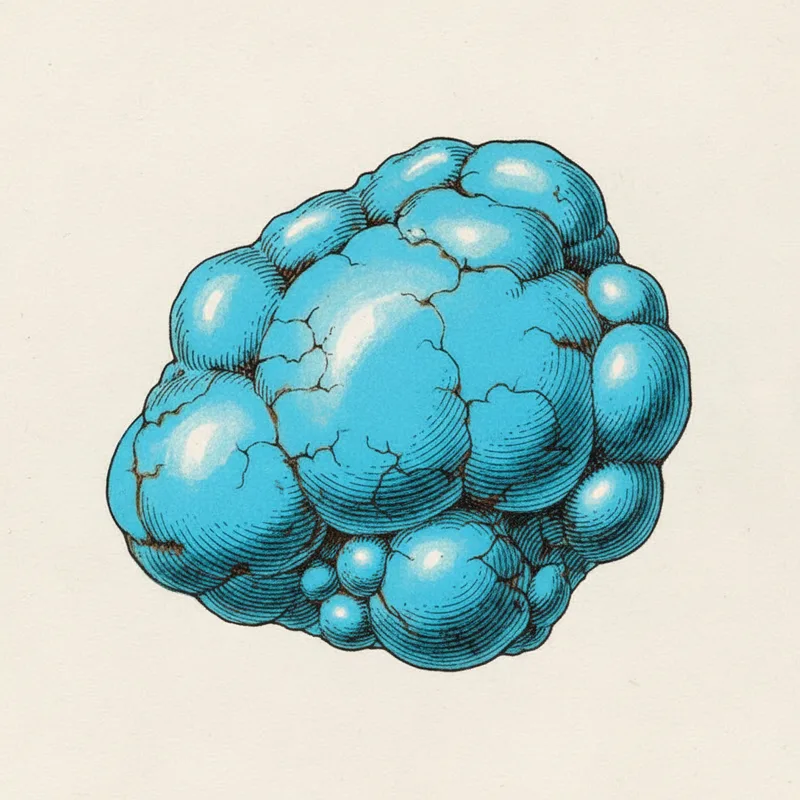
Turquoise
The Sky Stone
Affiliate links. We may earn a commission, at no cost to you.
Quick Facts
Formation & Origin
Turquoise is a hydrated copper aluminum phosphate mineral, valued for its sky-blue to blue-green color that comes from its copper content. Turquoise forms in arid environments where acidic, copper-rich groundwater percolates through aluminum-rich rock (typically volcanic or sedimentary). As this water evaporates in the dry climate, turquoise precipitates in fractures, cavities, and pore spaces within the host rock.
The process requires a specific cocktail of elements - copper provides the blue color, aluminum and phosphorus form the structural framework, and the right pH and temperature allow crystallization. This is why turquoise is found almost exclusively in arid and semi-arid regions: the American Southwest, Iran, the Sinai Desert, and central China.
The finest turquoise - the pure robin's-egg blue from Nishapur, Iran - forms when copper is the dominant coloring agent without significant iron contamination. As iron content increases, the color shifts from blue toward green. The dark veining seen in many specimens (called 'matrix') is the host rock in which the turquoise formed - limonite, sandstone, or other materials that filled adjacent fractures.
Identification Guide
Turquoise's opaque blue to blue-green color and waxy luster are distinctive, but many imitations exist. Genuine turquoise has a Mohs hardness of 5-6 (depending on porosity), a white to pale green streak, and a waxy to dull luster on natural surfaces.
The most reliable field test is a hot needle: genuine turquoise won't melt or produce a chemical smell, while plastic imitations and resin-stabilized material will. Under magnification, natural turquoise often shows a slightly irregular, granular texture rather than a perfectly smooth surface. Matrix patterns in genuine turquoise are irregular and random - manufactured matrix (painted onto howlite or magnesite) looks too even.
Spotting Fakes
Turquoise has one of the most fraud-prone markets in the gem world. Common substitutes include dyed howlite (white mineral dyed blue - do a scratch test on an inconspicuous area; the white base will show), dyed magnesite, reconstituted turquoise (ground and reformed with resin), and outright plastic. Even genuine turquoise is often 'stabilized' with resin to improve durability and color - this is standard practice and not considered deceptive when disclosed. The key question is whether you're paying natural-turquoise prices for stabilized or imitation material. Buy from reputable dealers who disclose treatments.
Some links in this post go to Amazon and Etsy. Crystal Almanac earns a commission from qualifying purchases at no extra cost to you. Tools recommended here are ones we would use ourselves to run the tests described - the recommendation comes first, the link is downstream of it.
Cultural & Metaphysical Traditions
Presented as cultural traditions, not scientific evidence
Turquoise may be the oldest gemstone in human use - Egyptian pharaohs wore it by 3000 BCE, and it adorned the funeral mask of Tutankhamun. Native American tribes consider turquoise sacred - the Navajo call it 'doo tl'izh ii' and use it in healing ceremonies, jewelry, and prayer. Persian tradition held that turquoise protected the wearer from an unnatural death. Tibetans associate it with health and good fortune.
Metaphysical and “healing” associations are cultural traditions, not medical advice or scientific fact. Crystals are not a substitute for professional medical care.
Where It's Found
Finest quality turquoise for over 2,000 years
Sleeping Beauty, Kingman, Bisbee, and other famous mines
Major modern producer, wide quality range
One of the oldest known sources, mined since 3000 BCE
Price Guide
Good to Know
Scratch test: At hardness 6, Turquoise resists scratching from a knife but can be scratched by quartz. Best for pendants and earrings rather than rings.
Global supply: Found in 4 notable locations worldwide, from Iran to Egypt.
Heft test: Turquoise has average mineral density (2.76). It feels about as heavy as you'd expect from a stone its size.
Common Questions
What is the chemical formula of Turquoise?
The chemical formula of Turquoise is CuAl₆(PO₄)₄(OH)₈·4H₂O.
What is Turquoise's Mohs hardness?
Turquoise has a Mohs hardness of 6 on the 1 to 10 Mohs scale, hard enough to scratch glass but softer than quartz.
Is Turquoise a mineral?
Yes. Turquoise is a naturally occurring mineral (Phosphate Group) with a definite chemical composition and an ordered crystal structure.
Care & Safety
The water, salt, and sunlight questions people actually ask before cleansing or displaying turquoise, answered from its hardness (Mohs 6) and chemistry (CuAl₆(PO₄)₄(OH)₈·4H₂O).
Can Turquoise go in water?
Not recommended. Extremely porous. Absorbs water, oils, soap, and chemicals, all of which permanently change its color. Keep dry.
Can Turquoise go in salt water?
No. Turquoise is highly porous and absorbs whatever liquid touches it. Salt water soaks in, deposits corrosive salt inside the stone, and can permanently shift the color. Keep turquoise away from salt water, sweat included where possible.
Does Turquoise fade in sunlight?
It can discolor. Prolonged direct sunlight can discolor or dehydrate turquoise, and heat-driven water loss shifts blue material toward green. The stone is also porous enough to absorb oils and chemicals. Keep turquoise out of sustained direct sun and away from heat.
Sources & References
The mineralogical and gemological data on this page is drawn from and can be cross-checked against these external references.
- WikipediaTurquoise on Wikipedia
- WebmineralTurquoise mineral data (Webmineral)
- Handbook of MineralogyTurquoise (Handbook of Mineralogy, PDF)
- GIATurquoise in the GIA Gem Encyclopedia
Explore More
Phosphate Minerals
The Protection Collection
One of the most universally protective stones. Persian horsemen attached it to bridles, believing it prevented falls. Native American peoples used it in ceremony for thousands of years.
The Communication Collection
Truth stone in Persian culture. Given as a gift symbolizing friendship and honest exchange across many traditions.
The Healing Collection
One of the oldest healing stones - used in Tibetan medicine, Native American healing ceremonies, and ancient Egyptian therapeutic practices. Copper content provides real antimicrobial activity.
The Travel Collection
Persian horsemen attached turquoise to bridles believing it prevented falls. Native American traditions use it for safe passage. One of the oldest and most geographically widespread travel protection stones.
How to Protect Crystals from Summer Heat and Sunlight
Is It a Mineral? Obsidian, Amber, Pearl, and Opal
Best Calming Crystals for Anxiety and Stress
Mohs Hardness Scale
See where Turquoise sits on the scale
Crystal Care Guide
Water safety, sunlight, and handling tips
Save This Stone

Keep this turquoise reference handy. Save the card to a Pinterest board and the profile is one tap away.
Save to PinterestNewsletter
Something shiny, now and then
A stone worth knowing, or a fake worth spotting, every so often. No spam.