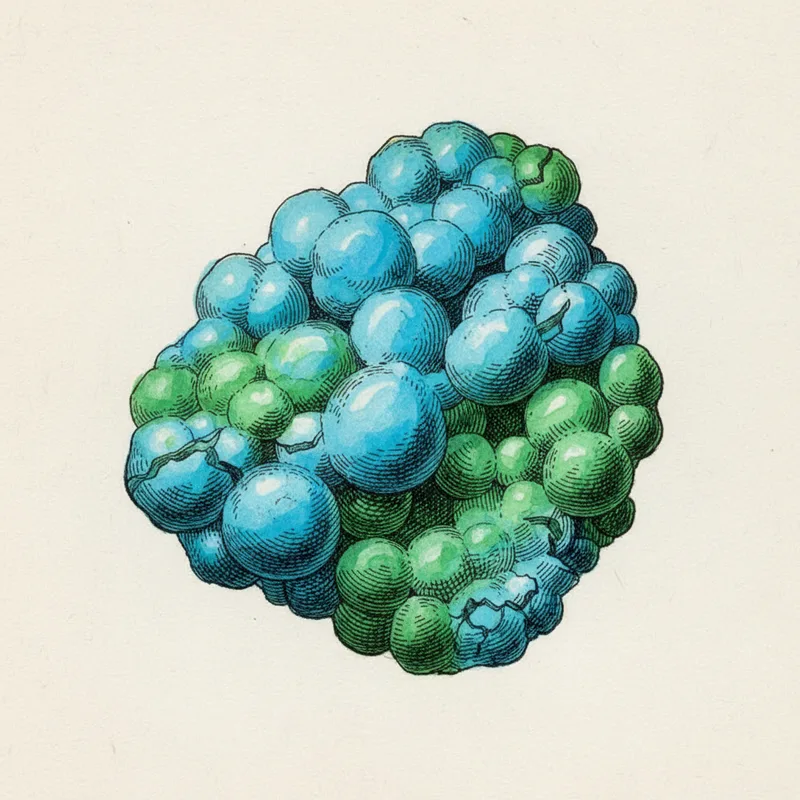
Chrysocolla
The Teaching Stone
Affiliate links. We may earn a commission, at no cost to you.
Quick Facts
Formation & Origin
Chrysocolla is a secondary copper mineral that forms in the oxidation zone of copper ore deposits - the shallow, weathered layer above the primary sulfide ore body. When copper-rich groundwater interacts with silica-bearing solutions in the presence of aluminum, chrysocolla precipitates as blue-green crusts, coatings, and botryoidal masses.
The vivid blue-green color comes directly from the copper content. Chrysocolla often forms alongside other copper secondary minerals - malachite (green), azurite (blue), and cuprite (red) - creating spectacular multicolored specimens that tell the story of copper chemistry in action.
Gem silica - a rare, highly translucent blue-green variety where chrysocolla is intermixed with chalcedony quartz - is the most valuable form. Gem silica from Arizona and Peru commands prices rivaling fine turquoise, and its hardness (thanks to the quartz component) makes it durable enough for jewelry.
Identification Guide
Chrysocolla is identified by its vivid blue-green color, low hardness (2.5-3, scratchable with a copper coin), and association with other copper minerals. Its luster ranges from waxy to glassy depending on silica content.
Distinguish from turquoise (harder at 5-6, different crystal structure), azurite (darker blue, reacts with acid), and malachite (green, banded). Chrysocolla often grades into these other minerals on a single specimen. Gem silica (chrysocolla-quartz mix) is harder (6-7) and more translucent than pure chrysocolla.
Spotting Fakes
Pure chrysocolla is too soft for most jewelry (2.5 Mohs), so 'chrysocolla jewelry' often uses gem silica or chrysocolla mixed with quartz for durability. This isn't deceptive if disclosed. Dyed howlite and dyed magnesite are sometimes sold as chrysocolla - the dye test (checking for color in cracks and around drill holes) catches these. Genuine chrysocolla has an uneven, naturally varied color distribution.
Some links in this post go to Amazon and Etsy. Crystal Almanac earns a commission from qualifying purchases at no extra cost to you. Tools recommended here are ones we would use ourselves to run the tests described - the recommendation comes first, the link is downstream of it.
Cultural & Metaphysical Traditions
Presented as cultural traditions, not scientific evidence
Cleopatra reportedly carried chrysocolla as a diplomatic stone, believing it promoted negotiation and compromise. In Renaissance Europe, goldsmiths used chrysocolla as a flux for soldering gold - the name literally means 'gold glue' from the Greek. Native American peoples of the American Southwest used chrysocolla in jewelry and ceremony. Modern practitioners associate it with communication, teaching, and feminine empowerment.
Metaphysical and “healing” associations are cultural traditions, not medical advice or scientific fact. Crystals are not a substitute for professional medical care.
Where It's Found
Exceptional gem silica and chrysocolla specimens
Classic copper mining district specimens
Deep blue specimens, often with malachite
High-grade material from copper porphyry deposits
Price Guide
Good to Know
Scratch test: At hardness 2.5, Chrysocolla can be scratched with a fingernail. This is a display specimen, not a wearable stone.
Global supply: Found in 4 notable locations worldwide, from Peru to Chile.
Heft test: With a specific gravity of 2.00-2.40, Chrysocolla feels lighter than most minerals. This lightness can help identify it.
Common Questions
What is the chemical formula of Chrysocolla?
The chemical formula of Chrysocolla is (Cu,Al)₂H₂Si₂O₅(OH)₄·nH₂O.
What is Chrysocolla's Mohs hardness?
Chrysocolla has a Mohs hardness of 2.5 on the 1 to 10 Mohs scale, soft enough to scratch with a fingernail.
Is Chrysocolla a mineral?
Yes. Chrysocolla is a naturally occurring mineral (Phyllosilicate Group) with a definite chemical composition and an ordered crystal structure.
Care & Safety
The water, salt, and sunlight questions people actually ask before cleansing or displaying chrysocolla, answered from its hardness (Mohs 2.5) and chemistry ((Cu,Al)₂H₂Si₂O₅(OH)₄·nH₂O).
Can Chrysocolla go in water?
Not recommended. At Mohs 2.5, chrysocolla is soft enough that water can slowly dull, etch, or wear down the surface, so a water cleanse does more harm than good here. Reach for a dry cloth instead.
Can Chrysocolla go in salt water?
No. Chrysocolla is best kept away from water altogether, and salt water is the harsher version of that problem: the dissolved salt is corrosive while the stone is wet, then leaves gritty crystals behind in cracks and crevices as it dries. Salt also accelerates corrosion of copper-bearing minerals like chrysocolla.
Sources & References
The mineralogical and gemological data on this page is drawn from and can be cross-checked against these external references.
- WikipediaChrysocolla on Wikipedia
- WebmineralChrysocolla mineral data (Webmineral)
- Handbook of MineralogyChrysocolla (Handbook of Mineralogy, PDF)
Related Minerals
Similar color, harder, different chemistry
Another copper secondary, often found together
Blue copper carbonate, frequently co-occurs
Chrysocolla-chalcedony mix, the premium variety
Explore More
Mica & Sheet Silicates
The Calming Collection
Cleopatra reportedly carried it for diplomatic calm. Associated with thoughtful communication.
The Communication Collection
Cleopatra's diplomatic stone. Associated with negotiation, teaching, and compassionate communication.
The Sleep Collection
Cleopatra's negotiation stone. Its blue-green copper color has a distinctly cooling, quieting quality. Associated with calming strong emotions before sleep.
The Healing Collection
Copper silicate used as a medicinal pigment and skin treatment in Andean and Egyptian traditions. Its association with calm communication aids emotional processing during healing.
The Grief Collection
Associated with the grief of strong women in crisis. Cleopatra carried it during political upheaval. Connected to finding grace and calm expression during the most difficult emotional seasons.
Toxic Crystals: The Complete Safety Guide
Best Crystals for Pregnancy and New Motherhood
Is My Turquoise Real? Spot Howlite and Plastic Fakes
Mohs Hardness Scale
See where Chrysocolla sits on the scale
Crystal Care Guide
Water safety, sunlight, and handling tips
Save This Stone

Keep this chrysocolla reference handy. Save the card to a Pinterest board and the profile is one tap away.
Save to PinterestNewsletter
Something shiny, now and then
A stone worth knowing, or a fake worth spotting, every so often. No spam.