Howlite
The Calming Stone
Affiliate links. We may earn a commission, at no cost to you.
Quick Facts
Formation & Origin
Howlite is a calcium borosilicate mineral, white with gray veining, and is frequently dyed to imitate turquoise. Howlite forms in evaporite deposits - environments where mineral-rich water evaporates, concentrating dissolved minerals until they crystallize. It specifically occurs in borate-rich evaporite sequences, where boron from volcanic activity accumulates in enclosed basins.
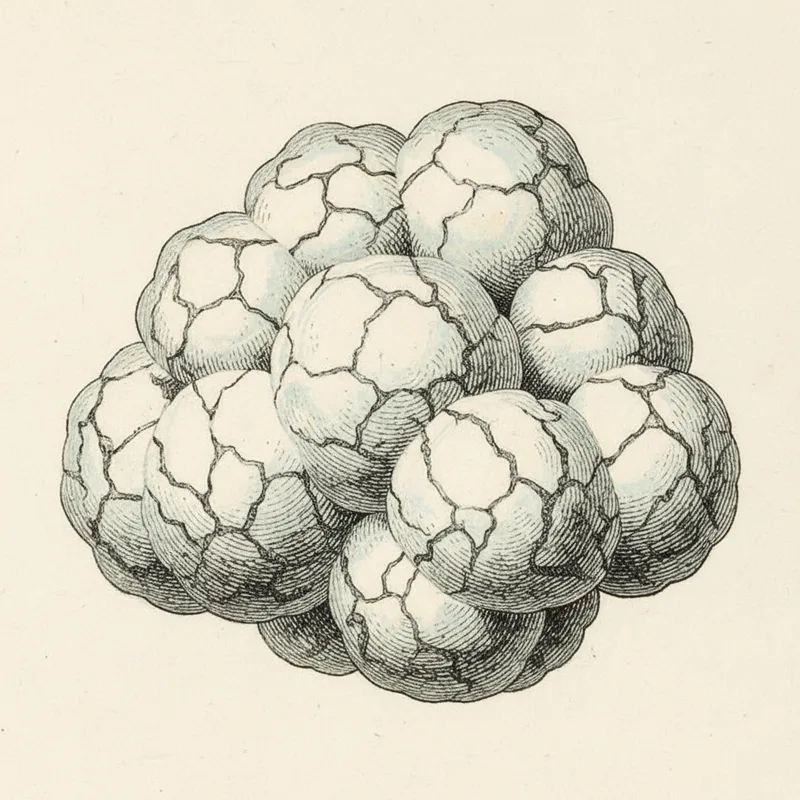
The mineral typically forms as irregular nodules or masses with a distinctive white color and gray to black veining pattern (which is actually the matrix material the howlite grew within). Individual crystals are extremely rare - howlite almost always occurs as massive, cauliflower-like nodules.
Howlite's fame in the crystal world is paradoxically tied to its role as an impostor. Because it's porous, soft, and white, it absorbs dye readily and can be colored to imitate turquoise, lapis lazuli, red coral, and other more expensive stones. More howlite is probably sold dyed than in its natural white form.
Identification Guide
Natural howlite is white with distinctive gray-black veining in an irregular web pattern. At hardness 3.5, it's soft enough to scratch with a copper coin. The porcelain-like luster and light weight help distinguish it from other white minerals.
The key identification scenario is recognizing DYED howlite masquerading as other stones. Blue-dyed howlite sold as 'turquoise' shows dye concentrated in the veining (the veins absorb more dye than the surrounding material) and the color rubs off on a wet cloth. Under the dye, scratching reveals white base material.
Spotting Fakes
Howlite is more commonly the fake than the faked. Natural white howlite is honest and legitimate. The problem is howlite dyed to imitate turquoise (blue), lapis lazuli (dark blue), red coral (red), or other stones. Detection: scratch an inconspicuous area - if white shows under color, it's dyed. Wipe with acetone (nail polish remover) - dye will transfer. Genuine turquoise, lapis, and coral don't lose color this way.
Some links in this post go to Amazon and Etsy. Crystal Almanac earns a commission from qualifying purchases at no extra cost to you. Tools recommended here are ones we would use ourselves to run the tests described - the recommendation comes first, the link is downstream of it.
Cultural & Metaphysical Traditions
Presented as cultural traditions, not scientific evidence
Howlite is a relatively modern addition to crystal healing traditions, having been first described scientifically in 1868. It lacks the ancient history of stones like turquoise or jade. Modern practitioners associate it with calming anxiety, promoting sleep, and patience. Its white color connects it to purity and clarity in various traditions. Ironically, howlite's most important cultural role is as the stone most commonly used to deceive crystal buyers through dyeing.
Metaphysical and “healing” associations are cultural traditions, not medical advice or scientific fact. Crystals are not a substitute for professional medical care.
Where It's Found
Original discovery location, commercial source
Classic locality, named after Canadian geologist Henry How
Commercial source for dyed material
Price Guide
Good to Know
Scratch test: At hardness 3.5, Howlite can be scratched with a copper coin. Handle gently and keep away from harder stones in your collection.
Global supply: Found in 3 notable locations worldwide, from United States to Turkey.
Heft test: Howlite has average mineral density (2.53). It feels about as heavy as you'd expect from a stone its size.
Common Questions
What is the chemical formula of Howlite?
The chemical formula of Howlite is Ca₂B₅SiO₉(OH)₅.
What is Howlite's Mohs hardness?
Howlite has a Mohs hardness of 3.5 on the 1 to 10 Mohs scale, soft enough to scratch with a copper coin.
Is Howlite a mineral?
Yes. Howlite is a naturally occurring mineral (Borate Group) with a definite chemical composition and an ordered crystal structure.
Care & Safety
The water, salt, and sunlight questions people actually ask before cleansing or displaying howlite, answered from its hardness (Mohs 3.5) and chemistry (Ca₂B₅SiO₉(OH)₅).
Can Howlite go in water?
Not recommended. Howlite can react with water, draw in moisture, or break down when it gets wet, so skip the rinse. Wipe it with a dry or barely damp cloth and dry it right away.
Can Howlite go in salt water?
No. Howlite is best kept away from water altogether, and salt water is the harsher version of that problem: the dissolved salt is corrosive while the stone is wet, then leaves gritty crystals behind in cracks and crevices as it dries.
Sources & References
The mineralogical and gemological data on this page is drawn from and can be cross-checked against these external references.
- WikipediaHowlite on Wikipedia
- WebmineralHowlite mineral data (Webmineral)
- Handbook of MineralogyHowlite (Handbook of Mineralogy, PDF)
Explore More
Borates, Tungstates & Rare Groups
The Calming Collection
Associated with slowing an overactive mind. Its white color with gray veining suggests marble calm.
The Sleep Collection
Specifically associated with sleep and overactive minds. Its white color with gray veining is visually quiet. Practitioners place it under pillows to calm the mental chatter that prevents sleep.
Best Calming Crystals for Anxiety and Stress
Red, White, and Blue Crystals: The Real Geology
Selenite vs Satin Spar: What's the Difference?
Mohs Hardness Scale
See where Howlite sits on the scale
Crystal Care Guide
Water safety, sunlight, and handling tips
Save This Stone

Keep this howlite reference handy. Save the card to a Pinterest board and the profile is one tap away.
Save to PinterestNewsletter
Something shiny, now and then
A stone worth knowing, or a fake worth spotting, every so often. No spam.