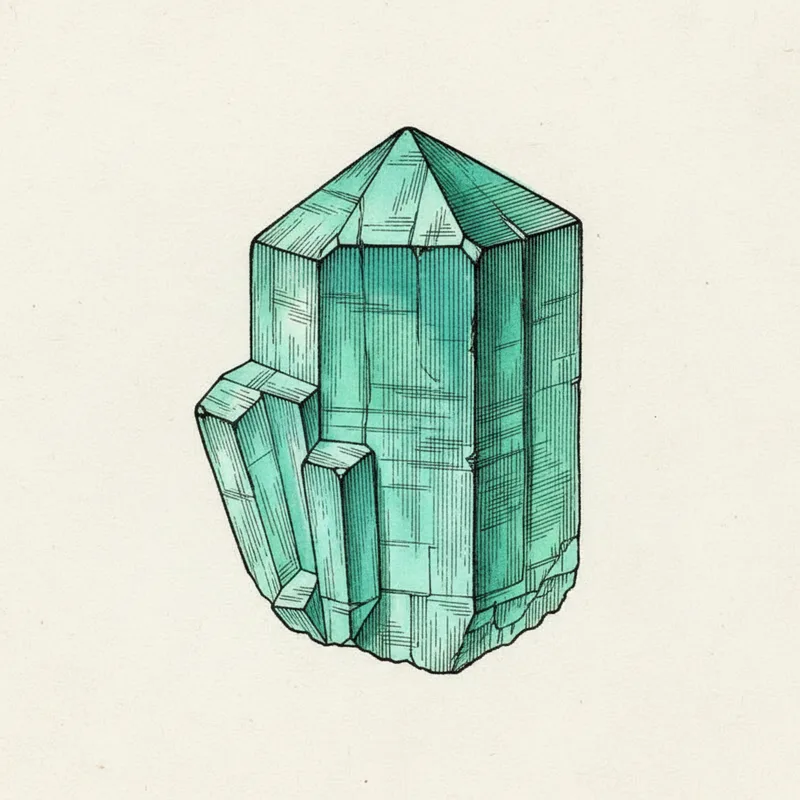
Amazonite
The Hope Stone
Affiliate links. We may earn a commission, at no cost to you.
Quick Facts
Formation & Origin
Amazonite is the blue-green variety of microcline feldspar. For decades, the cause of its color was debated - lead impurities, iron, water content, and structural effects were all proposed. Research in the 2010s established that the color is caused by small amounts of lead and water within the crystal structure, combined with natural radiation that creates the specific color centers responsible for the blue-green hue.
Amazonite forms in granitic pegmatites - the coarse-grained igneous rocks that crystallize from the last volatile-rich fluids of cooling magma. The classic locality at Pikes Peak, Colorado, produces stunning specimens of bright green amazonite crystals perched on gray granite matrix, often accompanied by smoky quartz and sometimes albite. These specimens are among the most photogenic in American mineralogy.
Despite its name, amazonite has no confirmed connection to the Amazon River. The name may come from green stones traded by indigenous peoples along the Amazon, but those stones were likely nephrite or other green minerals, not amazonite.
Identification Guide
Amazonite is identified by its distinctive blue-green color in a feldspar mineral. No other common feldspar is this color. It has two directions of cleavage at nearly 90 degrees (characteristic of feldspar), hardness 6, and often shows a grid-like texture called perthitic exsolution (fine white streaks within the green).
Distinguish from turquoise (opaque, no cleavage, different luster), chrysoprase (chalcedony, waxy luster, no cleavage), and green aventurine (shows sparkly aventurescence). Amazonite's cleavage surfaces and the fine white streaking are diagnostic when present.
Spotting Fakes
Look for the white perthitic streaking: genuine amazonite usually shows fine lines or patches of white albite within the green, so uniformly colored stones deserve a closer look.
- Dyed howlite or dyed quartzite sold as amazonite shows dye concentrated in cracks.
- Glass imitations lack cleavage entirely.
Amazonite is affordable enough that faking is uncommon, but dyed stones do exist.
Some links in this post go to Amazon and Etsy. Crystal Almanac earns a commission from qualifying purchases at no extra cost to you. Tools recommended here are ones we would use ourselves to run the tests described - the recommendation comes first, the link is downstream of it.
Cultural & Metaphysical Traditions
Presented as cultural traditions, not scientific evidence
Amazonite was used by ancient Egyptians - it was found among the treasures in Tutankhamun's tomb and was carved into scarabs and amulets. Some scholars believe it was one of the stones in the breastplate of the Jewish High Priest. In Russian imperial tradition, amazonite from the Urals was used in decorative objects and jewelry. Modern practitioners associate it with hope, communication, and setting healthy boundaries.
Metaphysical and “healing” associations are cultural traditions, not medical advice or scientific fact. Crystals are not a substitute for professional medical care.
Where It's Found
Classic locality, often with smoky quartz on matrix
Exceptional deep blue-green specimens
Affordable tumbled material, good color
Gem-grade transparent crystals, relatively recent discovery
Price Guide
Good to Know
Scratch test: At hardness 6, Amazonite resists scratching from a knife but can be scratched by quartz. Best for pendants and earrings rather than rings.
Global supply: Found in 4 notable locations worldwide, from United States to Ethiopia.
Heft test: Amazonite has average mineral density (2.56). It feels about as heavy as you'd expect from a stone its size.
Common Questions
What is the chemical formula of Amazonite?
The chemical formula of Amazonite is KAlSi₃O₈.
What is Amazonite's Mohs hardness?
Amazonite has a Mohs hardness of 6 on the 1 to 10 Mohs scale, hard enough to scratch glass but softer than quartz.
Is Amazonite a mineral?
Yes. Amazonite is a naturally occurring mineral (Feldspar Group) with a definite chemical composition and an ordered crystal structure.
Care & Safety
The water, salt, and sunlight questions people actually ask before cleansing or displaying amazonite, answered from its hardness (Mohs 6) and chemistry (KAlSi₃O₈).
Can Amazonite go in water?
Only briefly. A quick rinse under running water is fine for amazonite, but do not let it soak or sit submerged. At Mohs 6 it is tough enough for a rinse but not for a long soak. Dry it thoroughly afterward.
Can Amazonite go in salt water?
No. Amazonite can take a brief fresh-water rinse and nothing more, and salt water is harder on it both ways: corrosive while wet, then abrasive as the salt dries into crystals. If it does meet salt water, rinse it with fresh water and dry it promptly.
Sources & References
The mineralogical and gemological data on this page is drawn from and can be cross-checked against these external references.
- WikipediaAmazonite on Wikipedia
- WebmineralMicrocline mineral data (Webmineral)
- Handbook of MineralogyMicrocline (Handbook of Mineralogy, PDF)
Explore More
Feldspar Group
The Calming Collection
Called the 'hope stone.' Associated with setting healthy boundaries and reducing worry.
The Communication Collection
Found in Tutankhamun's tomb. Associated with honest communication and setting clear boundaries.
The Workplace Collection
The boundary-setting stone. Blue-green microcline associated with calm assertion and the confidence to say no. Particularly useful for those who struggle with workplace people-pleasing.
The Grief Collection
The hope stone. Associated with recovering equilibrium after trauma and moving through difficulty with dignity. Its blue-green color has a specifically reviving, forward-looking quality among grief stones.
Virgo Season Crystals 2026: Stones for Clarity
Mercury Retrograde Crystals: July 23 and the Shadow Period
Best Calming Crystals for Anxiety and Stress
Mohs Hardness Scale
See where Amazonite sits on the scale
Crystal Care Guide
Water safety, sunlight, and handling tips
Save This Stone

Keep this amazonite reference handy. Save the card to a Pinterest board and the profile is one tap away.
Save to PinterestNewsletter
Something shiny, now and then
A stone worth knowing, or a fake worth spotting, every so often. No spam.