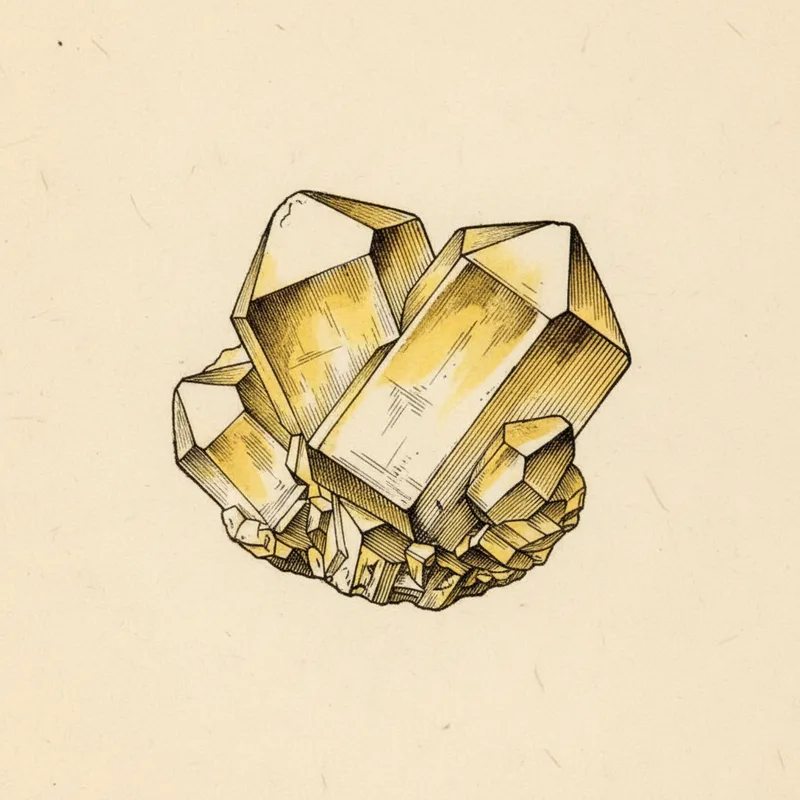
Calcite
The Shapeshifter
Affiliate links. We may earn a commission, at no cost to you.
Quick Facts
Formation & Origin
Calcite is one of the most common and most versatile minerals on Earth. It's the primary mineral in limestone, marble, and chalk. It forms stalactites and stalagmites in caves. It makes up coral reefs and seashells. It precipitates from hot springs and volcanic vents. It fills fractures in virtually every rock type. No other mineral forms in as many different environments or takes as many different shapes.
Calcite crystallizes in over 800 known crystal forms - more than any other mineral. The most common are rhombohedrons (tilted cubes), scalenohedrons (pointed, dog-tooth shapes), and prismatic crystals. This extraordinary polymorphism makes calcite the most visually diverse mineral in any collection.
Iceland spar - perfectly transparent calcite - demonstrates one of the most dramatic optical properties in mineralogy: double refraction. Place a piece of Iceland spar over text and you see doubled letters. This occurs because calcite splits light into two polarized beams traveling at different speeds through the crystal. Viking navigators may have used Iceland spar as a polarizing filter to locate the sun on overcast days.
Identification Guide
Calcite is identified by three properties: hardness 3 (scratched by a copper coin), perfect rhombohedral cleavage (breaks into tilted parallelogram shapes), and vigorous effervescence in dilute hydrochloric acid (it fizzes dramatically). These three tests together are definitive.
Distinguish from quartz (much harder at 7, no acid reaction), aragonite (same chemistry but different crystal system), and dolomite (slower acid reaction, only fizzes in hot acid or when powdered). Calcite's rhombohedral cleavage - visible in any broken piece - is one of the most diagnostic features of any mineral.
Spotting Fakes
Calcite is so common and affordable that faking is pointless for most specimens. Rare varieties (large optical-quality Iceland spar, deeply colored specimens, unusual crystal forms) are occasionally misrepresented. Some 'blue calcite' on the market is dyed - genuine blue calcite has a soft, natural blue rather than vivid artificial blue. Green calcite is sometimes confused with green fluorite (different hardness, different cleavage). The acid test instantly confirms calcite versus any non-carbonate mineral.
Some links in this post go to Amazon and Etsy. Crystal Almanac earns a commission from qualifying purchases at no extra cost to you. Tools recommended here are ones we would use ourselves to run the tests described - the recommendation comes first, the link is downstream of it.
Cultural & Metaphysical Traditions
Presented as cultural traditions, not scientific evidence
Calcite's diversity of colors has made it popular across many metaphysical traditions, with each color associated with different properties. Clear calcite (Iceland spar) has been connected to clarity and insight since the Viking era. Orange calcite is one of the most popular energy stones in the crystal market. In ancient Egypt, calcite (in the form of alabaster) was carved into canopic jars and sacred vessels. The Elmwood Mine specimens from Tennessee are considered among the finest mineral specimens of any species.
Metaphysical and “healing” associations are cultural traditions, not medical advice or scientific fact. Crystals are not a substitute for professional medical care.
Where It's Found
Spectacular crystal specimens in every form
Historic source of optical-grade Iceland spar
World-class transparent crystals
Major producer of all colors and forms
Price Guide
Good to Know
Scratch test: At hardness 3, Calcite can be scratched with a copper coin. Handle gently and keep away from harder stones in your collection.
Global supply: Found in 4 notable locations worldwide, from Mexico to China.
Heft test: Calcite has average mineral density (2.71). It feels about as heavy as you'd expect from a stone its size.
Common Questions
What is the chemical formula of Calcite?
The chemical formula of Calcite is CaCO₃.
What is Calcite's Mohs hardness?
Calcite has a Mohs hardness of 3 on the 1 to 10 Mohs scale, soft enough to scratch with a copper coin.
Is Calcite a mineral?
Yes. Calcite is a naturally occurring mineral (Carbonate Group) with a definite chemical composition and an ordered crystal structure.
Care & Safety
The water, salt, and sunlight questions people actually ask before cleansing or displaying calcite, answered from its hardness (Mohs 3) and chemistry (CaCO₃).
Can Calcite go in water?
Not recommended. Calcium carbonate dissolves in acidic water. Even slightly acidic tap water will etch the surface over time.
Can Calcite go in salt water?
No. Calcite is best kept away from water altogether, and salt water is the harsher version of that problem: the dissolved salt is corrosive while the stone is wet, then leaves gritty crystals behind in cracks and crevices as it dries.
Sources & References
The mineralogical and gemological data on this page is drawn from and can be cross-checked against these external references.
- WikipediaCalcite on Wikipedia
- WebmineralCalcite mineral data (Webmineral)
- Handbook of MineralogyCalcite (Handbook of Mineralogy, PDF)
Related Minerals
Same CaCO₃ chemistry, different crystal structure
Calcium-magnesium carbonate, similar appearance
Similar crystal forms, different chemistry
Optical-grade transparent calcite variety
Explore More
Carbonate Minerals
Libra Season Crystals 2026: Stones for Balance
September Birthstone: Sapphire and Its Many Colors
Is It a Mineral? Obsidian, Amber, Pearl, and Opal
Mohs Hardness Scale
See where Calcite sits on the scale
Crystal Care Guide
Water safety, sunlight, and handling tips
Save This Stone

Keep this calcite reference handy. Save the card to a Pinterest board and the profile is one tap away.
Save to PinterestNewsletter
Something shiny, now and then
A stone worth knowing, or a fake worth spotting, every so often. No spam.