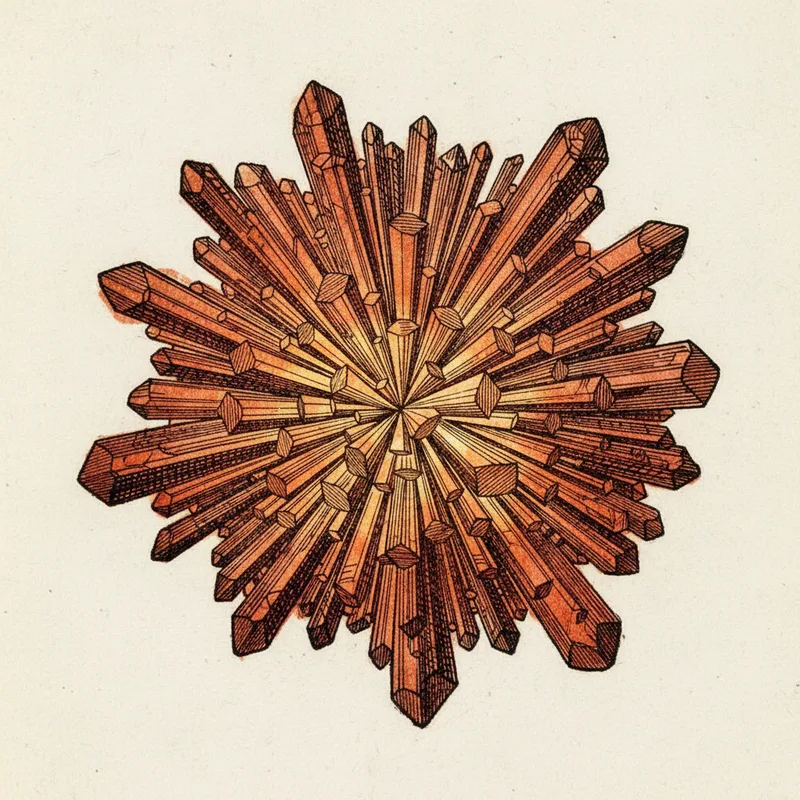
Aragonite
The Earth Healer
Affiliate links. We may earn a commission, at no cost to you.
Quick Facts
Formation & Origin
Aragonite is a carbonate mineral, calcium carbonate (CaCO₃), and a polymorph of calcite that shares the same chemistry but a different crystal structure. Aragonite has the same chemical formula as calcite (CaCO₃) but a different crystal structure - they're polymorphs. Aragonite forms under higher pressure or lower temperature conditions than calcite, and in the presence of certain ions (especially magnesium and strontium) that inhibit calcite growth.
The most iconic aragonite form is the 'star cluster' or 'sputnik' variety from Morocco - radiating clusters of prismatic crystals that look like geometric sea urchins. These form in clay sediments where aragonite crystallizes from groundwater solutions. The clusters grow outward from a central point, creating the distinctive starburst shape.
Aragonite is metastable at Earth's surface conditions - over geological time, it slowly converts to the more stable calcite form. This means all aragonite specimens are relatively young in geological terms. Aragonite is also biologically important: it's the primary mineral in pearls, mother of pearl, and many marine shells.
Identification Guide
Aragonite is identified by its orthorhombic crystal habit (often as pseudo-hexagonal twins or radiating clusters), hardness of 3.5-4, and effervescence in dilute acid (confirming carbonate composition). The Moroccan star clusters are immediately recognizable.
Distinguish from calcite (different crystal system, rhombohedral cleavage), gypsum (softer, no acid reaction), and siderite (iron carbonate, higher SG). Aragonite's characteristic cyclic twinning produces pseudo-hexagonal forms that look hexagonal but have different cleavage.
Spotting Fakes
Aragonite star clusters from Morocco are abundant and inexpensive, making faking unnecessary. Some specimens are coated with iron oxide or other minerals to enhance color - this is natural in some cases but artificially applied in others. Blue aragonite from Namibia is genuine but sometimes enhanced. The main market confusion is between aragonite and calcite, which look different but share the same chemistry.
Some links in this post go to Amazon and Etsy. Crystal Almanac earns a commission from qualifying purchases at no extra cost to you. Tools recommended here are ones we would use ourselves to run the tests described - the recommendation comes first, the link is downstream of it.
Cultural & Metaphysical Traditions
Presented as cultural traditions, not scientific evidence
Aragonite's association with Earth healing and grounding is its primary modern metaphysical connection. The star cluster form's resemblance to a root system or network reinforces this grounding association. Practitioners use it for environmental conservation meditation and connecting with Earth's energy. The biological connection to pearls and shells adds associations with patience, nurturing, and the ocean.
Metaphysical and “healing” associations are cultural traditions, not medical advice or scientific fact. Crystals are not a substitute for professional medical care.
Where It's Found
Major source of star cluster and sputnik forms
Type locality, classic twin crystals
Blue aragonite specimens
Fine crystalline specimens, sulfur association
Price Guide
Good to Know
Scratch test: At hardness 3.5, Aragonite can be scratched with a copper coin. Handle gently and keep away from harder stones in your collection.
Global supply: Found in 4 notable locations worldwide, from Morocco to Italy.
Heft test: Aragonite has average mineral density (2.93). It feels about as heavy as you'd expect from a stone its size.
Common Questions
What is the chemical formula of Aragonite?
The chemical formula of Aragonite is CaCO₃.
What is Aragonite's Mohs hardness?
Aragonite has a Mohs hardness of 3.5 on the 1 to 10 Mohs scale, soft enough to scratch with a copper coin.
Is Aragonite a mineral?
Yes. Aragonite is a naturally occurring mineral (Carbonate Group) with a definite chemical composition and an ordered crystal structure.
Care & Safety
The water, salt, and sunlight questions people actually ask before cleansing or displaying aragonite, answered from its hardness (Mohs 3.5) and chemistry (CaCO₃).
Can Aragonite go in water?
Not recommended. Same composition as calcite (CaCO₃) but less stable crystal structure. Dissolves in acid and degrades in water.
Can Aragonite go in salt water?
No. Aragonite is best kept away from water altogether, and salt water is the harsher version of that problem: the dissolved salt is corrosive while the stone is wet, then leaves gritty crystals behind in cracks and crevices as it dries.
Sources & References
The mineralogical and gemological data on this page is drawn from and can be cross-checked against these external references.
- WikipediaAragonite on Wikipedia
- WebmineralAragonite mineral data (Webmineral)
- Handbook of MineralogyAragonite (Handbook of Mineralogy, PDF)
Related Minerals
Same chemistry, different crystal structure (polymorph)
Made of aragonite layers deposited by mollusks
Third CaCO₃ polymorph, very rare
Related carbonate with strontium
Explore More
Carbonate Minerals
Is It a Mineral? Obsidian, Amber, Pearl, and Opal
How Crystals Form: Pegmatite, Hydrothermal, Sedimentary
Cancer Season Crystals 2026: Stones for Intuition
Mohs Hardness Scale
See where Aragonite sits on the scale
Crystal Care Guide
Water safety, sunlight, and handling tips
Save This Stone

Keep this aragonite reference handy. Save the card to a Pinterest board and the profile is one tap away.
Save to PinterestNewsletter
Something shiny, now and then
A stone worth knowing, or a fake worth spotting, every so often. No spam.