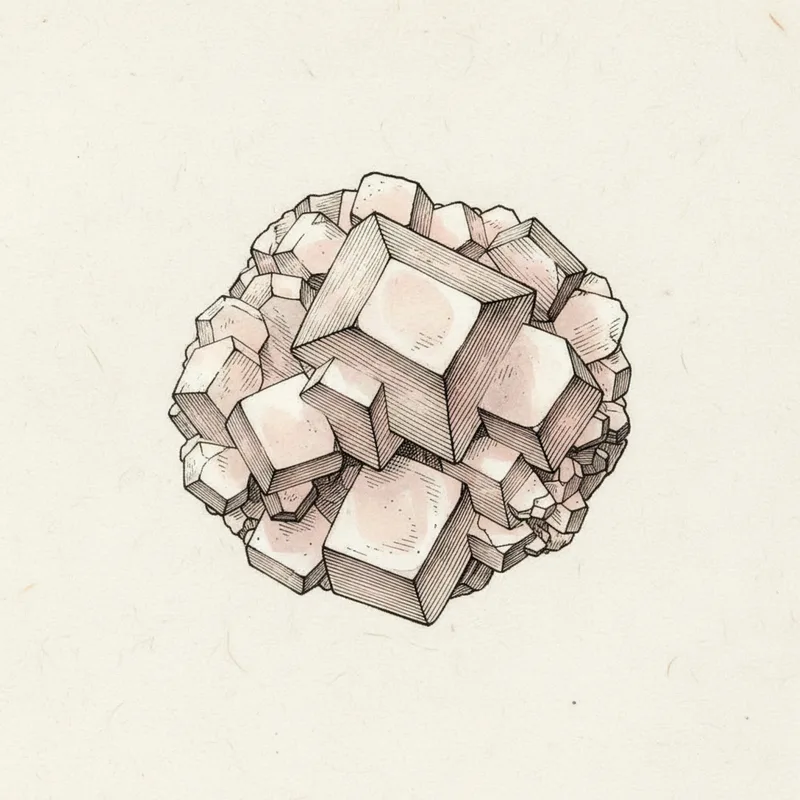
Dolomite
The Stabilizer
Affiliate links. We may earn a commission, at no cost to you.
Quick Facts
Formation & Origin
Dolomite is a calcium magnesium carbonate that forms one of the great puzzles in geology: the 'dolomite problem.' Despite being the most common magnesium-bearing sedimentary mineral, scientists have struggled for over 200 years to synthesize dolomite at surface temperatures in the laboratory. It forms easily in nature but refuses to crystallize under controlled conditions, suggesting that biological activity (microbial processes) may play a crucial role in its formation.
The Dolomite Mountains of northern Italy - one of the most spectacular mountain ranges in Europe - are composed primarily of ancient dolomite rock, and both the mountains and the mineral are named after French mineralogist Deodat de Dolomieu, who first described the mineral in 1791.
Dolomite crystals are famous for their distinctive curved 'saddle-shaped' or rhombohedral form. This curved crystal habit is almost unique to dolomite among common minerals and is one of its most recognizable features.
Identification Guide
Dolomite is identified by its curved saddle-shaped crystal habit, hardness of 3.5-4, and slow reaction with dilute hydrochloric acid (it fizzes only in hot acid or when powdered, unlike calcite which fizzes readily in cold dilute acid). This slow acid reaction is the key distinction from calcite.
Distinguish from calcite (stronger acid reaction, different crystal forms), magnesite (similar chemistry but rarely well-crystallized), and quartz (much harder, no acid reaction). The curved crystal faces visible on well-formed specimens are essentially diagnostic.
Spotting Fakes
Dolomite is common and affordable, so faking is unnecessary. The main identification challenge is distinguishing it from calcite, which looks similar. The acid test is definitive: a drop of cold dilute HCl on dolomite produces little or no fizzing, while calcite fizzes vigorously. Powdered dolomite will fizz in cold acid, so test on a crystal face, not a scratch.
Some links in this post go to Amazon and Etsy. Crystal Almanac earns a commission from qualifying purchases at no extra cost to you. Tools recommended here are ones we would use ourselves to run the tests described - the recommendation comes first, the link is downstream of it.
Cultural & Metaphysical Traditions
Presented as cultural traditions, not scientific evidence
Dolomite is a gentle, quieter stone in the crystal healing world compared to more dramatic minerals. Practitioners associate it with centering, emotional stability, and reducing stress. Pink dolomite specifically is used for heart-centered calming work. The mineral's resistance to dissolving (the 'dolomite problem') is sometimes interpreted metaphysically as representing resilience and emotional stability.
Metaphysical and “healing” associations are cultural traditions, not medical advice or scientific fact. Crystals are not a substitute for professional medical care.
Where It's Found
Named after these mountains, which are named after the mineral
Fine pink saddle-shaped crystals
Classic curved crystal specimens
Quality crystal specimens
Price Guide
Good to Know
Scratch test: At hardness 3.5, Dolomite can be scratched with a copper coin. Handle gently and keep away from harder stones in your collection.
Global supply: Found in 4 notable locations worldwide, from Italy to Mexico.
Heft test: Dolomite has average mineral density (2.85). It feels about as heavy as you'd expect from a stone its size.
Common Questions
What is the chemical formula of Dolomite?
The chemical formula of Dolomite is CaMg(CO₃)₂.
What is Dolomite's Mohs hardness?
Dolomite has a Mohs hardness of 3.5 on the 1 to 10 Mohs scale, soft enough to scratch with a copper coin.
Is Dolomite a mineral?
Yes. Dolomite is a naturally occurring mineral (Carbonate Group) with a definite chemical composition and an ordered crystal structure.
Care & Safety
The water, salt, and sunlight questions people actually ask before cleansing or displaying dolomite, answered from its hardness (Mohs 3.5) and chemistry (CaMg(CO₃)₂).
Can Dolomite go in water?
Not recommended. Dolomite can react with water, draw in moisture, or break down when it gets wet, so skip the rinse. Wipe it with a dry or barely damp cloth and dry it right away.
Can Dolomite go in salt water?
No. Dolomite is best kept away from water altogether, and salt water is the harsher version of that problem: the dissolved salt is corrosive while the stone is wet, then leaves gritty crystals behind in cracks and crevices as it dries.
Sources & References
The mineralogical and gemological data on this page is drawn from and can be cross-checked against these external references.
- WikipediaDolomite (mineral) on Wikipedia
- WebmineralDolomite mineral data (Webmineral)
- Handbook of MineralogyDolomite (Handbook of Mineralogy, PDF)
Explore More
Save This Stone

Keep this dolomite reference handy. Save the card to a Pinterest board and the profile is one tap away.
Save to PinterestNewsletter
Something shiny, now and then
A stone worth knowing, or a fake worth spotting, every so often. No spam.