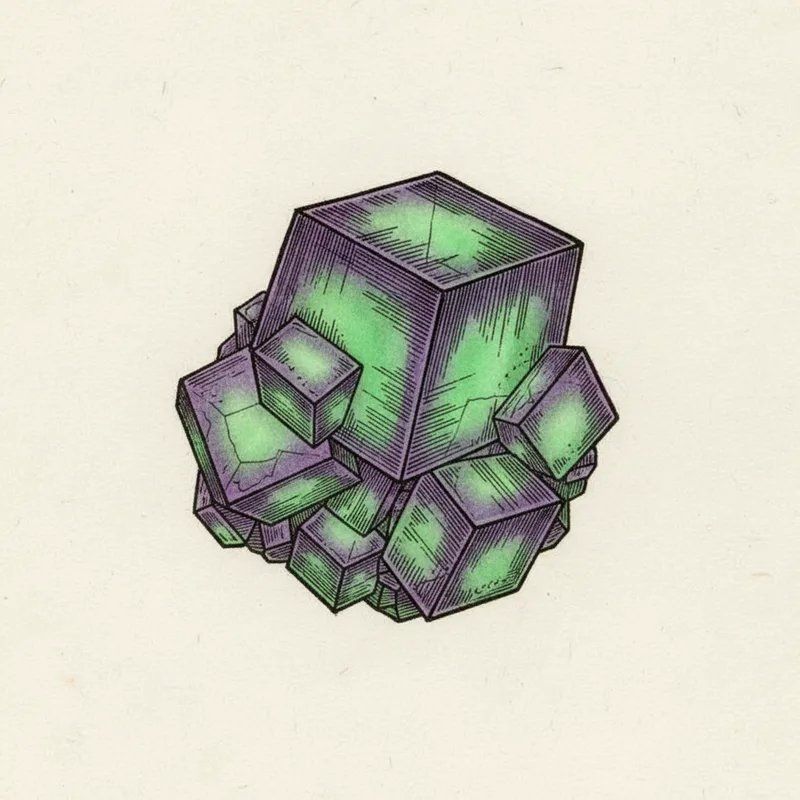
Fluorite
The Genius Stone
Affiliate links. We may earn a commission, at no cost to you.
Quick Facts
Formation & Origin
Fluorite is a halide mineral, calcium fluoride (CaF₂), and the natural source of the element fluorine. Fluorite crystallizes from hydrothermal fluids - hot, mineral-rich water circulating through fractures in the Earth's crust. As these fluids cool and the dissolved calcium fluoride reaches saturation, fluorite begins to precipitate, atom by atom, building its characteristic cubic crystal structure.
What makes fluorite remarkable is its staggering range of colors. The pure mineral is actually colorless - every hue you see is caused by defects in the crystal lattice. When radiation from nearby radioactive minerals knocks electrons out of position, these displaced electrons create 'color centers' that absorb specific wavelengths of light. Different defect configurations produce different colors, which is why a single fluorite crystal can display multiple bands of purple, green, blue, and yellow.
Fluorite also gives its name to fluorescence - the phenomenon was first scientifically described in fluorite specimens. Many fluorite crystals glow vivid blue or purple under ultraviolet light, caused by trace amounts of europium or other rare earth elements substituting for calcium in the crystal structure.
Identification Guide
Fluorite's perfect octahedral cleavage is its most distinctive diagnostic feature. It breaks cleanly along four planes, producing fragments shaped like octahedrons (eight-faced solids). No other common mineral cleaves this way. At hardness 4, fluorite can be scratched by a steel knife but not by a copper coin.
Its cubic crystal habit is also diagnostic. Fluorite typically forms as cubes, octahedrons, or combinations of both. The wide color range can cause confusion with amethyst (purple varieties), emerald (green), and even sapphire (blue), but the hardness test immediately resolves these: fluorite at 4 is dramatically softer than all of them. Testing with a UV flashlight can also help, since many fluorite specimens fluoresce strongly.
Spotting Fakes
The quickest tell is hardness: at Mohs 4, fluorite is softer than the gems it imitates, so any 'fluorite' that resists a steel knife is something harder pretending to be it.
- Dyed specimens show color concentrated in cracks.
- Glass imitations lack cleavage and won't show color zoning.
- 'Rainbow fluorite' is genuine but heavily marketed at inflated wellness-market prices.
Fluorite is inexpensive enough that outright faking is rare. The main caution is fragility: at hardness 4 with perfect cleavage, it's easily damaged, so chipped edges and cleaved corners on 'mint' specimens suggest rough handling, not fakes.
Some links in this post go to Amazon and Etsy. Crystal Almanac earns a commission from qualifying purchases at no extra cost to you. Tools recommended here are ones we would use ourselves to run the tests described - the recommendation comes first, the link is downstream of it.
Cultural & Metaphysical Traditions
Presented as cultural traditions, not scientific evidence
Ancient Romans believed drinking from fluorite vessels prevented drunkenness (a claim also made for amethyst). Chinese artisans have carved fluorite for centuries, and it features in traditional Feng Shui as a stone of order and clarity. Modern crystal practitioners call it 'the genius stone,' associating it with mental focus, learning, and decision-making.
Metaphysical and “healing” associations are cultural traditions, not medical advice or scientific fact. Crystals are not a substitute for professional medical care.
Where It's Found
World's largest producer, stunning color variety
Famous Blue John variety with banded purple and yellow
Classic golden cubic crystals on limestone
Exceptional green and purple phantom crystals
Blue and purple cubes, often on quartz matrix
Price Guide
Good to Know
Scratch test: At hardness 4, Fluorite can be scratched with a copper coin. Handle gently and keep away from harder stones in your collection.
Global supply: Found in 5 notable locations worldwide, from China to Morocco.
Heft test: Fluorite has average mineral density (3.18). It feels about as heavy as you'd expect from a stone its size.
Common Questions
What is the chemical formula of Fluorite?
The chemical formula of Fluorite is CaF₂.
What is Fluorite's Mohs hardness?
Fluorite has a Mohs hardness of 4 on the 1 to 10 Mohs scale, which a steel knife will scratch.
Is Fluorite a mineral?
Yes. Fluorite is a naturally occurring mineral (Halide Group) with a definite chemical composition and an ordered crystal structure.
Care & Safety
The water, salt, and sunlight questions people actually ask before cleansing or displaying fluorite, answered from its hardness (Mohs 4) and chemistry (CaF₂).
Can Fluorite go in water?
Only briefly. A quick rinse under running water is fine for fluorite, but do not let it soak or sit submerged. Calcium fluoride is slightly water-soluble over long exposure. Brief rinse is fine, but avoid prolonged soaking.
Can Fluorite go in salt water?
No. Fluorite can take a brief fresh-water rinse and nothing more, and salt water is harder on it both ways: corrosive while wet, then abrasive as the salt dries into crystals. If it does meet salt water, rinse it with fresh water and dry it promptly.
Does Fluorite fade in sunlight?
Many fluorites do. Fluorite's colors come from color centers and trace impurities that strong light can bleach, and some varieties, notably the deep purples and blues, pale noticeably with prolonged sun exposure. Display fluorite away from direct sunlight.
Sources & References
The mineralogical and gemological data on this page is drawn from and can be cross-checked against these external references.
- WikipediaFluorite on Wikipedia
- WebmineralFluorite mineral data (Webmineral)
- Handbook of MineralogyFluorite (Handbook of Mineralogy, PDF)
Related Minerals
Similar environments, often found together
Common associate in hydrothermal veins
Frequently co-occurs in lead-zinc deposits
Fellow hydrothermal mineral, similar habitats
Explore More
Halide Minerals
The Creative Collection
Called 'the genius stone' by some practitioners. Its wide color range and geometric crystal forms are associated with mental clarity and creative organization.
The Meditation Collection
Geometric cubic and octahedral crystals provide satisfying tactile objects. The color range offers variety for different meditation intentions.
The Manifestation Collection
The genius stone. Its geometric perfection and color range are associated with mental clarity and the organized thinking that turns vague intentions into actionable plans.
The Workplace Collection
The genius stone. Its geometric crystal forms and wide color range make it a visual focus object. Roman aristocrats drank from fluorite cups. Associated with mental organization and cutting through confusion.
Virgo Season Crystals 2026: Stones for Clarity
Mercury Retrograde Crystals: July 23 and the Shadow Period
How to Protect Crystals from Summer Heat and Sunlight
Mohs Hardness Scale
See where Fluorite sits on the scale
Crystal Care Guide
Water safety, sunlight, and handling tips
Save This Stone

Keep this fluorite reference handy. Save the card to a Pinterest board and the profile is one tap away.
Save to PinterestNewsletter
Something shiny, now and then
A stone worth knowing, or a fake worth spotting, every so often. No spam.