Rainbow Moonstone vs White Moonstone: The Difference
Key Takeaway: They are sold under the same name, but they are not the same mineral. White moonstone is true orthoclase feldspar with a soft blue-to-white glow (adularescence). Rainbow moonstone is actually a variety of labradorite that flashes multiple spectral colors (labradorescence). Different minerals, different optical physics, different price points.
If you have shopped for moonstone, especially around June, when moonstone is one of the birthstones, you have probably seen "white moonstone" and "rainbow moonstone" sold side by side, often at different prices, often with no explanation of the difference. The confusing part is that they are not just two grades of the same stone. They are two different feldspar minerals with two different light effects that happen to share a trade name.
Here is what is actually going on, and what to look for before you buy.
At a Glance
| Feature | White Moonstone | Rainbow Moonstone |
|---|---|---|
| True mineral | Orthoclase (K-feldspar) | Labradorite (plagioclase feldspar) |
| Chemical Formula | KAlSi₃O₈ | (Ca,Na)(Al,Si)₄O₈ |
| Light effect | Adularescence (blue/white sheen) | Labradorescence (multicolor flash) |
| Body color | Milky white to colorless | Near-transparent, clear |
| Hardness | 6 to 6.5 | 6 to 6.5 |
| Sheen color | Single soft blue or silvery white | Blue, violet, green, gold, sometimes full spectrum |
| Price (typical) | $2 to $15 per carat | $5 to $30+ per carat |
They Are Two Different Minerals
This is the core of it. Feldspar is not one mineral; it is a whole family that makes up more than half of Earth's crust. The family splits into two main branches: the potassium feldspars (orthoclase) and the plagioclase feldspars (a sodium-to-calcium series that includes albite, andesine, and labradorite).
True white moonstone is orthoclase, a potassium feldspar. Rainbow moonstone is labradorite, a plagioclase feldspar sitting near the calcium-rich end of that series. They are cousins in the same family, but they are chemically distinct minerals. Calling rainbow moonstone "moonstone" is a trade-name habit, not mineralogy. Gemologically, the more accurate name for rainbow moonstone is "white labradorite."
How Each One Makes Its Light
Both effects come from the same broad cause, light scattering off microscopic internal layers, but the layers form differently and produce different results.
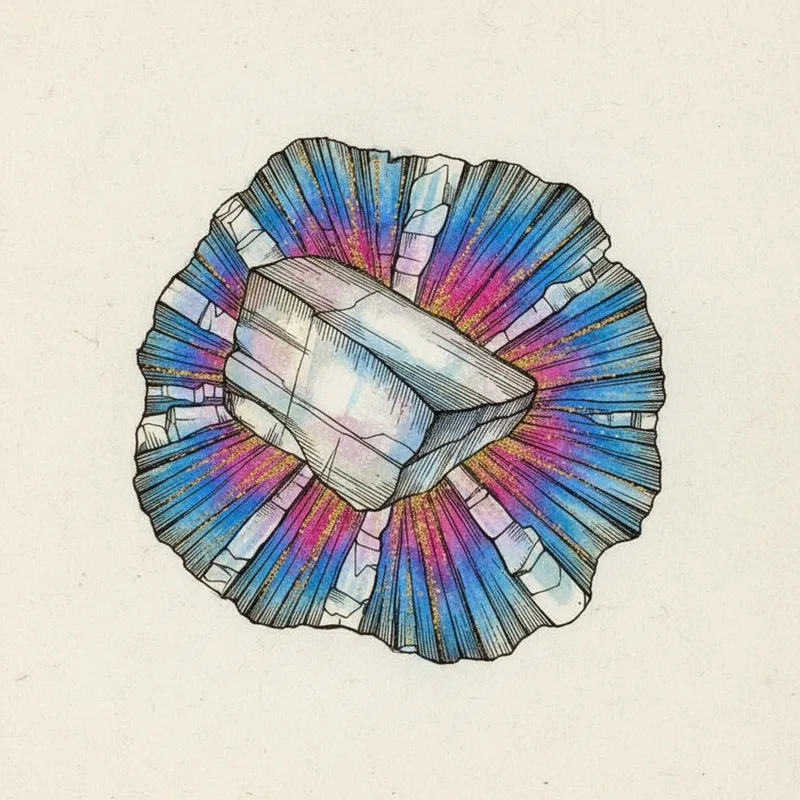
White moonstone's adularescence: As orthoclase cooled slowly underground, it unmixed into alternating microscopic layers of two feldspars (orthoclase and albite), a process called exsolution. Those layers are thin, on the order of the wavelength of light, so light entering the stone scatters off them and re-emerges as a soft, billowy blue-white glow that seems to float just under the surface and moves as you tilt the stone. It is a single-color sheen, usually blue or silvery white, and it is directional.
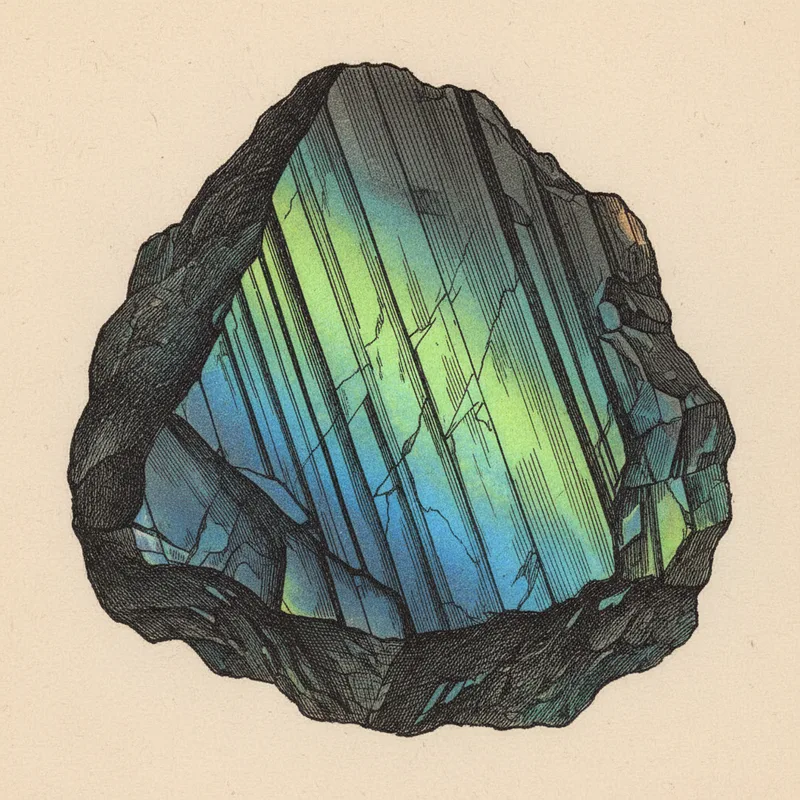
Rainbow moonstone's labradorescence: Labradorite also unmixed into layers as it cooled, but into a structure of alternating lamellae with a different spacing and arrangement. Those layers act as a stack that diffracts and interferes with light across multiple wavelengths, throwing back distinct flashes of blue, violet, green, and gold, sometimes a near-complete spectrum, depending on the angle. This is the same phenomenon that gives gray labradorite its dramatic peacock flash; in rainbow moonstone, the body is nearly transparent so the colors float against clear stone.
In short: white moonstone scatters light into one soft glow; rainbow moonstone diffracts light into many sharp flashes.
How to Tell Them Apart in Person
You usually do not need a loupe. Tilt the stone under a single light source and watch the light effect.
- One soft, cloudy blue or silver glow that drifts across the stone as you tilt it, with a slightly milky or translucent body: that is true white moonstone (orthoclase).
- Sharp flashes of two or more colors (blue plus green, or blue plus gold, sometimes a full rainbow) against a clear, near-transparent body: that is rainbow moonstone (labradorite).
If the stone is perfectly clear with a milky-blue sheen and a faint orange glow when backlit, and especially if you can spot tiny round bubbles with a loupe, you are looking at opalite, manufactured glass sold as a fake for both moonstone types. Real feldspar moonstone will not contain spherical bubbles.
Price and Value
White and rainbow moonstone overlap in price, but the value drivers differ.
For white moonstone, the premium is on a strong, clean blue sheen against a transparent (not milky) body. The most prized material, fine blue moonstone from Sri Lanka, can climb well past the typical range, but most white moonstone is affordable.
For rainbow moonstone, value tracks the brightness and breadth of the flash and the clarity of the body. A stone that throws blue alone is common and cheap; one that flashes a full spectrum of color cleanly across a transparent body commands a premium. Most rainbow moonstone on the market is mined in India and Sri Lanka.
Neither is an expensive gem by the standards of, say, sapphire, which is the practical reason the names get used loosely: there is little incentive to police the labeling at these price points.
Which Should You Choose?
Choose white moonstone if you want the classic, understated look, the soft single-color glow most people picture when they hear "moonstone." It is the more traditional birthstone material and pairs well with simple settings.
Choose rainbow moonstone if you want more visible drama, the multicolor flash reads as flashier and more eye-catching, especially in larger cabochons and in motion.
Both are moderately soft (hardness 6 to 6.5) and have a tendency to cleave if struck, so both are better suited to pendants and earrings than to everyday rings. Care is identical: avoid hard knocks, clean with mild soap and water, and store away from harder stones.
The Bottom Line
They share a name and a price neighborhood, but white moonstone is orthoclase with a single soft glow, and rainbow moonstone is labradorite with a multicolor flash. Once you know to watch how the stone handles light, one glow versus many flashes, you will never confuse them again.
Related:
Metaphysical and “healing” associations mentioned here are cultural traditions, not medical advice or scientific fact. Crystals are not a substitute for professional medical care. Full disclaimer.
Crystals in This Article

Keep Reading
Newsletter
Something shiny, now and then
A stone worth knowing, or a fake worth spotting, every so often. No spam.