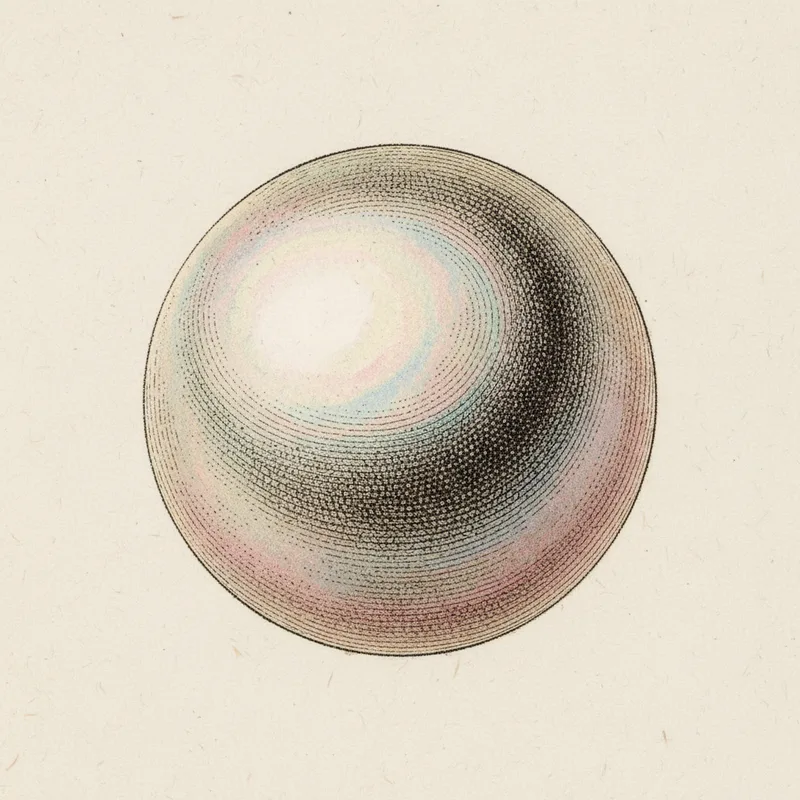
Pearl
The Gem of the Sea
Affiliate links. We may earn a commission, at no cost to you.
Quick Facts
Formation & Origin
Pearl is an organic gem, a biomineral grown inside mollusks from nacre, alternating microscopic layers of aragonite (a form of calcium carbonate) bound by the protein conchiolin. Pearls form when an irritant (a parasite, not a grain of sand - the sand myth is wrong) becomes lodged in a mollusk's tissue. The animal coats the irritant with nacre - alternating microscopic layers of aragonite (calcium carbonate) platelets and conchiolin (organic protein). These layers build up over years, eventually creating a pearl.
Nacre's beauty comes from its layered structure. The aragonite platelets are roughly the same thickness as the wavelength of visible light, so they act as a natural diffraction grating - splitting and reflecting light to create the luminous, iridescent quality called 'orient.' The more uniform and numerous the nacre layers, the finer the pearl's luster.
Natural pearls (formed without human intervention) are extraordinarily rare today. Virtually all pearls on the market are cultured - a technician surgically inserts a bead nucleus into the mollusk, which then coats it with nacre over 1-5 years. Kokichi Mikimoto patented the cultured pearl process in 1893, democratizing what had been the world's most exclusive gem.
Identification Guide
Pearls are identified by their characteristic pearly luster, organic origin, and the 'tooth test' - rub a pearl gently against the biting edge of your front teeth. Genuine nacre feels slightly gritty (the edges of aragonite platelets), while plastic or glass imitations feel smooth.
Distinguish from shell pearls (coated glass beads - too perfect, too heavy), plastic imitations (smooth tooth test, lighter), and Majorica pearls (high-quality glass imitations from Mallorca). Under magnification, genuine nacre shows overlapping platelet edges; imitations show paint or coating layers.
Spotting Fakes
The tooth test is the simplest and most reliable field test for pearls. Beyond that: genuine pearls have slight surface irregularities and vary slightly from each other in a strand; perfect uniformity suggests imitation. X-ray examination can distinguish natural from cultured pearls by revealing the nucleus. For valuable strands, a lab report from GIA confirms whether pearls are natural, cultured, or imitation. The terms 'saltwater' and 'freshwater' describe the mollusk's habitat, not the pearl's quality.
Some links in this post go to Amazon and Etsy. Crystal Almanac earns a commission from qualifying purchases at no extra cost to you. Tools recommended here are ones we would use ourselves to run the tests described - the recommendation comes first, the link is downstream of it.
Cultural & Metaphysical Traditions
Presented as cultural traditions, not scientific evidence
Pearls have been treasured since antiquity - Cleopatra famously dissolved a pearl in vinegar and drank it to win a bet about hosting the most expensive dinner. In Hindu tradition, pearls are associated with the moon and are one of the navaratna (nine sacred gems). Chinese tradition associates pearls with dragons - legends say pearls fell from the sky when dragons fought. In Western tradition, pearls symbolize purity and were required adornments for Renaissance nobility. June birthstone.
Metaphysical and “healing” associations are cultural traditions, not medical advice or scientific fact. Crystals are not a substitute for professional medical care.
Where It's Found
Finest white and golden South Sea pearls
Black Tahitian pearls
Akoya pearls, Mikimoto's pioneering farms
World's largest producer by volume
Price Guide
Good to Know
Scratch test: At hardness 3, Pearl can be scratched with a copper coin. Handle gently and keep away from harder stones in your collection.
Global supply: Found in 4 notable locations worldwide, from Australia to China.
Heft test: Pearl has average mineral density (2.70). It feels about as heavy as you'd expect from a stone its size.
Common Questions
What is the chemical formula of Pearl?
The chemical formula of Pearl is CaCO₃ (aragonite) + conchiolin (organic).
What is Pearl's Mohs hardness?
Pearl has a Mohs hardness of 3 on the 1 to 10 Mohs scale, soft enough to scratch with a copper coin.
Is Pearl a mineral?
No. Pearl is an organic gem, not a mineral, because it forms from once-living material rather than purely geological crystallization.
Care & Safety
The water, salt, and sunlight questions people actually ask before cleansing or displaying pearl, answered from its hardness (Mohs 3) and chemistry (CaCO₃ (aragonite) + conchiolin (organic)).
Can Pearl go in water?
Not recommended. Organic gem made of calcium carbonate layers (nacre). Water, soap, and chemicals degrade the nacre over time.
Can Pearl go in salt water?
No. Pearls form in the sea, but a finished pearl should never soak in salt water: drying salt dehydrates and abrades the nacre layers and attacks the silk thread of strands. Wipe pearls with a soft damp cloth after wearing instead.
Is sunlight safe for Pearl?
Mostly, with a heat caveat. GIA rates pearl as generally stable to light, but heat from intense light can dehydrate the nacre and crack it, and high heat can cause discoloration or splitting. Wearing pearls in daylight is fine; storing them in hot direct sun or under intense lamps is not.
Famous Pearl Specimens
Individual pearls with documented histories - verified provenance, ownership timelines, and where each stone sits today.
The full Famous Stones catalogue →Sources & References
The mineralogical and gemological data on this page is drawn from and can be cross-checked against these external references.
Related Minerals
The mineral that forms nacre's crystalline layers
The nacre lining of the shell itself
Produces colorful nacre but different from pearl
Another organic marine gem
Explore More
Organic & Biogenic Gems
Is It a Mineral? Obsidian, Amber, Pearl, and Opal
How to Identify a Crystal by Its Mineral Group
Crystal Hardness Chart: What Mohs Means for You
Mohs Hardness Scale
See where Pearl sits on the scale
Crystal Care Guide
Water safety, sunlight, and handling tips
Save This Stone

Keep this pearl reference handy. Save the card to a Pinterest board and the profile is one tap away.
Save to PinterestNewsletter
Something shiny, now and then
A stone worth knowing, or a fake worth spotting, every so often. No spam.