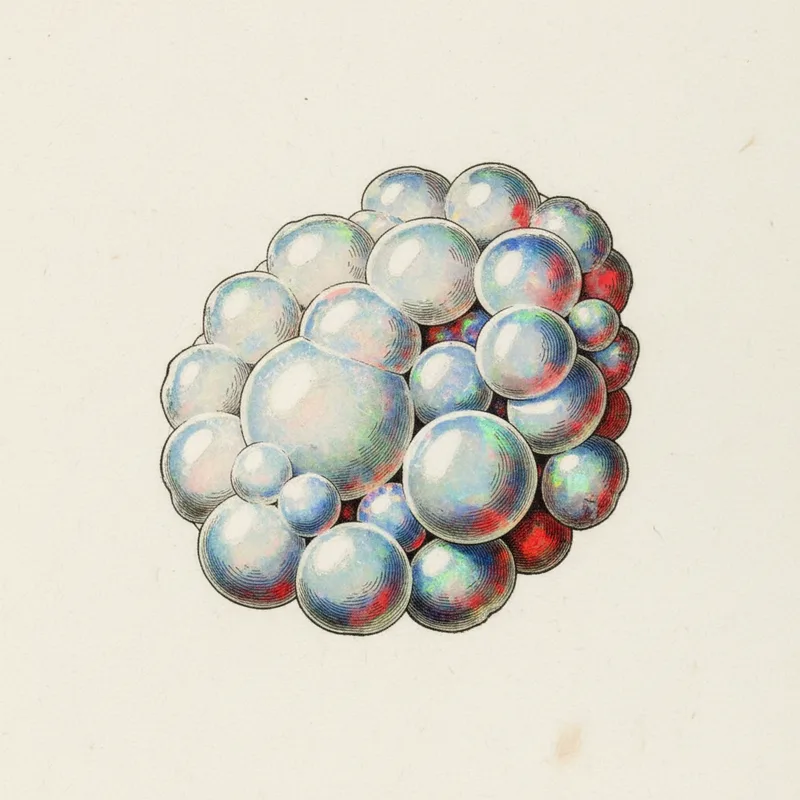
Opal
The Eye Stone
Affiliate links. We may earn a commission, at no cost to you.
Quick Facts
Formation & Origin
Opal is one of the few gemstones that isn't crystalline - it's an amorphous solid, a hardened silica gel containing 3-21% water by weight. It forms when silica-rich water seeps into cracks and voids in rock, then slowly evaporates over millions of years, leaving behind layers of microscopic silica spheres.
The magic of precious opal - the play-of-color that makes it flash red, green, blue, and every color between - comes from the arrangement of these spheres. When the spheres are uniform in size (around 150-400 nanometers) and stacked in orderly, three-dimensional arrays, they diffract white light into its component colors, like a natural diffraction grating. Larger spheres produce red flashes (the rarest and most valuable), while smaller spheres produce blue and violet.
Black opal from Lightning Ridge, Australia, is the most valuable variety because the dark body color provides maximum contrast for the play-of-color. The opal forms in ancient weathered sandstone, filling cracks, cavities, and even the interiors of fossils - opalised shells, bones, and even a complete opalised dinosaur skeleton have been found.
Identification Guide
Precious opal is identified by its play-of-color - the internal flashing of spectral colors that shifts as the stone is moved. No other natural gemstone produces this effect (labradorite shows a different phenomenon called labradorescence). Common opal lacks play-of-color and appears as a simple opaque to translucent stone.
Opal is soft (5.5-6.5 Mohs), has no cleavage, and has a notably low specific gravity (2.10) - it feels light for its size. It contains water and can crack ('crazing') if it dries out too quickly. Ethiopian opal is hydrophane - it absorbs water, becoming temporarily transparent, and returns to its original appearance when dry.
Spotting Fakes
Opal doublets (a thin slice of opal glued to a dark backing) and triplets (doublet with a clear cap on top) are common and legitimate products but should be priced accordingly - not as solid opal. Look at the stone from the side: a doublet shows a flat, dark base layer. Synthetic opal (Gilson) exists and shows a distinctive 'lizard skin' pattern under magnification. Lab reports are essential for any opal sold as natural black opal at premium prices. Also beware 'opalite' - this is man-made glass, not opal.
Some links in this post go to Amazon and Etsy. Crystal Almanac earns a commission from qualifying purchases at no extra cost to you. Tools recommended here are ones we would use ourselves to run the tests described - the recommendation comes first, the link is downstream of it.
Cultural & Metaphysical Traditions
Presented as cultural traditions, not scientific evidence
Ancient Romans considered opal the most precious gemstone because it contained the colors of all other gems. A persistent superstition that opals are 'bad luck' traces to Sir Walter Scott's 1829 novel 'Anne of Geierstein,' in which an opal amulet destroys its owner. Queen Victoria actively fought this superstition by giving opals as gifts. In Aboriginal Australian tradition, the creator's foot touched a rainbow where it met the Earth, turning the stones into opals.
Metaphysical and “healing” associations are cultural traditions, not medical advice or scientific fact. Crystals are not a substitute for professional medical care.
Where It's Found
World's finest black opal and white opal
Hydrophane opal, absorbs water and changes appearance
Fire opal - transparent orange with or without play-of-color
Fine quality white and crystal opal
Price Guide
Good to Know
Scratch test: At hardness 5.5, Opal resists scratching from a knife but can be scratched by quartz. Best for pendants and earrings rather than rings.
Global supply: Found in 4 notable locations worldwide, from Australia to Brazil.
Heft test: With a specific gravity of 2.10, Opal feels lighter than most minerals. This lightness can help identify it.
Common Questions
What is the chemical formula of Opal?
The chemical formula of Opal is SiO₂·nH₂O.
What is Opal's Mohs hardness?
Opal has a Mohs hardness of 5.5 on the 1 to 10 Mohs scale, hard enough to scratch glass but softer than quartz.
Is Opal a mineral?
Not exactly. Opal is a mineraloid: it has a mineral-like composition but lacks the ordered, repeating crystal structure required to be a true mineral.
Care & Safety
The water, salt, and sunlight questions people actually ask before cleansing or displaying opal, answered from its hardness (Mohs 5.5) and chemistry (SiO₂·nH₂O).
Can Opal go in water?
Only briefly. A quick rinse under running water is fine for opal, but do not let it soak or sit submerged. Contains up to 20% water internally. Soaking can cause differential expansion and cracking (crazing). The water content is structural.
Can Opal go in salt water?
No. Opal is hydrated silica (SiO₂·nH₂O) with structural water content. Soaking risks crazing on its own, and dissolved salt can be carried into the porous structure, where it crystallizes and stresses the stone from inside as it dries. Keep opal away from salt water.
Is sunlight safe for Opal?
The light is not the problem; the heat and dryness are. Opal is hydrated silica (SiO₂·nH₂O), and prolonged sun exposure can dehydrate it, leading to crazing, a network of fine permanent cracks. Display opal away from direct sun, heat, and very dry air.
Famous Opal Specimens
Individual opals with documented histories - verified provenance, ownership timelines, and where each stone sits today.
The full Famous Stones catalogue →Sources & References
The mineralogical and gemological data on this page is drawn from and can be cross-checked against these external references.
- WikipediaOpal on Wikipedia
- WebmineralOpal mineral data (Webmineral)
- GIAOpal in the GIA Gem Encyclopedia
Explore More
Quartz & Chalcedony
Scorpio Season Crystals 2026: Stones for Transformation
Libra Season Crystals 2026: Stones for Balance
October Birthstones: Opal and Tourmaline
Mohs Hardness Scale
See where Opal sits on the scale
Crystal Care Guide
Water safety, sunlight, and handling tips
Save This Stone

Keep this opal reference handy. Save the card to a Pinterest board and the profile is one tap away.
Save to PinterestNewsletter
Something shiny, now and then
A stone worth knowing, or a fake worth spotting, every so often. No spam.