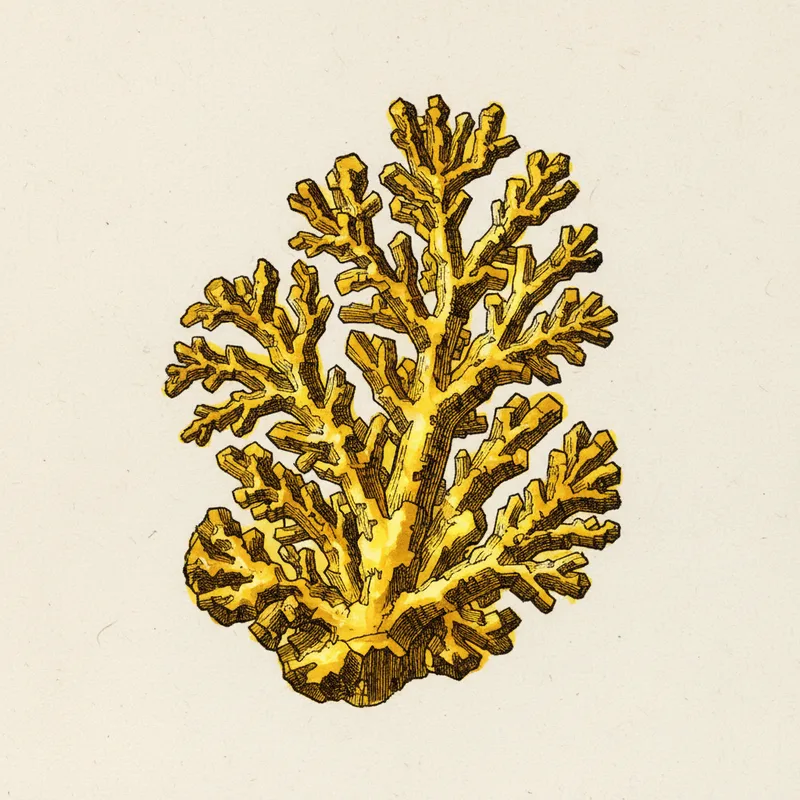
Gold
The Eternal Metal
Affiliate links. We may earn a commission, at no cost to you.
Quick Facts
Formation & Origin
Gold is a native element, a metal that occurs in nature as the chemically uncombined element (Au) and resists tarnish because it rarely reacts with other substances. Gold forms deep in the Earth's crust through hydrothermal processes - superheated water dissolving gold from surrounding rock and depositing it in quartz veins and fracture systems as the fluid cools. Most gold deposits formed billions of years ago, and the gold itself was created in neutron star collisions before Earth existed. Every atom of gold on Earth was forged in the violent merger of dead stars and delivered to our planet by asteroid bombardment 4 billion years ago.
Gold occurs in two primary deposit types. Lode deposits (hard-rock gold) are quartz veins containing native gold that formed from hydrothermal fluids at temperatures of 200-400 degrees Celsius. Placer deposits are secondary - gold eroded from lode deposits accumulates in stream and river gravels because its extreme density (19.3) causes it to settle while lighter material washes away. The California Gold Rush of 1849 targeted placer deposits.
Gold's remarkable properties explain its value: it doesn't corrode, oxidize, or tarnish. It's the most malleable metal - a single ounce can be hammered into a sheet covering 9 square meters. It's an excellent electrical conductor. And it's genuinely rare - all the gold ever mined in human history would form a cube only 22 meters on each side.
Identification Guide
Native gold is identified by its bright yellow metallic color, extreme density (19.3 - it feels shockingly heavy), malleability (it bends without breaking), and the fact that it doesn't tarnish. The golden yellow streak on a streak plate is diagnostic.
Distinguish from pyrite ('fool's gold' - harder at 6.5, brittle, breaks rather than bends), chalcopyrite (brassy yellow, tarnishes to iridescent), and mica flakes in streams (flat, lightweight, float). The simplest test: hit it with a hammer. Gold flattens; pyrite shatters.
Spotting Fakes
In the specimen market, gold on quartz matrix is sometimes enhanced by attaching additional gold flakes or nuggets to genuine quartz with adhesive. Look for unnatural attachment points and gold that appears 'placed' rather than grown into the matrix. Gold-plated pyrite and brass are obvious fakes - they lack gold's density and malleability. For gold nuggets, specific gravity testing is definitive. In jewelry, gold purity is stamped (14K, 18K, 24K) - testing kits using acid or electronic testers verify purity.
Some links in this post go to Amazon and Etsy. Crystal Almanac earns a commission from qualifying purchases at no extra cost to you. Tools recommended here are ones we would use ourselves to run the tests described - the recommendation comes first, the link is downstream of it.
Cultural & Metaphysical Traditions
Presented as cultural traditions, not scientific evidence
Gold has been revered across virtually every civilization in human history. Ancient Egyptians associated it with the sun god Ra and believed pharaohs would become one with the sun upon death - hence the gold burial masks. Alchemists spent centuries trying to transmute base metals into gold (the philosopher's stone). In Hindu tradition, gold represents the energy of the sun and is considered the most auspicious metal. Inca civilization called gold 'the sweat of the sun.' Gold's incorruptibility made it a symbol of immortality across cultures.
Metaphysical and “healing” associations are cultural traditions, not medical advice or scientific fact. Crystals are not a substitute for professional medical care.
Where It's Found
World's largest gold deposits, deep mining
Historic Gold Rush, modern industrial mining
Major producer, large nuggets found
Significant alluvial and hard-rock deposits
Price Guide
Good to Know
Scratch test: At hardness 2.5, Gold can be scratched with a fingernail. This is a display specimen, not a wearable stone.
Global supply: Found in 4 notable locations worldwide, from South Africa to Russia.
Heft test: With a specific gravity of 19.30, Gold feels surprisingly heavy for its size. This weight is actually a useful identification tool.
Common Questions
What is the chemical formula of Gold?
The chemical formula of Gold is Au.
What is Gold's Mohs hardness?
Gold has a Mohs hardness of 2.5 on the 1 to 10 Mohs scale, soft enough to scratch with a fingernail.
Is Gold a mineral?
Yes. Gold is a naturally occurring mineral (Native Element) with a definite chemical composition and an ordered crystal structure.
Care & Safety
The water, salt, and sunlight questions people actually ask before cleansing or displaying gold, answered from its hardness (Mohs 2.5) and chemistry (Au).
Can Gold go in water?
Not recommended. Not because gold reacts: it is chemically inert and does not corrode. But native gold is very soft (Mohs 2.5) and specimens often sit on fragile matrix that wet handling can damage. Clean with a dry soft brush instead.
Can Gold go in salt water?
Best avoided. Salt water does not corrode gold itself (the metal is famously inert), but it attacks the matrix minerals and sulfides that accompany native gold specimens, and dried salt abrades the soft metal surface (Mohs 2.5). Keep specimens dry.
Sources & References
The mineralogical and gemological data on this page is drawn from and can be cross-checked against these external references.
- WikipediaGold on Wikipedia
- WebmineralGold mineral data (Webmineral)
- Handbook of MineralogyGold (Handbook of Mineralogy, PDF)
Related Minerals
Fool's gold - similar color, completely different
Another precious native metal
Natural gold-silver alloy
Another native metal element
Explore More
Native Elements & Metals
The Abundance Collection
The eternal metal. Every civilization in human history has associated gold with wealth, power, and divine favor.
Scorpio Season Crystals 2026: Stones for Transformation
Libra Season Crystals 2026: Stones for Balance
Virgo Season Crystals 2026: Stones for Clarity
Mohs Hardness Scale
See where Gold sits on the scale
Crystal Care Guide
Water safety, sunlight, and handling tips
Save This Stone

Keep this gold reference handy. Save the card to a Pinterest board and the profile is one tap away.
Save to PinterestNewsletter
Something shiny, now and then
A stone worth knowing, or a fake worth spotting, every so often. No spam.