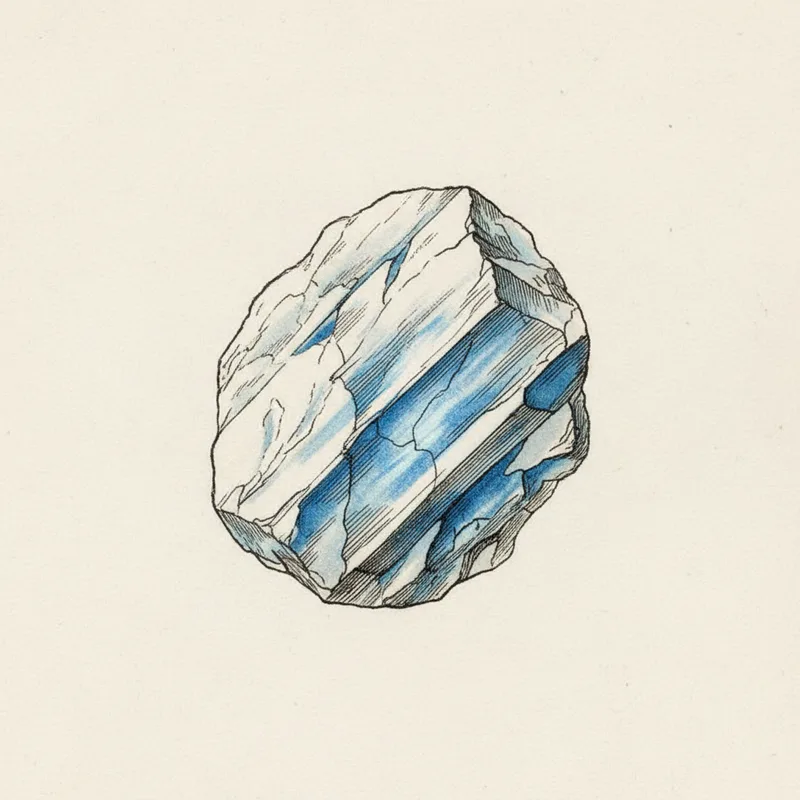
Moonstone
The Traveler's Stone
Affiliate links. We may earn a commission, at no cost to you.
Quick Facts
Formation & Origin
Moonstone is a variety of orthoclase feldspar that owes its ethereal glow to a phenomenon called adularescence. During crystallization, two types of feldspar - orthoclase and albite - initially form a homogeneous mixture. As the crystal cools, these two components slowly separate into microscopically thin, alternating layers, like shuffled cards.
When light enters the stone and encounters these internal layers, it scatters and interferes, producing a billowy, floating glow that seems to move beneath the surface as the stone is rotated. The effect is named after the Adular Mountains in Switzerland, where fine moonstone specimens were historically found.
The thickness of the internal layers determines the color of the sheen. Thinner layers produce the prized blue adularescence found in Sri Lankan stones, while thicker layers produce white or silver glows. The finest moonstones are nearly transparent with a strong blue sheen that floats across the domed surface of a cabochon cut.
Identification Guide
Moonstone is identified by its distinctive adularescence, a soft, billowy glow that moves across the surface when the stone is rotated under light. This distinguishes it from opal (which shows multicolored flashes), labradorite (which shows sharper, more directional color play), and chalcedony (which has no optical phenomenon).
At hardness 6, moonstone can be scratched by quartz. It has two directions of cleavage, which makes it somewhat fragile for jewelry use. The specific gravity of 2.57 is typical for feldspar. Under magnification, the internal layered structure may be visible as a subtle schiller effect.
Spotting Fakes
The defining test is whether the glow moves: genuine moonstone's adularescence floats across the surface as you tilt it, while glass and opalite imitations have a static, uniform sheen.
- 'Rainbow moonstone' is actually white labradorite, a different mineral showing sharper, more colorful flashes (labradorescence) rather than moonstone's soft, diffuse glow.
- Glass imitations lack the floating quality of real adularescence.
- Opalite (man-made glass) has an oily, uniform blue-white glow with none of the real stone's subtlety.
Synthetic moonstone exists but is rare.
Some links in this post go to Amazon and Etsy. Crystal Almanac earns a commission from qualifying purchases at no extra cost to you. Tools recommended here are ones we would use ourselves to run the tests described - the recommendation comes first, the link is downstream of it.
Cultural & Metaphysical Traditions
Presented as cultural traditions, not scientific evidence
Ancient Romans believed moonstone was formed from solidified moonlight and associated it with their lunar deity Diana. Hindu tradition considers moonstone sacred - it's embedded in the forehead of the moon god Ganesh's statue in some depictions. In Art Nouveau jewelry, moonstone was favored by designers like Rene Lalique for its dreamy, feminine quality. Travelers historically carried moonstone for protection on journeys, especially at night.
Metaphysical and “healing” associations are cultural traditions, not medical advice or scientific fact. Crystals are not a substitute for professional medical care.
Where It's Found
Finest blue sheen moonstone in the world
'Rainbow moonstone' (actually white labradorite)
High quality with strong blue adularescence
Peach and champagne colored specimens
Price Guide
Good to Know
Scratch test: At hardness 6, Moonstone resists scratching from a knife but can be scratched by quartz. Best for pendants and earrings rather than rings.
Global supply: Found in 4 notable locations worldwide, from Sri Lanka to Tanzania.
Heft test: Moonstone has average mineral density (2.57). It feels about as heavy as you'd expect from a stone its size.
Common Questions
What is the chemical formula of Moonstone?
The chemical formula of Moonstone is KAlSi₃O₈.
What is Moonstone's Mohs hardness?
Moonstone has a Mohs hardness of 6 on the 1 to 10 Mohs scale, hard enough to scratch glass but softer than quartz.
Is Moonstone a mineral?
Yes. Moonstone is a naturally occurring mineral (Feldspar Group) with a definite chemical composition and an ordered crystal structure.
Care & Safety
The water, salt, and sunlight questions people actually ask before cleansing or displaying moonstone, answered from its hardness (Mohs 6) and chemistry (KAlSi₃O₈).
Can Moonstone go in water?
Only briefly. A quick rinse under running water is fine for moonstone, but do not let it soak or sit submerged. Feldspar with cleavage planes. Water can seep into micro-fractures and expand during temperature changes, causing cracking.
Can Moonstone go in salt water?
No. Moonstone can take a brief fresh-water rinse and nothing more, and salt water is harder on it both ways: corrosive while wet, then abrasive as the salt dries into crystals. If it does meet salt water, rinse it with fresh water and dry it promptly.
Sources & References
The mineralogical and gemological data on this page is drawn from and can be cross-checked against these external references.
- WikipediaMoonstone (gemstone) on Wikipedia
- WebmineralOrthoclase mineral data (Webmineral)
- Handbook of MineralogyOrthoclase (Handbook of Mineralogy, PDF)
- GIAMoonstone in the GIA Gem Encyclopedia
Explore More
Feldspar Group
The Sleep Collection
Connected to lunar cycles and the nighttime world. Hindu tradition considers it sacred and associated with dream states. Its adularescent shimmer is associated with the soft, shifting quality of sleep.
The Travel Collection
The traveler's stone in Hindu tradition - specifically for night journeys and travel by water. Its connection to lunar cycles (which govern tides) made it essential for seafarers.
The Grief Collection
Connected to emotional cycles and the natural ebb of feeling. Grief has its own rhythm, like tides. Moonstone's adularescent shimmer - present, then gone, then present again - mirrors the wavelike nature of loss.
Libra Season Crystals 2026: Stones for Balance
October Birthstones: Opal and Tourmaline
Red, White, and Blue Crystals: The Real Geology
Mohs Hardness Scale
See where Moonstone sits on the scale
Crystal Care Guide
Water safety, sunlight, and handling tips
Save This Stone

Keep this moonstone reference handy. Save the card to a Pinterest board and the profile is one tap away.
Save to PinterestStay in the loop
From the Almanac
Updates from Crystal Almanac, when there’s something worth sharing.