Rainbow Moonstone
The Labradorite in Disguise
Affiliate links. We may earn a commission, at no cost to you.
Quick Facts
Formation & Origin
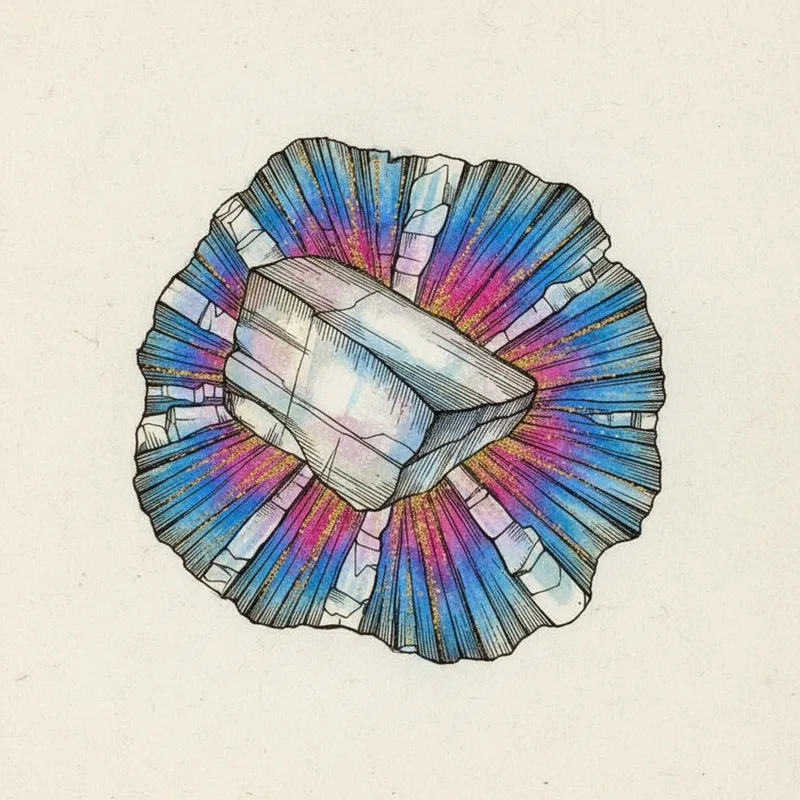
Rainbow moonstone is, despite its name, a transparent variety of labradorite, a plagioclase feldspar prized for its blue-to-multicolor flash. Here's a fact that surprises many crystal enthusiasts: rainbow moonstone is not actually moonstone. Mineralogically, it's a transparent to translucent variety of labradorite (a plagioclase feldspar) with a white body and blue-to-multicolor flash (labradorescence). True moonstone is orthoclase (a potassium feldspar) with adularescence, a billowy, moving glow.
The 'rainbow' effect in rainbow moonstone comes from the same mechanism as in standard labradorite: light diffracting off submicroscopic layers of alternating feldspar compositions within the crystal. In labradorite, these layers create the famous play of color. In rainbow moonstone, the host crystal is transparent enough to show this effect against a white or clear background.
The trade name 'rainbow moonstone' persists because it sells better than 'white labradorite' and because the visual effect (a luminous glow from within a translucent white stone) does resemble moonstone to the casual observer. Both the FTC and gemological labs recognize the name as a trade convention while noting the mineralogical distinction.
Identification Guide
Rainbow moonstone shows blue to multicolor flashes (labradorescence) in a white translucent body. True moonstone shows a softer, billowy adularescence (typically blue or white) without the sharp, colorful flashes.
Distinguish from true moonstone (adularescence vs. labradorescence), opalite (man-made glass, too uniform), and white labradorite (same mineral, different trade name). The sharp, colorful flashes visible when tilted distinguish rainbow moonstone from the softer glow of true moonstone.
Spotting Fakes
Opalite (man-made opalescent glass) is widely sold as rainbow moonstone. Opalite has a uniform, milky blue glow that doesn't change dramatically with angle, while genuine rainbow moonstone shows distinct flashes that appear and disappear as you tilt the stone. Under magnification, rainbow moonstone shows natural inclusions and internal layering, while opalite is perfectly clean. Weight is another clue: feldspar is denser than glass.
Some links in this post go to Amazon and Etsy. Crystal Almanac earns a commission from qualifying purchases at no extra cost to you. Tools recommended here are ones we would use ourselves to run the tests described - the recommendation comes first, the link is downstream of it.
Cultural & Metaphysical Traditions
Presented as cultural traditions, not scientific evidence
Rainbow moonstone carries the metaphysical associations of both moonstone and labradorite. It's considered a stone of new beginnings, feminine energy, and intuition (from the moonstone tradition) combined with transformation and psychic protection (from the labradorite tradition). Practitioners value it for connecting to lunar cycles and enhancing dream awareness.
Metaphysical and “healing” associations are cultural traditions, not medical advice or scientific fact. Crystals are not a substitute for professional medical care.
Where It's Found
Primary commercial source
Fine quality material
Growing source
Some fine specimens
Price Guide
Good to Know
Scratch test: At hardness 6, Rainbow Moonstone resists scratching from a knife but can be scratched by quartz. Best for pendants and earrings rather than rings.
Global supply: Found in 4 notable locations worldwide, from India to Myanmar.
Heft test: Rainbow Moonstone has average mineral density (2.69-2.72). It feels about as heavy as you'd expect from a stone its size.
Common Questions
What is the chemical formula of Rainbow Moonstone?
The chemical formula of Rainbow Moonstone is NaAlSi₃O₈ - CaAl₂Si₂O₈ (labradorite composition).
What is Rainbow Moonstone's Mohs hardness?
Rainbow Moonstone has a Mohs hardness of 6 on the 1 to 10 Mohs scale, hard enough to scratch glass but softer than quartz.
Is Rainbow Moonstone a mineral?
Yes. Rainbow Moonstone is a naturally occurring mineral (Feldspar Group (Plagioclase)) with a definite chemical composition and an ordered crystal structure.
Care & Safety
The water, salt, and sunlight questions people actually ask before cleansing or displaying rainbow moonstone, answered from its hardness (Mohs 6) and chemistry (NaAlSi₃O₈ - CaAl₂Si₂O₈ (labradorite composition)).
Can Rainbow Moonstone go in water?
Yes. Rainbow Moonstone is not water-soluble and durable enough (Mohs 6), so a rinse or a quick wash with mild soap is no problem, cleanse it in water freely if that is your practice. A long soak does nothing for it either way, so skip that, and dry the stone afterward.
Can Rainbow Moonstone go in salt water?
Not recommended, even though rainbow moonstone itself is hard and not water-soluble. Salt is both corrosive and mildly abrasive: it can dull a polished surface, attack metal settings, and crystallize inside small fractures as the stone dries. A quick dip will not destroy rainbow moonstone, but rinse it with fresh water afterward and dry it. For routine cleaning, plain water is the kinder choice.
Sources & References
The mineralogical and gemological data on this page is drawn from and can be cross-checked against these external references.
- WikipediaMoonstone (gemstone) on Wikipedia
- WebmineralLabradorite mineral data (Webmineral)
- Handbook of MineralogyLabradorite (Handbook of Mineralogy, PDF)
- GIARainbow Moonstone in the GIA Gem Encyclopedia
Explore More
Feldspar Group
Rainbow Moonstone vs White Moonstone: The Difference
Cancer Season Crystals 2026: Stones for Intuition
June Birthstones: Pearl, Moonstone, and Alexandrite
Mohs Hardness Scale
See where Rainbow Moonstone sits on the scale
Crystal Care Guide
Water safety, sunlight, and handling tips
Save This Stone
%20is%20widely%20sold%20as%20rainbow%20moonstone.%20Meaning%2C%20properties%20%26%20how%20to%20spot%20fakes%20at%20Crystal%20Almanac.)
Keep this rainbow moonstone reference handy. Save the card to a Pinterest board and the profile is one tap away.
Save to PinterestNewsletter
Something shiny, now and then
A stone worth knowing, or a fake worth spotting, every so often. No spam.