Peridot: The August Birthstone Having a Moment in 2026
Some links in this post go to Amazon and Etsy. Crystal Almanac earns a commission from qualifying purchases at no extra cost to you. Tools recommended here are ones we would use ourselves to run the tests described - the recommendation comes first, the link is downstream of it.
Key Takeaway: Peridot is the August birthstone and the gem variety of olivine, one of the most common minerals in Earth's mantle but rare at the surface. Its fresh yellow-green color comes from iron built into the crystal itself, not a trace impurity, which is why peridot is always green. It's affordable, durable enough for everyday jewelry, and one of the only gemstones found in meteorites. The 2026 jewel-tone trend has pushed its olive-green shade back into fashion just as summer birthstone search ramps up.
Peridot has spent most of modern history as the gemstone people couldn't quite place. Too yellow to read as emerald, too green to be a citrine, it never carried the brand recognition of the "precious four." That is changing. The 2026 colored-gemstone market has leaned hard into warm, saturated jewel tones, and peridot's fresh olive-green sits right in the middle of that palette. If you were born in August, this is your birthstone, and the timing of renewed interest is convenient.
Here is what peridot actually is, where it comes from, why it's having a moment, and what to watch for when you buy.
What Peridot Actually Is
Peridot is the gem-quality variety of olivine, with the chemical formula Mg₂SiO₄ (magnesium iron silicate). Olivine is one of the most abundant minerals inside the Earth, a primary component of the upper mantle, but it is comparatively rare at the surface in gem-clean crystals. That contrast, common at depth and scarce above ground, is the whole story of peridot.
Most gemstones get their color from trace impurities: a little chromium turns beryl into emerald, a little iron and titanium turns corundum into blue sapphire. Peridot is different. It is idiochromatic, meaning its color comes from iron (Fe²⁺) that is an essential part of its chemistry, not an accidental contaminant. Take the iron out and you no longer have peridot. This is why peridot is always green and never shows up in other colors the way quartz or beryl do.
The hardness is 6.5 on the Mohs scale. That is durable enough for earrings, pendants, and occasional-wear rings, but soft enough that a daily-wear peridot ring will eventually show wear on the facet edges. It is not a stone to garden in.
One more thing makes peridot unusual: it has strong double refraction (birefringence). Look through a larger faceted peridot at an angle and you can actually see the back facet edges doubled, like a faint echo. This is visible to the naked eye in bigger stones and is one of the easiest ways to confirm you're looking at real peridot rather than glass.
The Meteorite Connection
Peridot holds a distinction almost no other gemstone can claim: it falls from space. Pallasite meteorites, a rare class made of olivine crystals embedded in an iron-nickel matrix, formed in the cores of destroyed protoplanets billions of years ago. When these meteorites are cut and polished, the olivine inside is gem peridot, extraterrestrial in the most literal sense.
Meteoritic peridot is among the most expensive peridot per carat, prized by collectors more than mainstream jewelry buyers. But it's a genuinely true fact that makes peridot one of the best stones to own if you like a good origin story. The same green crystal that lava carries up from Earth's mantle also rode in on a chunk of a shattered ancient world.
Where Peridot Comes From
Peridot reaches the surface two ways: volcanic eruption, where basaltic magma carries olivine up from the mantle, and tectonic uplift, where mantle rock is thrust to the surface along fault zones.
United States (Arizona). The San Carlos Apache Reservation in Arizona is the most productive peridot source in the world. The stones weather out of old basalt flows and are mined largely by Apache families. Most of the small, affordable peridot in American jewelry comes from here.
Pakistan (Kohistan). The Kohistan region produces the finest gem-quality crystals, sometimes called Kashmir peridot, formed by tectonic uplift rather than volcanism. These are the large, clean, vivid stones at the top of the market.
Myanmar (Mogok). A historic source known for large crystals, part of the same legendary gem region that produces top ruby and spinel.
Egypt (Zabargad Island). Zabargad, also called St. John's Island in the Red Sea, is the original ancient source, mined for more than 3,500 years. Much of the peridot in antiquity, including stones the Egyptians associated with the sun, came from here. Some scholars now think several famous historical "emeralds," including pieces attributed to Cleopatra, were actually peridot.
Why Peridot Is Trending in 2026
A few things are converging:
- The jewel-tone trend. 2026 colored-stone forecasts favor warm, lively, saturated colors over icy neutrals. Peridot's yellow-green is one of the freshest greens in the gem world and reads as energetic rather than formal.
- The shift away from diamond. Younger buyers continue moving toward colored stones for both fashion and engagement jewelry, and peridot is one of the most affordable entry points into fine colored gems.
- Birthstone seasonality. August birthstone searches climb every summer as people shop for birthdays and gifts, and that annual ramp lands right when the trend is peaking.
- Affordability. In a market where fine emerald runs into the thousands per carat, peridot delivers a vivid green at a fraction of the price. That value story matters more in 2026 than it did a few years ago.
Price Expectations
Peridot is one of the better values in colored gemstones. A rough orientation:
- Tumbled and small rough specimens: $5-30 for a decent piece
- Small commercial faceted peridot (under 1 carat): $20-80 per carat
- Good-quality faceted peridot (1-3 carats, clean, vivid): $50-150 per carat
- Fine large Pakistani/Kashmir peridot (5+ carats, top color and clarity): $200-450 per carat
- Meteoritic (pallasite) peridot: priced as a collector curiosity, often well above gem value for the rarity
Color is the main price driver. The most valued peridot is a pure, slightly yellowish grass-green with no brown. Stones that lean too yellow or too brown drop in value, and very small stones command little per-carat premium.
How to Spot Fake Peridot
Good news first: synthetic peridot is not produced commercially, so any genuine peridot is natural. There is no lab-grown version flooding the market the way there is for emerald or sapphire. The problem is simulants, other materials sold as peridot, and the two main culprits are green glass and green cubic zirconia (CZ).
Here is how to tell:
- Double refraction. Real peridot's strong birefringence doubles the back facet edges when you look through a larger stone at an angle. Glass and CZ are singly refractive and show no doubling. This single test settles most cases.
- Lily-pad inclusions. Natural peridot often contains distinctive circular stress fractures around tiny chromite crystals, called "lily pad" inclusions. Under 10x magnification these are diagnostic. Glass instead shows round gas bubbles and swirl/flow lines.
- Weight. Green CZ and green glass are denser than peridot, so a CZ or glass "peridot" of the same size feels noticeably heavier in the hand. A small digital scale and a known size make this an easy check.
- Color consistency. Peridot's green is specific. A stone that's too blue-green is likely glass or a different gem; CZ often looks slightly too bright and "electric."
For anything expensive, a gemological lab report removes all doubt.
For the full mineral-by-mineral approach to authentication, see the how to spot fake crystals guide and the most-faked crystals ranking.
Traditional Properties
Peridot's symbolism leans almost entirely toward light, sun, and renewal, which fits both its color and its August timing.
Stone of the sun. The ancient Egyptians called peridot the "gem of the sun" and believed it captured sunlight. Mined at night on Zabargad Island (legend held the glowing stones were easier to spot in darkness), it was associated with light driving out darkness and fear.
Renewal and new growth. The fresh green is tied to growth, vitality, and fresh starts, which is part of why it reads as a natural late-summer and back-to-school stone.
Heart and solar plexus. In contemporary crystal practice, peridot is used for both the heart (the green) and the solar plexus (personal power and confidence), making it a stone people reach for during transitions and confidence work.
Releasing negativity. A long-running folk association holds peridot to be protective against envy and negative emotion, helping the wearer let go of resentment. This is folklore, not mineralogy, but it's the most common modern use.
As always on this site: these are cultural and historical associations, not verified physical effects.
How Peridot Is Used Today
The vast majority of peridot is worn as jewelry, especially birthstone pieces for August babies. Its affordability makes it a popular choice for everyday earrings and pendants, and the 2026 trend has pushed it into more fashion-forward settings paired with yellow gold, which flatters the warm green.
Beyond jewelry, raw and tumbled peridot is collected as a display and meditation stone, often paired with other green and heart-centered stones like emerald, green aventurine, and prehnite. Collectors also seek polished pallasite slices for the meteorite connection.
Care Instructions
At hardness 6.5 with no significant cleavage, peridot is reasonably tough but needs sensible care.
- Clean with warm water, mild soap, and a soft brush. That's all it needs.
- No ultrasonic or steam cleaning. Sudden temperature changes and vibration can stress the stone, especially if it has inclusions.
- Avoid acids. Peridot is slightly susceptible to attack from acids, including sweat over long periods, so wipe it down after wear.
- Store separately. Keep peridot away from harder stones (topaz, sapphire, diamond) that could scratch its facet edges in a shared jewelry box.
- Take rings off for chores. A daily-wear peridot ring will show edge wear over years; remove it for cleaning, gardening, and the gym.
See the crystal care guide for more on caring for moderately soft stones, and the water-safe crystals list for which stones tolerate water.
Bottom Line
Peridot is the August birthstone, the gem face of one of Earth's most common deep minerals, and one of the only gems that also arrives by meteorite. Its color is locked into its chemistry, so it's always a fresh, lively green, and it delivers that green at a fraction of emerald's price. The main thing to watch for is green glass or CZ sold as peridot, and the double-refraction and lily-pad tests catch nearly all of those.
If you or someone you love was born in August, peridot is an easy stone to recommend: affordable, durable enough for real wear, genuinely interesting, and right on trend for 2026.
For the other monthly stones, see the birthstones page. For the broader olivine and silicate context, browse the mineral groups page, and for more green stones, the green crystals family. Since August sits at the close of Leo and the start of Virgo, peridot also features in our Virgo season crystals guide as the birthstone bridge into the season. The next month along is covered in our September birthstone (sapphire) guide, and October has two stones of its own in the October birthstones guide.
Metaphysical and “healing” associations mentioned here are cultural traditions, not medical advice or scientific fact. Crystals are not a substitute for professional medical care. Full disclaimer.
Crystals in This Article
Aventurine
The Stone of Opportunity
Prehnite
The Healer's Stone
Sapphire
The Gem of the Heavens
Citrine
The Merchant's Stone
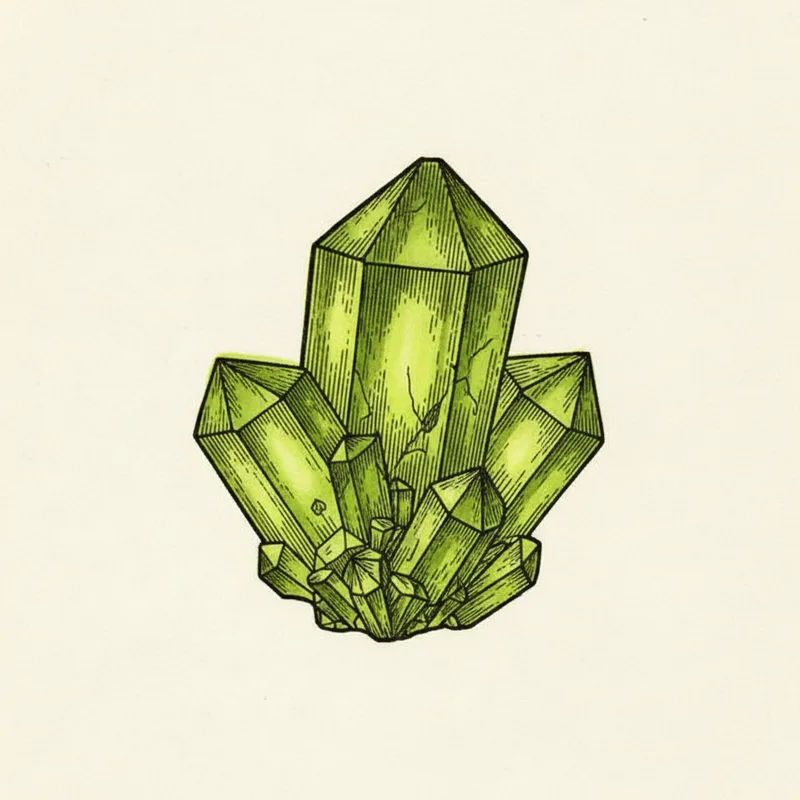
Peridot
The Evening Emerald
Diamond
The Invincible
Emerald
The Stone of Successful Love

Olivine
The Mantle Mineral
Spinel
The Great Impostor
Basalt
The Ocean Floor Rock
Topaz
The Stone of Clarity
Ruby
The King of Gems
Keep Reading
Newsletter
Something shiny, now and then
A stone worth knowing, or a fake worth spotting, every so often. No spam.