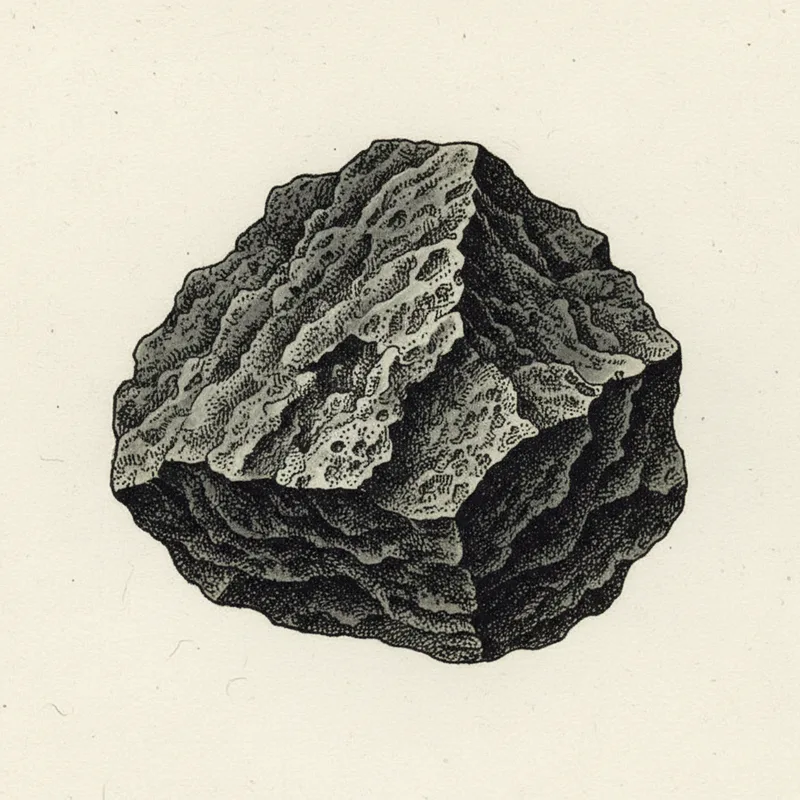
Basalt
The Ocean Floor Rock
Affiliate links. We may earn a commission, at no cost to you.
Quick Facts
Formation & Origin
Basalt is the most common rock on Earth's surface. It forms the entire ocean floor and makes up massive volcanic provinces on every continent. It erupts as low-viscosity lava that flows easily, sometimes traveling tens of kilometers from its source.
Unlike granite (which cools slowly underground to form large crystals), basalt cools rapidly at the surface, producing a fine-grained texture where individual mineral grains are too small to see without magnification. The minerals present are the same as in gabbro (its slow-cooled equivalent): plagioclase feldspar, pyroxene, and olivine.
Basalt is the rock that fills the cavities where zeolites, agates, and amethyst form. When basaltic lava solidifies, trapped gas bubbles create vesicles (holes). Over millions of years, mineral-rich groundwater fills these cavities with secondary minerals, producing the geodes and crystal-lined cavities that crystal collectors prize.
Identification Guide
Basalt is identified by its dark gray to black color, fine-grained texture (crystals too small to see), and density (noticeably heavier than granite). Vesicular basalt contains round gas-bubble holes. Columnar basalt forms dramatic hexagonal columns (Giant's Causeway, Devils Postpile).
Distinguish from obsidian (glassy, no visible texture), gabbro (same minerals but coarse-grained), and slate (layered, can split into sheets). Basalt feels dense and solid with a uniform dark appearance.
Spotting Fakes
Basalt is too common and inexpensive to fake. The main distinction worth knowing: commercial 'basalt' hot stone massage sets may actually be any dark, fine-grained rock. True basalt retains heat well due to its density, making it genuinely superior for hot stone therapy compared to lighter alternatives.
Some links in this post go to Amazon and Etsy. Crystal Almanac earns a commission from qualifying purchases at no extra cost to you. Tools recommended here are ones we would use ourselves to run the tests described - the recommendation comes first, the link is downstream of it.
Cultural & Metaphysical Traditions
Presented as cultural traditions, not scientific evidence
Basalt carries the raw energy of volcanic eruption. Hot basalt massage is one of the oldest therapeutic uses of stone, practiced across Polynesian, Native American, and Asian traditions for millennia. In crystal healing, basalt is associated with grounding, courage, and the transformative power of Earth's interior.
Metaphysical and “healing” associations are cultural traditions, not medical advice or scientific fact. Crystals are not a substitute for professional medical care.
Where It's Found
Makes up virtually all oceanic crust
Iceland is built almost entirely of basalt
Massive basalt flood province, 500,000 km²
Major continental and oceanic basalt
Price Guide
Good to Know
Scratch test: At hardness 6, Basalt resists scratching from a knife but can be scratched by quartz. Best for pendants and earrings rather than rings.
Global supply: Found in 4 notable locations worldwide, from Worldwide to United States.
Heft test: Basalt has average mineral density (2.8-3.0). It feels about as heavy as you'd expect from a stone its size.
Common Questions
What is the chemical formula of Basalt?
The chemical formula of Basalt is Plagioclase + Pyroxene + Olivine (variable).
What is Basalt's Mohs hardness?
Basalt has a Mohs hardness of 6 on the 1 to 10 Mohs scale, hard enough to scratch glass but softer than quartz.
Is Basalt a mineral?
Not quite. Basalt is a rock (a naturally occurring mixture of minerals), not a single mineral species.
Care & Safety
The water, salt, and sunlight questions people actually ask before cleansing or displaying basalt, answered from its hardness (Mohs 6) and chemistry (Plagioclase + Pyroxene + Olivine (variable)).
Can Basalt go in water?
Yes. Basalt is not water-soluble and durable enough (Mohs 6), so a rinse or a quick wash with mild soap is no problem, cleanse it in water freely if that is your practice. A long soak does nothing for it either way, so skip that, and dry the stone afterward.
Can Basalt go in salt water?
Not recommended, even though basalt itself is hard and not water-soluble. Salt is both corrosive and mildly abrasive: it can dull a polished surface, attack metal settings, and crystallize inside small fractures as the stone dries. A quick dip will not destroy basalt, but rinse it with fresh water afterward and dry it. For routine cleaning, plain water is the kinder choice.
Sources & References
The mineralogical and gemological data on this page is drawn from and can be cross-checked against these external references.
- WikipediaBasalt on Wikipedia
Related Minerals
Glassy version of the same magma
Vesicular basalt, porous and lightweight
Same composition but slow-cooled, coarse-grained
Explore More
Rocks & Multi-Mineral Composites
Is It a Mineral? Obsidian, Amber, Pearl, and Opal
Best Crystals for Meditation: A Science-First Guide
How Crystals Form: Pegmatite, Hydrothermal, Sedimentary
Mohs Hardness Scale
See where Basalt sits on the scale
Crystal Care Guide
Water safety, sunlight, and handling tips
Save This Stone

Keep this basalt reference handy. Save the card to a Pinterest board and the profile is one tap away.
Save to PinterestNewsletter
Something shiny, now and then
A stone worth knowing, or a fake worth spotting, every so often. No spam.