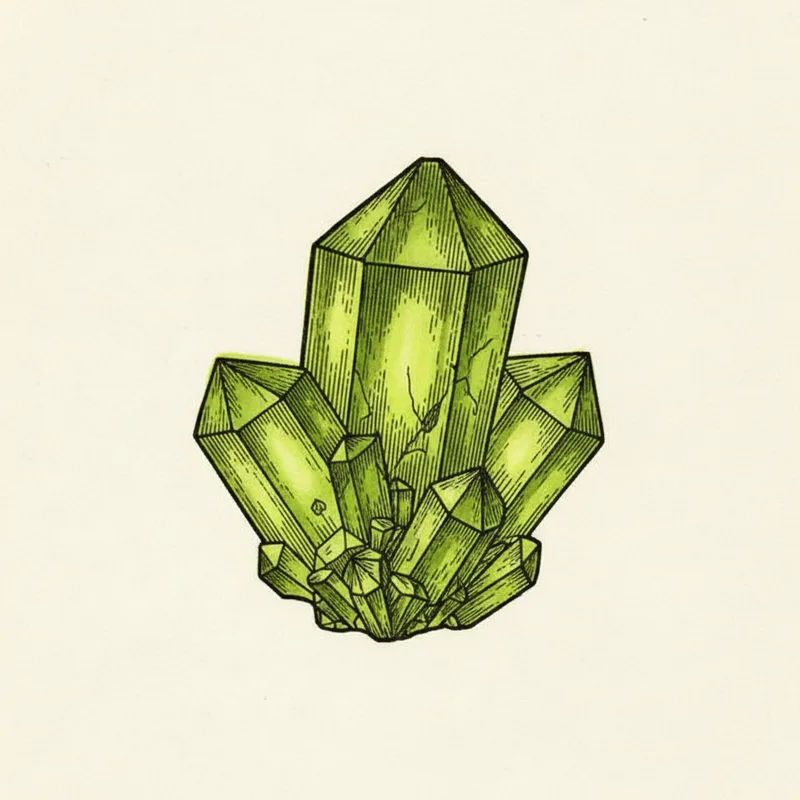
Peridot
The Evening Emerald
Affiliate links. We may earn a commission, at no cost to you.
Quick Facts
Formation & Origin
Peridot is the gem variety of olivine - one of the most common minerals in the Earth's upper mantle but relatively rare at the surface. Olivine crystallizes at extreme temperatures (1,200-1,500 degrees Celsius) deep in the mantle, and reaches the surface through two dramatic mechanisms.
The most common is volcanic eruption - basaltic magma carries olivine crystals upward from depth, depositing them in lava flows and volcanic bombs. The San Carlos deposit in Arizona produces peridot from weathered basalt flows. The second mechanism is tectonic uplift, where mantle rock is thrust to the surface along fault zones - the Kohistan deposit in Pakistan formed this way.
Peridot holds a unique distinction: it's one of the few gemstones found in meteorites. Pallasite meteorites contain olivine crystals embedded in an iron-nickel matrix - extraterrestrial peridot formed in the cores of destroyed protoplanets billions of years ago. These meteoritic specimens are among the most expensive peridot per carat.
The green color comes from iron (Fe²⁺) in the crystal structure. Unlike many gemstones that come in multiple colors, peridot is idiochromatic - its color comes from an essential element in its chemistry, not a trace impurity. Peridot is always green.
Identification Guide
Peridot's distinctive yellow-green color and high double refraction are its best diagnostic features. When you look through a faceted peridot at an angle, you can see doubled facet edges (a result of the strong birefringence) - this is visible even without a loupe in larger stones.
At hardness 6.5, peridot is moderately durable. Distinguish from green tourmaline (darker green, different crystal shape), chrysoberyl (higher hardness, different luster), and green glass (no double refraction, may contain bubbles).
Spotting Fakes
Synthetic peridot doesn't exist commercially, so any genuine peridot is natural. Glass imitations are the main concern - they lack the double refraction and characteristic 'lily pad' inclusions (circular stress fractures around chromite crystals) seen in natural peridot. Green CZ (cubic zirconia) and green glass are much denser than peridot, so they feel heavier. For expensive pieces, lab reports confirm identity.
Some links in this post go to Amazon and Etsy. Crystal Almanac earns a commission from qualifying purchases at no extra cost to you. Tools recommended here are ones we would use ourselves to run the tests described - the recommendation comes first, the link is downstream of it.
Cultural & Metaphysical Traditions
Presented as cultural traditions, not scientific evidence
The ancient Egyptians called peridot 'the gem of the sun' and mined it on Zabargad Island in the Red Sea for over 3,500 years. Cleopatra's famous emerald collection may have actually been peridot - the two were frequently confused in antiquity. Medieval Europeans brought peridot back from the Crusades and used it to decorate churches. In Hawaiian tradition, peridot crystals found in volcanic landscapes are called 'Pele's tears' after the volcano goddess.
Metaphysical and “healing” associations are cultural traditions, not medical advice or scientific fact. Crystals are not a substitute for professional medical care.
Where It's Found
World's most productive peridot source
Finest gem-quality crystals, Kashmir peridot
Historic source, large crystals
Ancient source, mined for 3,500+ years
Price Guide
Good to Know
Scratch test: At hardness 6.5, Peridot resists scratching from a knife but can be scratched by quartz. Best for pendants and earrings rather than rings.
Global supply: Found in 4 notable locations worldwide, from United States to Egypt.
Heft test: Peridot has average mineral density (3.34). It feels about as heavy as you'd expect from a stone its size.
Common Questions
What is the chemical formula of Peridot?
The chemical formula of Peridot is Mg₂SiO₄.
What is Peridot's Mohs hardness?
Peridot has a Mohs hardness of 6.5 on the 1 to 10 Mohs scale, hard enough to scratch glass but softer than quartz.
Is Peridot a mineral?
Yes. Peridot is a naturally occurring mineral (Olivine Group) with a definite chemical composition and an ordered crystal structure.
Care & Safety
The water, salt, and sunlight questions people actually ask before cleansing or displaying peridot, answered from its hardness (Mohs 6.5) and chemistry (Mg₂SiO₄).
Can Peridot go in water?
Yes. Peridot is not water-soluble and durable enough (Mohs 6.5), so a rinse or a quick wash with mild soap is no problem, cleanse it in water freely if that is your practice. A long soak does nothing for it either way, so skip that, and dry the stone afterward.
Can Peridot go in salt water?
Not recommended, even though peridot itself is hard and not water-soluble. Salt is both corrosive and mildly abrasive: it can dull a polished surface, attack metal settings, and crystallize inside small fractures as the stone dries. A quick dip will not destroy peridot, but rinse it with fresh water afterward and dry it. For routine cleaning, plain water is the kinder choice.
Sources & References
The mineralogical and gemological data on this page is drawn from and can be cross-checked against these external references.
- WikipediaPeridot on Wikipedia
- WebmineralForsterite mineral data (Webmineral)
- Handbook of MineralogyForsterite (Handbook of Mineralogy, PDF)
- GIAPeridot in the GIA Gem Encyclopedia
Related Minerals
Different mineral, historically confused with peridot
Old trade name for peridot, no longer used
Different green gem, different crystal system
Iron-rich olivine endmember, darker
Explore More
Other Silicates & Gems
October Birthstones: Opal and Tourmaline
Virgo Season Crystals 2026: Stones for Clarity
September Birthstone: Sapphire and Its Many Colors
Mohs Hardness Scale
See where Peridot sits on the scale
Crystal Care Guide
Water safety, sunlight, and handling tips
Save This Stone

Keep this peridot reference handy. Save the card to a Pinterest board and the profile is one tap away.
Save to PinterestNewsletter
Something shiny, now and then
A stone worth knowing, or a fake worth spotting, every so often. No spam.