Prehnite
The Healer's Stone
Affiliate links. We may earn a commission, at no cost to you.
Quick Facts
Formation & Origin
Prehnite is a calcium aluminum phyllosilicate (sheet silicate) mineral, typically pale yellow-green, that forms in cavities within volcanic rock. Prehnite forms in cavities within basaltic volcanic rocks - the same general environment as zeolites, with which it commonly co-occurs. It crystallizes from hydrothermal fluids at relatively low temperatures (200-350 degrees Celsius) as the volcanic rock cools and groundwater circulates through it.
Prehnite has a historical distinction: it was the first mineral to be named after a person. Colonel Hendrik von Prehn brought specimens back from South Africa to Europe in 1788, and German mineralogist Abraham Gottlob Werner named it in his honor.
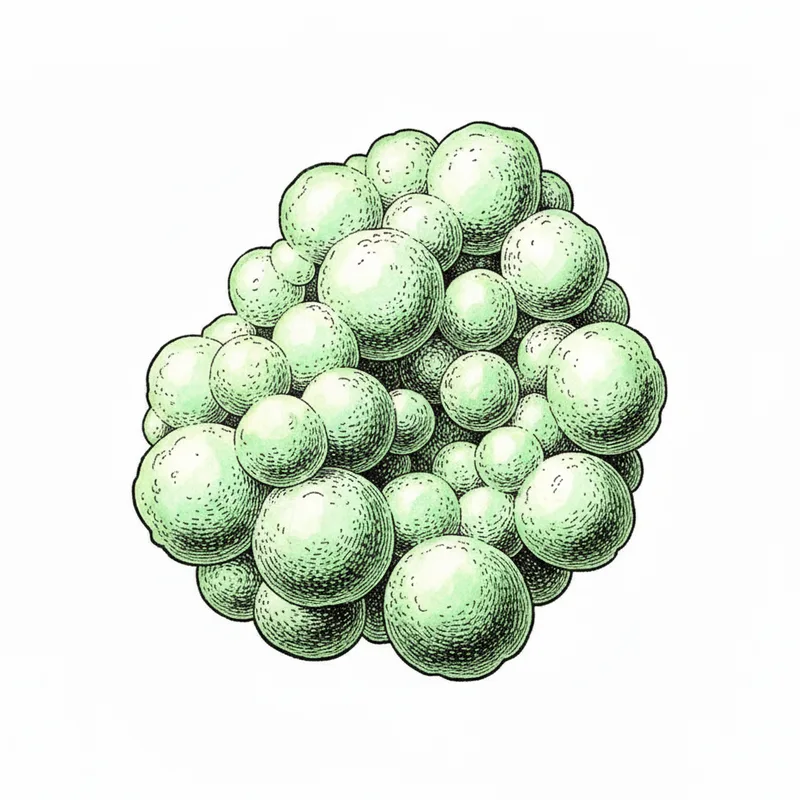
The most spectacular prehnite specimens come from Mali, where translucent, spherical aggregates of gem-quality prehnite form ball-like clusters that glow with an internal yellow-green light. These Malian specimens transformed prehnite's reputation from a modest collector's mineral to a sought-after gem and display specimen.
Identification Guide
Prehnite is identified by its distinctive translucent yellow-green color, botryoidal or spherical crystal habit, and characteristic 'inner glow' when light passes through it. At hardness 6.5, it's moderately hard. The slightly waxy luster on polished surfaces is typical.
Distinguish from peridot (much more vivid green, transparent, higher specific gravity), green chalcedony (different crystal structure, typically more opaque), and jade (much denser, different luster). Prehnite's botryoidal form and gentle luminosity are its most recognizable features.
Spotting Fakes
Prehnite is modestly priced and rarely faked outright. Glass imitations lack the internal glow and natural botryoidal texture. Some green-dyed quartz or chalcedony may be sold as prehnite - genuine prehnite has a specific pale yellow-green tone and translucent depth that dyed material can't replicate convincingly. The botryoidal crystal habit, when present, is diagnostic.
Some links in this post go to Amazon and Etsy. Crystal Almanac earns a commission from qualifying purchases at no extra cost to you. Tools recommended here are ones we would use ourselves to run the tests described - the recommendation comes first, the link is downstream of it.
Cultural & Metaphysical Traditions
Presented as cultural traditions, not scientific evidence
Indigenous South African peoples used prehnite for spiritual divination and prophecy. In modern crystal practice, it's called 'the healer's stone' and is associated with precognition, inner peace, and unconditional love. Its gentle green color connects it to heart-centered healing traditions. Prehnite's relative obscurity compared to mainstream crystals gives it a 'hidden gem' appeal among collectors.
Metaphysical and “healing” associations are cultural traditions, not medical advice or scientific fact. Crystals are not a substitute for professional medical care.
Where It's Found
Stunning gem-grade spherical aggregates
Fine yellow-green nodules
Original discovery locality (1788)
Commercial quantities, often with epidote
Price Guide
Good to Know
Scratch test: At hardness 6.5, Prehnite resists scratching from a knife but can be scratched by quartz. Best for pendants and earrings rather than rings.
Global supply: Found in 4 notable locations worldwide, from Mali to China.
Heft test: Prehnite has average mineral density (2.93). It feels about as heavy as you'd expect from a stone its size.
Common Questions
What is the chemical formula of Prehnite?
The chemical formula of Prehnite is Ca₂Al(AlSi₃O₁₀)(OH)₂.
What is Prehnite's Mohs hardness?
Prehnite has a Mohs hardness of 6.5 on the 1 to 10 Mohs scale, hard enough to scratch glass but softer than quartz.
Is Prehnite a mineral?
Yes. Prehnite is a naturally occurring mineral (Phyllosilicate Group) with a definite chemical composition and an ordered crystal structure.
Care & Safety
The water, salt, and sunlight questions people actually ask before cleansing or displaying prehnite, answered from its hardness (Mohs 6.5) and chemistry (Ca₂Al(AlSi₃O₁₀)(OH)₂).
Can Prehnite go in water?
Yes. Prehnite is not water-soluble and durable enough (Mohs 6.5), so a rinse or a quick wash with mild soap is no problem, cleanse it in water freely if that is your practice. A long soak does nothing for it either way, so skip that, and dry the stone afterward.
Can Prehnite go in salt water?
Not recommended, even though prehnite itself is hard and not water-soluble. Salt is both corrosive and mildly abrasive: it can dull a polished surface, attack metal settings, and crystallize inside small fractures as the stone dries. A quick dip will not destroy prehnite, but rinse it with fresh water afterward and dry it. For routine cleaning, plain water is the kinder choice.
Sources & References
The mineralogical and gemological data on this page is drawn from and can be cross-checked against these external references.
- WikipediaPrehnite on Wikipedia
- WebmineralPrehnite mineral data (Webmineral)
- Handbook of MineralogyPrehnite (Handbook of Mineralogy, PDF)
Related Minerals
Often found together, darker pistachio green
Similar color, different mineral family
More vivid green, different formation
Form in same volcanic cavity environments
Explore More
Save This Stone

Keep this prehnite reference handy. Save the card to a Pinterest board and the profile is one tap away.
Save to PinterestNewsletter
Something shiny, now and then
A stone worth knowing, or a fake worth spotting, every so often. No spam.