Coral
The Garden of the Sea
Affiliate links. We may earn a commission, at no cost to you.
Quick Facts
Formation & Origin
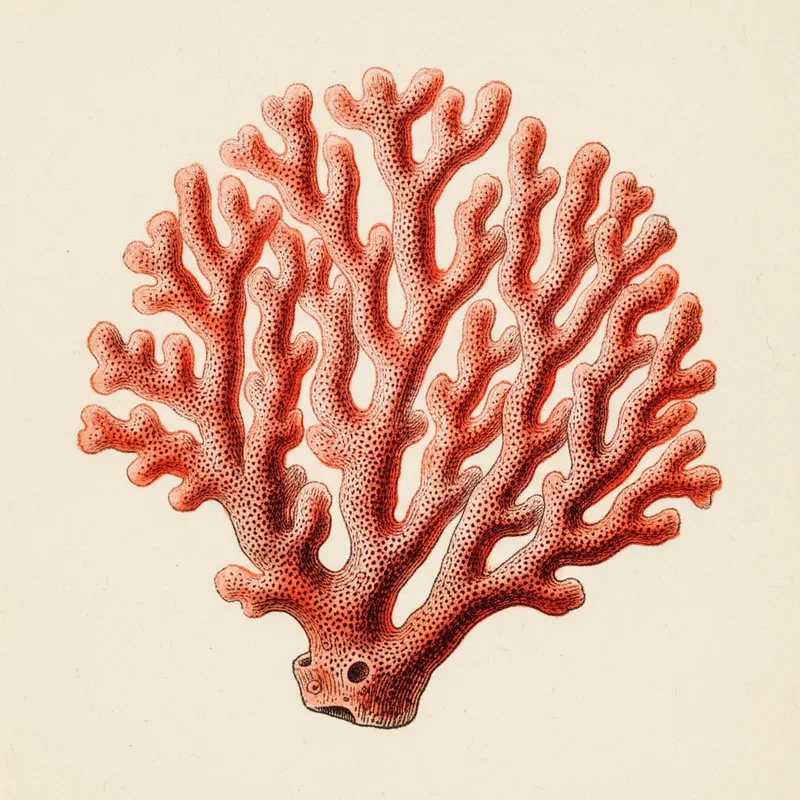
Coral is the skeletal remains of marine invertebrates - tiny colonial animals called polyps that secrete calcium carbonate to build branching, tree-like structures on the ocean floor. Precious coral (the gem variety, primarily Corallium rubrum and related species) grows extremely slowly - roughly 1 millimeter per year - in deep Mediterranean and Pacific waters at depths of 50-300 meters.
The red color that makes precious coral so valuable comes from carotenoid pigments incorporated into the calcium carbonate skeleton. The deeper the red (called 'ox blood' or 'moro'), the more valuable the material. 'Angel skin' coral - a delicate pale pink - is the second most valued variety.
Coral is now one of the most ethically complicated gems. Mediterranean coral populations have been devastated by centuries of harvesting. International regulations (CITES) restrict trade in many coral species. The intersection of gem value, marine conservation, and indigenous cultural practices (coral is sacred in many Pacific Island and Native American traditions) creates ongoing tension. Sustainable harvesting is possible but enforcement is difficult.
Identification Guide
Precious coral is identified by its organic branching structure, warm red-to-pink color, waxy luster, and the fine parallel growth lines visible on the surface when examined under magnification. At hardness 3.5, it's quite soft.
Distinguish from dyed bamboo coral (much cheaper, larger pieces, uniform color), glass imitations (no organic structure, may have bubbles), and plastic (too light, warm to touch, no growth lines). Genuine precious coral has a distinctive fine-grained texture and organic feel that imitations don't replicate.
Spotting Fakes
The coral market is full of substitutes. 'Apple coral' and 'sponge coral' are cheap, dyed materials sold at a fraction of precious coral prices but marketed ambiguously. Bamboo coral (Keratoisis) dyed red is the most common substitute. The key test: genuine precious coral shows fine concentric growth rings in cross-section. Dyed materials show dye concentrated in porous areas. Reconstituted coral (pressed coral powder) lacks the natural growth structure. For valuable pieces, lab reports confirm species identification.
Some links in this post go to Amazon and Etsy. Crystal Almanac earns a commission from qualifying purchases at no extra cost to you. Tools recommended here are ones we would use ourselves to run the tests described - the recommendation comes first, the link is downstream of it.
Cultural & Metaphysical Traditions
Presented as cultural traditions, not scientific evidence
In Italian tradition (particularly southern Italy), red coral horns (cornicello) are worn to ward off the evil eye - one of the most widespread and continuously practiced protective traditions in European folk magic. In Tibetan and Nepali culture, coral is one of the 'three treasures' alongside turquoise and amber. Native American peoples of the Southwest incorporate coral into ceremonial jewelry. In Ayurvedic tradition, red coral (moonga) is associated with Mars energy.
Metaphysical and “healing” associations are cultural traditions, not medical advice or scientific fact. Crystals are not a substitute for professional medical care.
Where It's Found
Historic center of precious red coral trade
Fine deep-red and pink coral
Important modern source
Historic source, heavily depleted
Price Guide
Good to Know
Scratch test: At hardness 3.5, Coral can be scratched with a copper coin. Handle gently and keep away from harder stones in your collection.
Global supply: Found in 4 notable locations worldwide, from Italy to Mediterranean.
Heft test: Coral has average mineral density (2.65). It feels about as heavy as you'd expect from a stone its size.
Common Questions
What is the chemical formula of Coral?
The chemical formula of Coral is CaCO₃ (with organic material).
What is Coral's Mohs hardness?
Coral has a Mohs hardness of 3.5 on the 1 to 10 Mohs scale, soft enough to scratch with a copper coin.
Is Coral a mineral?
No. Coral is an organic gem, not a mineral, because it forms from once-living material rather than purely geological crystallization.
Care & Safety
The water, salt, and sunlight questions people actually ask before cleansing or displaying coral, answered from its hardness (Mohs 3.5) and chemistry (CaCO₃ (with organic material)).
Can Coral go in water?
Not recommended. Calcium carbonate skeleton of marine organisms. Acids, soap, and prolonged water contact damage the surface.
Can Coral go in salt water?
No. Coral is a marine calcium carbonate skeleton, but once polished for jewelry it should stay out of salt water: salt residue abrades the soft surface and degrades the polish. Wipe it with a soft damp cloth instead.
Sources & References
The mineralogical and gemological data on this page is drawn from and can be cross-checked against these external references.
- WikipediaCoral on Wikipedia
Explore More
Organic & Biogenic Gems
The Love Collection
Italian cornicello tradition, Tibetan sacred treasure, and one of the oldest love-protection amulets in Mediterranean culture.
Is It a Mineral? Obsidian, Amber, Pearl, and Opal
How Crystals Form: Pegmatite, Hydrothermal, Sedimentary
Crystal of the Year 2026: Why Carnelian Is Everywhere
Mohs Hardness Scale
See where Coral sits on the scale
Crystal Care Guide
Water safety, sunlight, and handling tips
Save This Stone

Keep this coral reference handy. Save the card to a Pinterest board and the profile is one tap away.
Save to PinterestNewsletter
Something shiny, now and then
A stone worth knowing, or a fake worth spotting, every so often. No spam.