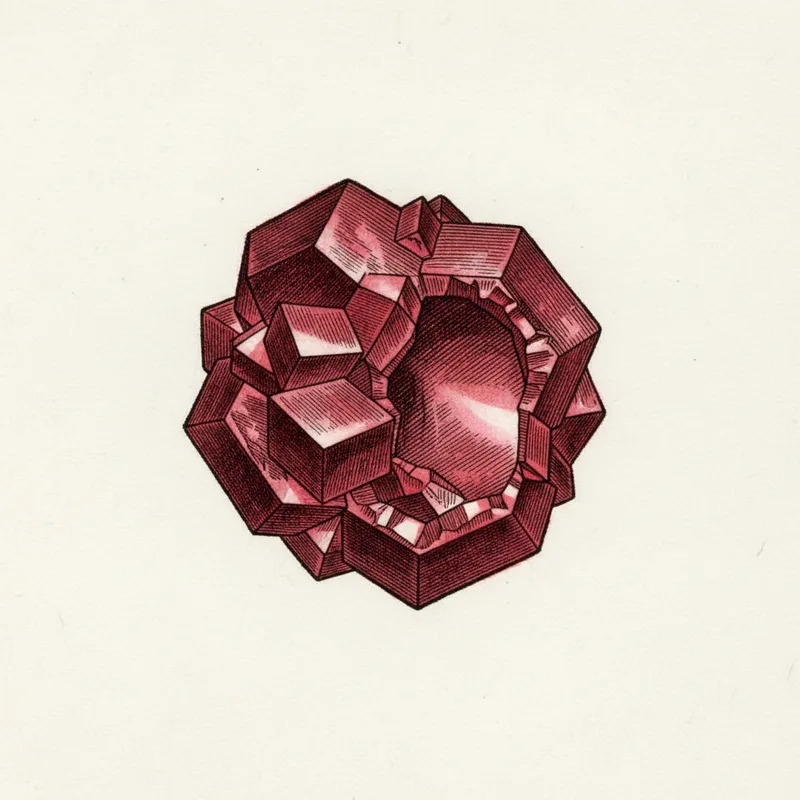
Garnet
The Warrior's Stone
Affiliate links. We may earn a commission, at no cost to you.
Quick Facts
Formation & Origin
Garnet is not a single mineral but a group of closely related silicates that share the same crystal structure but differ in chemistry. They form under conditions of high temperature and pressure - primarily in metamorphic rocks (where existing rocks are transformed by heat and pressure) and in some igneous rocks.
Almandine (red) forms in metamorphic schists and gneisses at moderate to high pressures. Pyrope (deep red) forms at extreme pressures deep in the Earth's mantle and is brought to the surface in kimberlite pipes - the same geological structures that produce diamonds. This is why pyrope garnets are used by diamond prospectors as indicator minerals.
Tsavorite (green) forms in a narrow set of conditions where calcium, aluminum, vanadium, and chromium are all available - conditions met in the metamorphosed graphite-bearing rocks of East Africa. Its rarity, combined with a color that rivals emerald at a fraction of the price, makes it one of the most sought-after colored gemstones.
Identification Guide
Garnets are most reliably identified by their crystal habit (dodecahedrons and trapezohedrons, 12- and 24-faced forms), high hardness (6.5-7.5), lack of cleavage, and high specific gravity. They show no cleavage and fracture conchoidally.
The most common confusion is between garnet and ruby (both can be deep red), but garnet is singly refractive while ruby is doubly refractive, a gemological test that easily distinguishes them. Garnet also tends to be darker and less vivid than ruby. The wide range of garnet colors means specific variety identification often requires gemological testing.
Spotting Fakes
The key test is single refraction: garnets are singly refractive, so viewing through the stone at text shows no doubling, which separates real garnet from the doubling-prone fakes and exposes glass imitations of deep red garnet.
- 'Garnet' beads on the market are sometimes dyed glass; genuine garnet beads feel cool to the touch and are noticeably heavier than glass.
- Rare varieties like demantoid, tsavorite, and color-change garnet should come with lab reports.
Garnets are abundant enough that outright faking is uncommon.
Some links in this post go to Amazon and Etsy. Crystal Almanac earns a commission from qualifying purchases at no extra cost to you. Tools recommended here are ones we would use ourselves to run the tests described - the recommendation comes first, the link is downstream of it.
Cultural & Metaphysical Traditions
Presented as cultural traditions, not scientific evidence
Garnets have been used as gemstones for over 5,000 years. Egyptian pharaohs wore garnet necklaces. Roman signet rings were carved from garnet. Crusaders carried garnets as talismans for safe travel. In medieval Europe, garnets were believed to cure depression and protect against bad dreams. The Victorians popularized Bohemian garnet jewelry, setting clusters of small pyrope garnets in distinctive close-set arrangements.
Metaphysical and “healing” associations are cultural traditions, not medical advice or scientific fact. Crystals are not a substitute for professional medical care.
Where It's Found
Classic almandine garnets, major global source
Tsavorite - the rare green garnet rivaling emerald
Historic pyrope garnet, deep red 'Bohemian garnet'
Diverse garnet varieties including fine rhodolite
Tsavorite discovery site, named after the park
Price Guide
Good to Know
Scratch test: At hardness 7, Garnet can scratch glass and steel. It's durable enough for any type of jewelry.
Global supply: Found in 5 notable locations worldwide, from India to Kenya.
Heft test: Garnet has a specific gravity of 3.50-4.30 - noticeably heavier than quartz. You'll feel the density when you pick it up.
Common Questions
What is the chemical formula of Garnet?
The chemical formula of Garnet is X₃Y₂(SiO₄)₃.
What is Garnet's Mohs hardness?
Garnet has a Mohs hardness of 7 on the 1 to 10 Mohs scale, hard enough to scratch glass and stand up to daily wear.
Is Garnet a mineral?
Yes. Garnet is a naturally occurring mineral (Garnet Group) with a definite chemical composition and an ordered crystal structure.
Care & Safety
The water, salt, and sunlight questions people actually ask before cleansing or displaying garnet, answered from its hardness (Mohs 7) and chemistry (X₃Y₂(SiO₄)₃).
Can Garnet go in water?
Yes. Garnet is hard (Mohs 7) and chemically stable, so a rinse or a quick wash with mild soap is no problem, cleanse it in water freely if that is your practice. A long soak does nothing for it either way, so skip that, and dry the stone afterward.
Can Garnet go in salt water?
Not recommended, even though garnet itself is hard and not water-soluble. Salt is both corrosive and mildly abrasive: it can dull a polished surface, attack metal settings, and crystallize inside small fractures as the stone dries. A quick dip will not destroy garnet, but rinse it with fresh water afterward and dry it. For routine cleaning, plain water is the kinder choice.
Sources & References
The mineralogical and gemological data on this page is drawn from and can be cross-checked against these external references.
Explore More
Garnet Group
The Grounding Collection
Deep red, dense, and ancient. Associated with root chakra stability and physical vitality across Hindu and Western traditions.
The Confidence Collection
The warrior's gem. Medieval knights set garnet in sword hilts. Its deep red color and high density suggest concentrated, reliable power - confidence with substance behind it.
The Healing Collection
Placed in wounds by medieval healers to stop bleeding. The deep red color associated with blood and vitality made it a standard healing stone across European traditions.
Scorpio Season Crystals 2026: Stones for Transformation
How to Protect Crystals from Summer Heat and Sunlight
Is It a Mineral? Obsidian, Amber, Pearl, and Opal
Mohs Hardness Scale
See where Garnet sits on the scale
Crystal Care Guide
Water safety, sunlight, and handling tips
Save This Stone

Keep this garnet reference handy. Save the card to a Pinterest board and the profile is one tap away.
Save to PinterestNewsletter
Something shiny, now and then
A stone worth knowing, or a fake worth spotting, every so often. No spam.