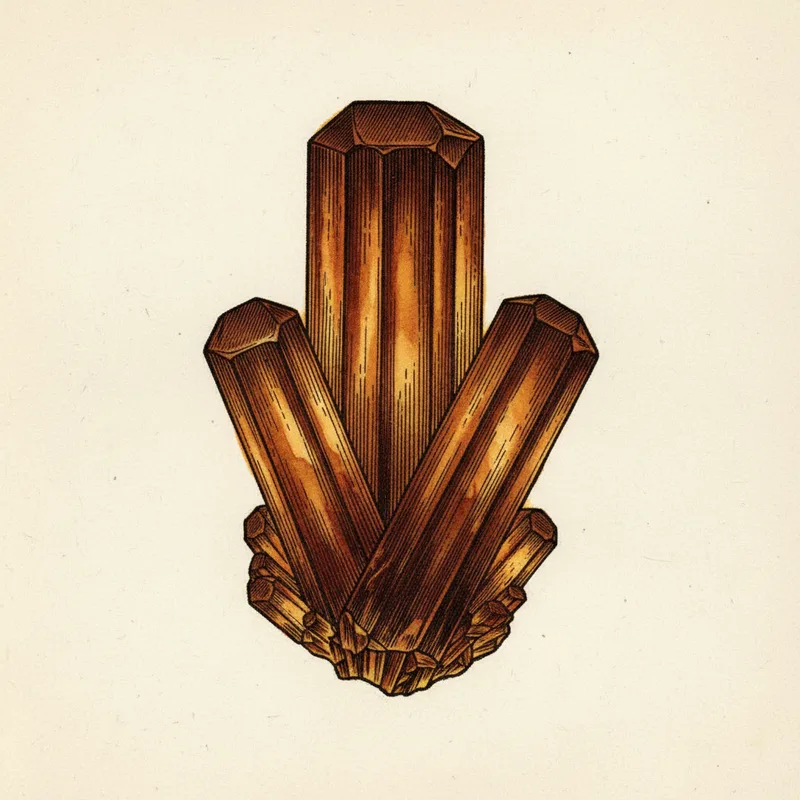
Tourmaline
The Rainbow Stone
Affiliate links. We may earn a commission, at no cost to you.
Quick Facts
Formation & Origin
Tourmaline is a group of complex boron silicate (borosilicate) minerals that share a common structure but vary widely in composition and color. Tourmaline forms primarily in granitic pegmatites - the last pockets of mineral-rich fluid that crystallize as a granite body cools. These pegmatite fluids are enriched in boron, lithium, and other volatile elements that don't easily fit into the crystal structures of common rock-forming minerals. As the fluid cools below about 600 degrees Celsius, tourmaline crystallizes, incorporating whatever trace elements are available.
This is why tourmaline comes in virtually every color. Iron produces black (schorl) and green. Manganese creates pink and red (rubellite). Copper - in the rarest and most valuable variety, Paraiba tourmaline - produces an electric neon blue-green unlike anything else in the gem world. Some crystals even show multiple colors, changing from green on the outside to pink in the center ('watermelon' tourmaline) as the chemistry of the fluid changed during growth.
Tourmaline is also piezoelectric and pyroelectric - it generates an electrical charge when squeezed or heated. This property was known to Dutch traders, who used heated tourmaline crystals to pull ash from their pipes, calling it 'aschentrekker' (ash puller).
Identification Guide
Tourmaline's elongated, striated prismatic crystals with a distinctive rounded triangular cross-section are its most diagnostic feature. No other common mineral shows this cross-sectional shape. At 7-7.5 Mohs hardness, it's durable enough for all jewelry applications.
Color alone is unreliable for identification since tourmaline spans every hue, but the combination of crystal shape, hardness, and lack of cleavage is definitive. Many tourmaline crystals show pleochroism - they appear different colors when viewed from different angles. Looking down the length of a green tourmaline crystal, it often appears much darker than when viewed from the side.
Spotting Fakes
Glass imitations exist but lack tourmaline's pleochroism and characteristic striations. Lab-grown tourmaline is not commercially available (unlike synthetic ruby or sapphire), so any genuine tourmaline is natural. The main concern is treatment disclosure: many pink and red tourmalines are heated to improve color, and some green stones are irradiated. Paraiba tourmaline commands extreme prices ($5,000-50,000+ per carat) and should always come with a gemological lab report confirming copper content.
Some links in this post go to Amazon and Etsy. Crystal Almanac earns a commission from qualifying purchases at no extra cost to you. Tools recommended here are ones we would use ourselves to run the tests described - the recommendation comes first, the link is downstream of it.
Cultural & Metaphysical Traditions
Presented as cultural traditions, not scientific evidence
Ancient Sinhalese believed tourmaline came from the sun and acquired rainbow colors on its journey to Earth. In Africa, tourmaline was traditionally used as a scrying stone. Black tourmaline (schorl) has been carried as a protective amulet across many cultures. Modern practitioners assign different properties to each color variety, making tourmaline one of the most versatile crystals in the wellness market.
Metaphysical and “healing” associations are cultural traditions, not medical advice or scientific fact. Crystals are not a substitute for professional medical care.
Where It's Found
Paraiba tourmaline - the world's most valuable variety
Vivid pink and blue crystals from pegmatites
Fine indicolite and green tourmaline
Classic American gem tourmaline localities
Paraiba-type copper-bearing tourmaline
Price Guide
Good to Know
Scratch test: At hardness 7.5, Tourmaline can scratch glass and steel. It's durable enough for any type of jewelry.
Global supply: Found in 5 notable locations worldwide, from Brazil to Mozambique.
Heft test: Tourmaline has average mineral density (3.06). It feels about as heavy as you'd expect from a stone its size.
Common Questions
What is the chemical formula of Tourmaline?
The chemical formula of Tourmaline is (Na,Ca)(Li,Mg,Fe,Al)₃Al₆(BO₃)₃Si₆O₁₈(OH)₄.
What is Tourmaline's Mohs hardness?
Tourmaline has a Mohs hardness of 7.5 on the 1 to 10 Mohs scale, hard enough to scratch glass and stand up to daily wear.
Is Tourmaline a mineral?
Yes. Tourmaline is a naturally occurring mineral (Borosilicate Group) with a definite chemical composition and an ordered crystal structure.
Care & Safety
The water, salt, and sunlight questions people actually ask before cleansing or displaying tourmaline, answered from its hardness (Mohs 7.5) and chemistry ((Na,Ca)(Li,Mg,Fe,Al)₃Al₆(BO₃)₃Si₆O₁₈(OH)₄).
Can Tourmaline go in water?
Yes. Tourmaline is hard (Mohs 7.5) and chemically stable, so a rinse or a quick wash with mild soap is no problem, cleanse it in water freely if that is your practice. A long soak does nothing for it either way, so skip that, and dry the stone afterward.
Can Tourmaline go in salt water?
Not recommended, even though tourmaline itself is hard and not water-soluble. Salt is both corrosive and mildly abrasive: it can dull a polished surface, attack metal settings, and crystallize inside small fractures as the stone dries. Tourmaline's iron content also makes rust staining likely if salt residue sits on the surface. A quick dip will not destroy tourmaline, but rinse it with fresh water afterward and dry it. For routine cleaning, plain water is the kinder choice.
Sources & References
The mineralogical and gemological data on this page is drawn from and can be cross-checked against these external references.
Related Minerals
Similar pegmatite origin, includes emerald
Another pegmatite gem mineral
Lithium mineral from same pegmatite environments
Paraiba-colored apatite often confused with tourmaline
Explore More
Tourmaline Group
Scorpio Season Crystals 2026: Stones for Transformation
Libra Season Crystals 2026: Stones for Balance
October Birthstones: Opal and Tourmaline
Mohs Hardness Scale
See where Tourmaline sits on the scale
Crystal Care Guide
Water safety, sunlight, and handling tips
Save This Stone

Keep this tourmaline reference handy. Save the card to a Pinterest board and the profile is one tap away.
Save to PinterestNewsletter
Something shiny, now and then
A stone worth knowing, or a fake worth spotting, every so often. No spam.