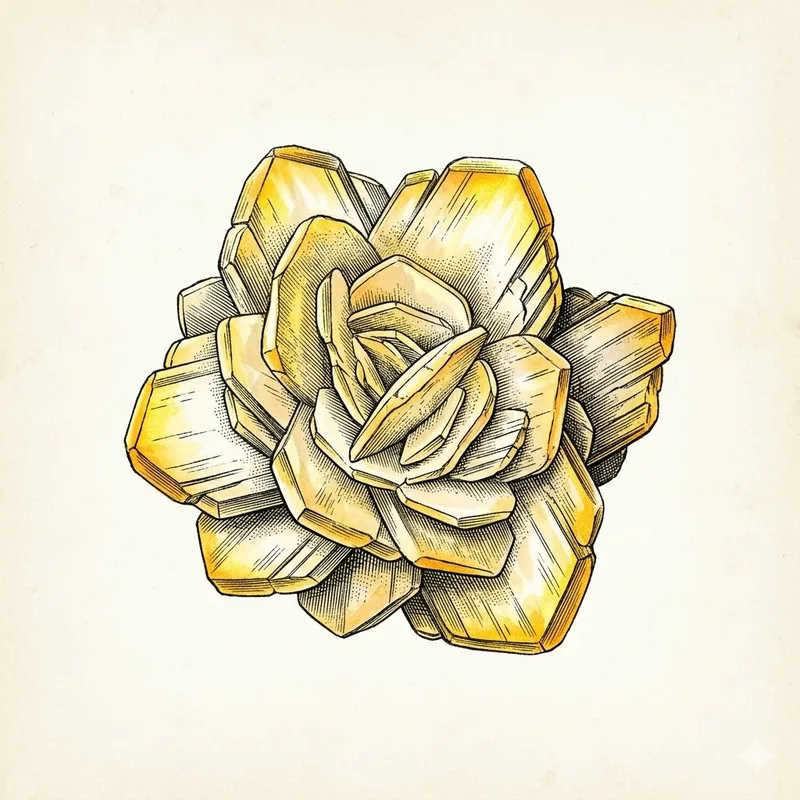
Barite
The Heavy Spar
Affiliate links. We may earn a commission, at no cost to you.
Quick Facts
Formation & Origin
Barite is a barium sulfate mineral (BaSO₄), notable for its high density, which earned it the old name heavy spar. Barite precipitates from barium-rich fluids, typically in hydrothermal veins, sedimentary deposits, and as a gangue mineral alongside metallic ores. It can also form at the interface of barium-bearing groundwater and sulfate-rich water.
The variety of crystal forms is remarkable. In Morocco, thin tabular crystals grow in spectacular clusters on lead mineral substrates. In South Dakota, barite forms rosette-shaped concretions within clay deposits as barium-rich groundwater meets sulfate in the soil. In England's Lake District, honey-yellow and blue crystals formed in lead-zinc veins alongside fluorite and galena.
Barite is the primary ore of barium and has a major industrial use: its extreme density (4.48 g/cm³, making it noticeably heavy) makes it the preferred weighting agent for drilling mud in oil and gas exploration. Over 80% of barite produced globally goes to the petroleum industry.
Identification Guide
Barite's most distinctive feature is its surprisingly high density for a non-metallic mineral. Pick up a barite specimen and it feels much heavier than expected. This, combined with relatively low hardness (3.5) and tabular or prismatic crystal habit, makes identification straightforward.
Distinguish from celestite (very similar but lighter SG of 3.95, often blue), calcite (lower SG, effervesces in acid), and feldspar (harder, different cleavage). Barite has perfect cleavage in two directions at nearly 90 degrees.
Spotting Fakes
Barite is not commonly faked. The main confusion is with celestite (strontium sulfate), which looks very similar, especially in blue specimens. A density test resolves this: barite (4.48) is noticeably heavier than celestite (3.95). Some commercial sellers may label celestite as barite or vice versa. The famous 'desert rose' formations from Oklahoma are often barite, while similar formations from the Sahara are often gypsum.
Some links in this post go to Amazon and Etsy. Crystal Almanac earns a commission from qualifying purchases at no extra cost to you. Tools recommended here are ones we would use ourselves to run the tests described - the recommendation comes first, the link is downstream of it.
Cultural & Metaphysical Traditions
Presented as cultural traditions, not scientific evidence
Crystal practitioners associate barite with dream recall and interdimensional travel. Its heaviness is seen as grounding while its clarity opens higher perception. Blue barite in particular is connected to throat chakra expression and honest communication. Some traditions use it for clearing confusion and connecting to inner truth.
Metaphysical and “healing” associations are cultural traditions, not medical advice or scientific fact. Crystals are not a substitute for professional medical care.
Where It's Found
Exceptional blue tabular crystals on cerussite
Famous golden barite rosettes in concretions
Classic blue and golden crystals
Fine crystal specimens, historical mines
Price Guide
Good to Know
Scratch test: At hardness 3.5, Barite can be scratched with a copper coin. Handle gently and keep away from harder stones in your collection.
Global supply: Found in 4 notable locations worldwide, from Morocco to Romania.
Heft test: Barite has a specific gravity of 4.48 - noticeably heavier than quartz. You'll feel the density when you pick it up.
Common Questions
What is the chemical formula of Barite?
The chemical formula of Barite is BaSO₄.
What is Barite's Mohs hardness?
Barite has a Mohs hardness of 3.5 on the 1 to 10 Mohs scale, soft enough to scratch with a copper coin.
Is Barite a mineral?
Yes. Barite is a naturally occurring mineral (Sulfate Mineral) with a definite chemical composition and an ordered crystal structure.
Care & Safety
The water, salt, and sunlight questions people actually ask before cleansing or displaying barite, answered from its hardness (Mohs 3.5) and chemistry (BaSO₄).
Can Barite go in water?
Only briefly. A quick rinse under running water is fine for barite, but do not let it soak or sit submerged. At Mohs 3.5 it is tough enough for a rinse but not for a long soak. Dry it thoroughly afterward.
Can Barite go in salt water?
No. Barite can take a brief fresh-water rinse and nothing more, and salt water is harder on it both ways: corrosive while wet, then abrasive as the salt dries into crystals. If it does meet salt water, rinse it with fresh water and dry it promptly.
Sources & References
The mineralogical and gemological data on this page is drawn from and can be cross-checked against these external references.
- WikipediaBaryte on Wikipedia
- WebmineralBarite mineral data (Webmineral)
Explore More
Save This Stone
%2C%20which%20looks%20very%20similar%2C%20especially%20in%20blue%20specimens.%20Meaning%2C%20properties%20%26%20how%20to%20spot%20fakes%20at%20Crystal%20Almanac.)
Keep this barite reference handy. Save the card to a Pinterest board and the profile is one tap away.
Save to PinterestNewsletter
Something shiny, now and then
A stone worth knowing, or a fake worth spotting, every so often. No spam.