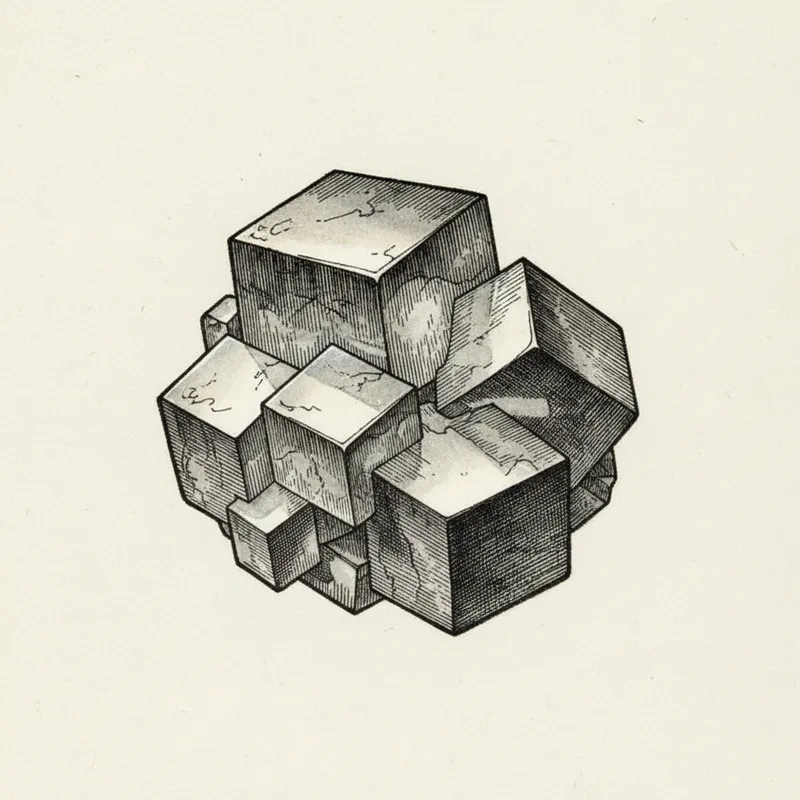
Galena
The Mirror Stone
Affiliate links. We may earn a commission, at no cost to you.
Quick Facts
Formation & Origin
Galena is the primary ore mineral of lead and one of the most abundant sulfide minerals on Earth. It forms in hydrothermal veins associated with zinc, copper, and silver ore deposits, and in sedimentary environments where metal-rich brines interact with sulfur-bearing fluids. The Mississippi Valley-type deposits of the American Midwest produced enormous quantities of galena from limestone-hosted ore bodies.
Galena crystallizes as near-perfect cubes - it has the cubic crystal system and perfect cubic cleavage, meaning it breaks into smaller and smaller cubes when struck. This cubic perfection makes galena one of the most geometrically satisfying minerals in any collection. The metallic luster on fresh cleavage surfaces is mirror-bright.
Galena frequently contains silver (sometimes several percent by weight), which made galena mining economically important for silver production as well as lead. The extraction of silver from galena ore (cupellation) was one of the earliest metallurgical processes, practiced since at least 3000 BCE.
Identification Guide
Galena is identified by its lead-gray color, extreme density (7.58 - it feels very heavy), perfect cubic cleavage, metallic luster, and softness (2.5 - scratched by a fingernail with effort). The cubic cleavage is the most diagnostic feature.
Distinguish from stibnite (bladed crystals, not cubic), molybdenite (foliated, bluish gray), and other metallic gray minerals. Galena's cubic cleavage and exceptional weight immediately identify it. CAUTION: Galena contains lead. Wash hands after handling and do not ingest or inhale dust.
Spotting Fakes
Galena is common and inexpensive, so faking is unnecessary. The main concern is safety rather than authenticity - galena is lead sulfide and should be handled with basic precautions (wash hands, don't let children mouth specimens, store separately from food). Some sellers fail to mention the lead content. Well-crystallized specimens from classic localities command modest premiums. Very large perfect cubes are natural and characteristic of galena.
Some links in this post go to Amazon and Etsy. Crystal Almanac earns a commission from qualifying purchases at no extra cost to you. Tools recommended here are ones we would use ourselves to run the tests described - the recommendation comes first, the link is downstream of it.
Cultural & Metaphysical Traditions
Presented as cultural traditions, not scientific evidence
Galena was used in ancient Egypt as kohl - ground galena was applied as eye makeup. While this sounds dangerous (lead!), the lead sulfide actually has mild antimicrobial properties and provided some protection against eye infections common in dusty, sunny environments. The Romans used galena as a lead ore for plumbing (the word 'plumbing' comes from 'plumbum,' Latin for lead). Modern crystal practitioners associate galena with grounding and self-transformation, though they should always note the lead content in safety advisories.
Metaphysical and “healing” associations are cultural traditions, not medical advice or scientific fact. Crystals are not a substitute for professional medical care.
Where It's Found
Classic cubes, major historic producer
Exceptional crystal specimens
Fine specimens, often with pyrite
Historic mining, classic specimens
Price Guide
Good to Know
Scratch test: At hardness 2.5, Galena can be scratched with a fingernail. This is a display specimen, not a wearable stone.
Global supply: Found in 4 notable locations worldwide, from United States to United Kingdom.
Heft test: With a specific gravity of 7.58, Galena feels surprisingly heavy for its size. This weight is actually a useful identification tool.
Common Questions
What is the chemical formula of Galena?
The chemical formula of Galena is PbS.
What is Galena's Mohs hardness?
Galena has a Mohs hardness of 2.5 on the 1 to 10 Mohs scale, soft enough to scratch with a fingernail.
Is Galena a mineral?
Yes. Galena is a naturally occurring mineral (Sulfide Group) with a definite chemical composition and an ordered crystal structure.
Care & Safety
The water, salt, and sunlight questions people actually ask before cleansing or displaying galena, answered from its hardness (Mohs 2.5) and chemistry (PbS).
Can Galena go in water?
Not recommended. Contains lead. Avoid water exposure as lead can leach. Wash hands after handling. Important: galena contains lead. Never use it for gem elixirs or crystal-infused water, and wash your hands after handling it.
Can Galena go in salt water?
No. Galena is best kept away from water altogether, and salt water is the harsher version of that problem: the dissolved salt is corrosive while the stone is wet, then leaves gritty crystals behind in cracks and crevices as it dries.
Sources & References
The mineralogical and gemological data on this page is drawn from and can be cross-checked against these external references.
- WikipediaGalena on Wikipedia
- WebmineralGalena mineral data (Webmineral)
- Handbook of MineralogyGalena (Handbook of Mineralogy, PDF)
Explore More
Sulfide Minerals
How to Identify a Crystal by Its Mineral Group
Best Crystals for Meditation: A Science-First Guide
How Crystals Form: Pegmatite, Hydrothermal, Sedimentary
Mohs Hardness Scale
See where Galena sits on the scale
Crystal Care Guide
Water safety, sunlight, and handling tips
Save This Stone

Keep this galena reference handy. Save the card to a Pinterest board and the profile is one tap away.
Save to PinterestNewsletter
Something shiny, now and then
A stone worth knowing, or a fake worth spotting, every so often. No spam.