Sugilite
The Healer's Stone of the Violet Ray
Affiliate links. We may earn a commission, at no cost to you.
Quick Facts
Formation & Origin
Sugilite is a rare potassium sodium lithium iron manganese aluminum silicate - its complex chemistry reflects the unusual geological conditions required to form it. It was first discovered on Iwagi Island, Japan in 1944 by Ken-ichi Sugi (for whom it was named), but those specimens were tiny and non-gem-quality.
The gem-grade sugilite that transformed its market status was discovered in 1979 in the Wessels manganese mine in South Africa's Kalahari Desert. Here, sugilite formed in a manganese-rich stratiform deposit where the complex chemistry of lithium, potassium, and manganese converged under specific metamorphic conditions. The purple color comes primarily from manganese.
Gem-quality sugilite is genuinely rare - the Wessels Mine remains the only significant source, and production is limited. The finest material - translucent, vivid purple with no matrix - commands prices that rival many traditional precious gems.
Identification Guide
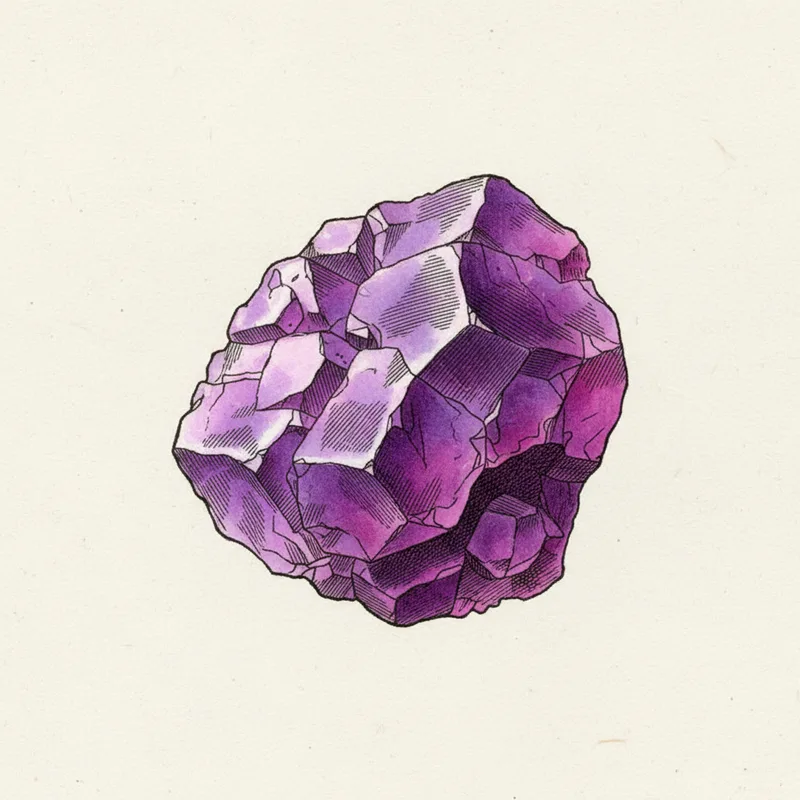
Sugilite is identified by its deep purple to magenta color with a waxy to vitreous luster. At hardness 5.5-6.5, it's moderately durable. The color tends to be more uniform and waxy than amethyst (which is transparent and glassy) and lacks the swirling pattern of charoite.
Distinguish from charoite (swirled fibrous texture), amethyst (transparent, crystalline), lepidolite (flaky mica texture), and dyed purple howlite or magnesite (check for dye in cracks). Genuine sugilite has a distinctive 'gel' quality - the finest pieces look almost like solidified purple liquid.
Spotting Fakes
Dyed purple howlite and magnesite are the most common sugilite substitutes. The dye test works: check for color concentrated in cracks and around drill holes. Genuine sugilite has an even, deep purple that extends uniformly through the material. Some 'sugilite' on the market is actually purpurite or dyed jasper. Given its value, any significant sugilite purchase should come from a reputable mineral dealer with locality information.
Some links in this post go to Amazon and Etsy. Crystal Almanac earns a commission from qualifying purchases at no extra cost to you. Tools recommended here are ones we would use ourselves to run the tests described - the recommendation comes first, the link is downstream of it.
Cultural & Metaphysical Traditions
Presented as cultural traditions, not scientific evidence
Sugilite's relatively recent discovery (1944/1979) means it has no ancient traditional associations. Modern crystal practitioners have enthusiastically adopted it, calling it one of the premier healing stones - particularly associated with the 'violet flame' of spiritual protection and transformation. Its rarity and vivid color have made it one of the most expensive crystals in the wellness market.
Metaphysical and “healing” associations are cultural traditions, not medical advice or scientific fact. Crystals are not a substitute for professional medical care.
Where It's Found
Primary gem-grade source, manganese deposits
Original discovery locality (1944), tiny specimens
Minor occurrences, not gem quality
Small specimens, collector interest only
Price Guide
Good to Know
Scratch test: At hardness 6, Sugilite resists scratching from a knife but can be scratched by quartz. Best for pendants and earrings rather than rings.
Global supply: Found in 4 notable locations worldwide, from South Africa to Canada.
Heft test: Sugilite has average mineral density (2.74). It feels about as heavy as you'd expect from a stone its size.
Common Questions
What is the chemical formula of Sugilite?
The chemical formula of Sugilite is KNa₂(Fe,Mn,Al)₂Li₃Si₁₂O₃₀.
What is Sugilite's Mohs hardness?
Sugilite has a Mohs hardness of 6 on the 1 to 10 Mohs scale, hard enough to scratch glass but softer than quartz.
Is Sugilite a mineral?
Yes. Sugilite is a naturally occurring mineral (Cyclosilicate Group) with a definite chemical composition and an ordered crystal structure.
Care & Safety
The water, salt, and sunlight questions people actually ask before cleansing or displaying sugilite, answered from its hardness (Mohs 6) and chemistry (KNa₂(Fe,Mn,Al)₂Li₃Si₁₂O₃₀).
Can Sugilite go in water?
Yes. Sugilite is not water-soluble and durable enough (Mohs 6), so a rinse or a quick wash with mild soap is no problem, cleanse it in water freely if that is your practice. A long soak does nothing for it either way, so skip that, and dry the stone afterward.
Can Sugilite go in salt water?
Not recommended, even though sugilite itself is hard and not water-soluble. Salt is both corrosive and mildly abrasive: it can dull a polished surface, attack metal settings, and crystallize inside small fractures as the stone dries. Sugilite's iron content also makes rust staining likely if salt residue sits on the surface. A quick dip will not destroy sugilite, but rinse it with fresh water afterward and dry it. For routine cleaning, plain water is the kinder choice.
Sources & References
The mineralogical and gemological data on this page is drawn from and can be cross-checked against these external references.
- WikipediaSugilite on Wikipedia
- WebmineralSugilite mineral data (Webmineral)
- Handbook of MineralogySugilite (Handbook of Mineralogy, PDF)
Explore More
Other Silicates & Gems
The Healing Collection
The 'love stone of this age.' Discovered in 1944, it quickly became central to crystal healing traditions for cancer support. Associated with unconditional self-love during illness.
How to Identify a Crystal by Its Mineral Group
Lepidolite for Anxiety: Science vs. Lore
Crystal Colors and Their Meanings: A Stone-by-Color Guide
Mohs Hardness Scale
See where Sugilite sits on the scale
Crystal Care Guide
Water safety, sunlight, and handling tips
Save This Stone

Keep this sugilite reference handy. Save the card to a Pinterest board and the profile is one tap away.
Save to PinterestNewsletter
Something shiny, now and then
A stone worth knowing, or a fake worth spotting, every so often. No spam.