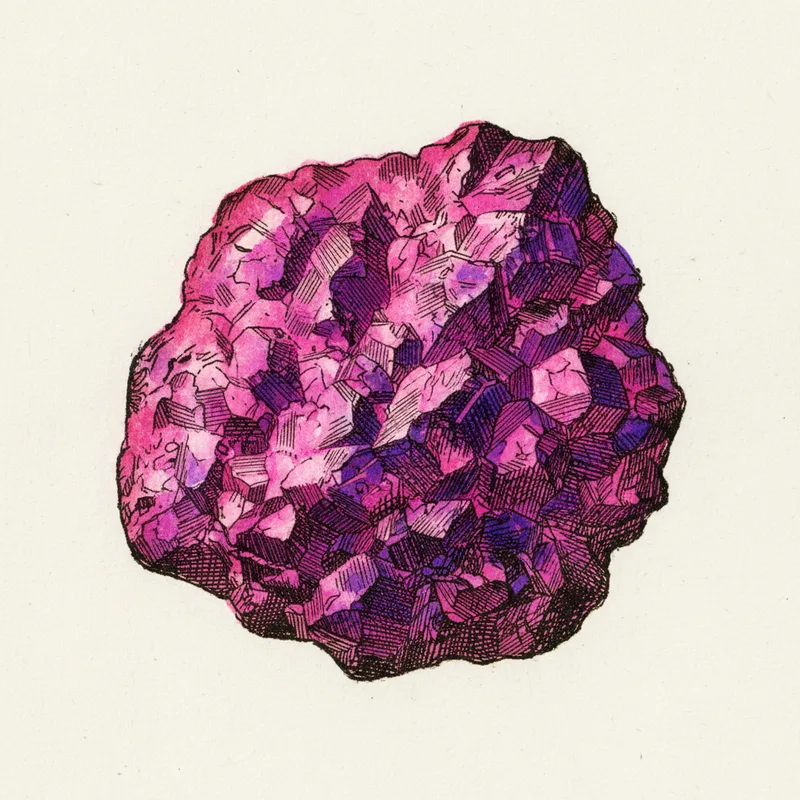
Purpurite
The Violet Phosphate
Affiliate links. We may earn a commission, at no cost to you.
Quick Facts
Formation & Origin
Purpurite is a manganese-iron phosphate mineral ((Mn³⁺,Fe³⁺)PO₄), distinguished by its deep violet-purple color. Purpurite forms through the oxidation and weathering of lithiophilite, a lithium-manganese-iron phosphate found in granitic pegmatites. When lithiophilite is exposed to weathering, lithium is leached out and the remaining manganese oxidizes from Mn²⁺ to Mn³⁺, creating the deep purple color.
The transformation can be written as a chemical weathering sequence: lithiophilite (gray-brown) weathers to purpurite (purple) as lithium departs and manganese oxidizes. If the original mineral was triphylite (the iron-dominant end member), the weathering product is heterosite (dark purple to black).
Purpurite's rich violet-purple color is among the most saturated natural purples in the mineral kingdom. The manganese(III) chromophore produces a deep, warm purple distinct from the cooler violet of amethyst or the blue-purple of charoite.
Identification Guide
Purpurite is identified by its deep violet-purple color, purple streak (unusual among minerals), matte to satiny luster, and association with weathered pegmatite phosphates. Hardness around 4.5 and the distinctive purple streak are diagnostic.
Distinguish from sugilite (harder, different association), charoite (harder, swirling patterns), and dyed howlite or magnesite (check hardness and streak). Purpurite's purple streak on unglazed porcelain is its most reliable identifier.
Spotting Fakes
Dyed magnesite or howlite in purple is sometimes sold as purpurite. Genuine purpurite has a distinctive matte to satiny luster rather than the porcelain gloss of dyed howlite. The purple streak test is definitive: purpurite leaves a purple streak, while dyed stones typically leave a white streak with possible dye transfer. Natural purpurite also tends to be heavier than howlite due to higher specific gravity.
Some links in this post go to Amazon and Etsy. Crystal Almanac earns a commission from qualifying purchases at no extra cost to you. Tools recommended here are ones we would use ourselves to run the tests described - the recommendation comes first, the link is downstream of it.
Cultural & Metaphysical Traditions
Presented as cultural traditions, not scientific evidence
Purpurite is associated with freedom, confidence in public speaking, and breaking free from unhealthy patterns. The deep purple connects it to spiritual awareness and higher consciousness. Practitioners use it for overcoming social anxiety, asserting personal boundaries, and connecting with spiritual guides.
Metaphysical and “healing” associations are cultural traditions, not medical advice or scientific fact. Crystals are not a substitute for professional medical care.
Where It's Found
Major commercial source for polished pieces
Good quality massive specimens
Classic European locality
Pegmatite occurrences
Price Guide
Good to Know
Scratch test: At hardness 4.5, Purpurite can be scratched with a copper coin. Handle gently and keep away from harder stones in your collection.
Global supply: Found in 4 notable locations worldwide, from Namibia to United States.
Heft test: Purpurite has average mineral density (3.2-3.4). It feels about as heavy as you'd expect from a stone its size.
Common Questions
What is the chemical formula of Purpurite?
The chemical formula of Purpurite is (Mn³⁺,Fe³⁺)PO₄.
What is Purpurite's Mohs hardness?
Purpurite has a Mohs hardness of 4.5 on the 1 to 10 Mohs scale, which a steel knife will scratch.
Is Purpurite a mineral?
Yes. Purpurite is a naturally occurring mineral (Phosphate Mineral) with a definite chemical composition and an ordered crystal structure.
Care & Safety
The water, salt, and sunlight questions people actually ask before cleansing or displaying purpurite, answered from its hardness (Mohs 4.5) and chemistry ((Mn³⁺,Fe³⁺)PO₄).
Can Purpurite go in water?
Only briefly. A quick rinse under running water is fine for purpurite, but do not let it soak or sit submerged. At Mohs 4.5 it is tough enough for a rinse but not for a long soak. Dry it thoroughly afterward.
Can Purpurite go in salt water?
No. Purpurite can take a brief fresh-water rinse and nothing more, and salt water is harder on it both ways: corrosive while wet, then abrasive as the salt dries into crystals. Purpurite's iron content also makes rust staining likely if salt residue sits on the surface. If it does meet salt water, rinse it with fresh water and dry it promptly.
Sources & References
The mineralogical and gemological data on this page is drawn from and can be cross-checked against these external references.
- WikipediaPurpurite on Wikipedia
- WebmineralPurpurite mineral data (Webmineral)
- Handbook of MineralogyPurpurite (Handbook of Mineralogy, PDF)
Related Minerals
Unweathered parent mineral
Iron-rich counterpart of purpurite
Another purple mineral, different formation
Explore More
Save This Stone

Keep this purpurite reference handy. Save the card to a Pinterest board and the profile is one tap away.
Save to PinterestNewsletter
Something shiny, now and then
A stone worth knowing, or a fake worth spotting, every so often. No spam.