Lepidolite
The Peace Stone
Affiliate links. We may earn a commission, at no cost to you.
Quick Facts
Formation & Origin
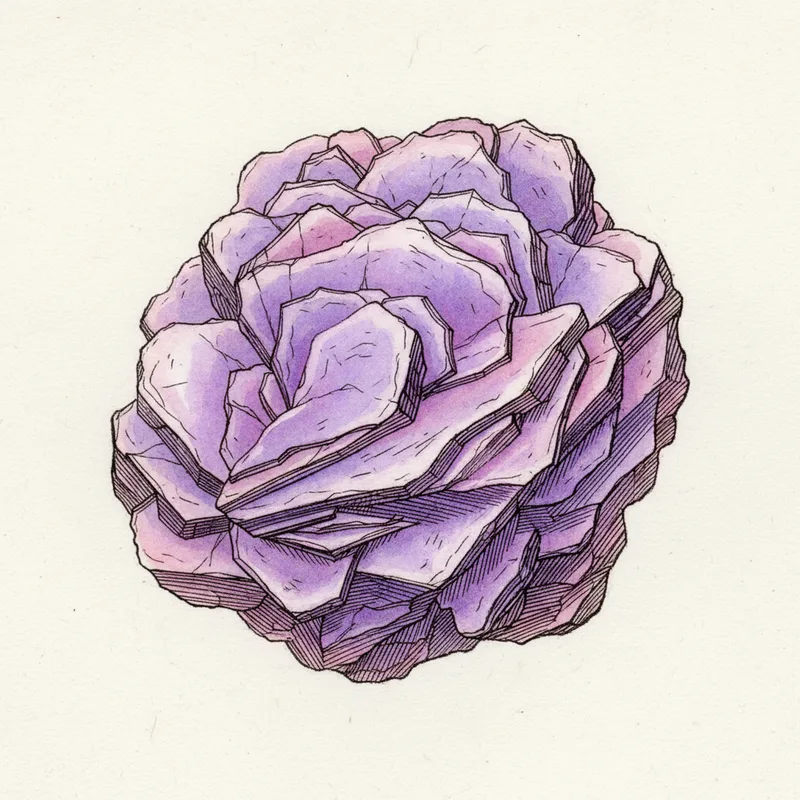
Lepidolite is a lithium-bearing mica that forms in granitic pegmatites - the same boron and lithium-enriched environments that produce tourmaline, spodumene, and other lithium minerals. Its purple color comes from its lithium and manganese content.
As a mica, lepidolite has a layered crystal structure - thin sheets that can be peeled apart, just like muscovite (the clear mica in granite). But unlike common micas, lepidolite contains significant lithium, making it one of the most important lithium ore minerals. With the surge in lithium demand for batteries, lepidolite deposits that were historically mined only for their mineral specimens are now being evaluated as lithium sources.
Lepidolite often occurs as massive, fine-grained aggregates that polish well - these are the pieces most commonly seen in the crystal market. Large individual crystals are much rarer and are prized by mineral collectors.
Identification Guide
Lepidolite is identified by its distinctive lilac to purple color combined with a pearly, flaky mica texture. It's soft (2.5 Mohs, scratchable with a fingernail) and has perfect basal cleavage - it separates into thin flexible sheets.
Distinguish from amethyst (much harder, crystalline, transparent), charoite (swirled pattern, harder), and sugilite (harder, waxy luster, no flaky texture). The mica texture - visible flakes and sheets - is diagnostic. If a purple mineral flakes when you run your nail across it, it's likely lepidolite.
Spotting Fakes
Lepidolite is inexpensive and distinctive enough that faking is rare. The main caution is that polished lepidolite can be fragile - the mica structure means it can delaminate (separate into layers) along cleavage planes, especially if thin. Some sellers coat lepidolite with resin or lacquer to stabilize it for jewelry use, which is practical but should be disclosed.
Some links in this post go to Amazon and Etsy. Crystal Almanac earns a commission from qualifying purchases at no extra cost to you. Tools recommended here are ones we would use ourselves to run the tests described - the recommendation comes first, the link is downstream of it.
Cultural & Metaphysical Traditions
Presented as cultural traditions, not scientific evidence
Lepidolite's association with calm and emotional balance is its defining characteristic in crystal healing traditions. It's one of the few crystals that actually contains a substance with documented effects on mood - lithium, the element used in psychiatric medication for bipolar disorder. Crystal practitioners are quick to note this connection, though the lithium in a lepidolite specimen is locked in the crystal structure and not bioavailable through touch. Modern practitioners associate it with anxiety relief, emotional healing, and transition support.
Metaphysical and “healing” associations are cultural traditions, not medical advice or scientific fact. Crystals are not a substitute for professional medical care.
Where It's Found
Large masses, often with tourmaline and quartz
Fine purple specimens, polished forms available
Pegmatite localities with gem tourmaline
Historic European source
Price Guide
Good to Know
Scratch test: At hardness 2.5, Lepidolite can be scratched with a fingernail. This is a display specimen, not a wearable stone.
Global supply: Found in 4 notable locations worldwide, from Brazil to Czech Republic.
Heft test: Lepidolite has average mineral density (2.84). It feels about as heavy as you'd expect from a stone its size.
Common Questions
What is the chemical formula of Lepidolite?
The chemical formula of Lepidolite is K(Li,Al)₃(Al,Si)₄O₁₀(F,OH)₂.
What is Lepidolite's Mohs hardness?
Lepidolite has a Mohs hardness of 2.5 on the 1 to 10 Mohs scale, soft enough to scratch with a fingernail.
Is Lepidolite a mineral?
Yes. Lepidolite is a naturally occurring mineral (Mica Group) with a definite chemical composition and an ordered crystal structure.
Care & Safety
The water, salt, and sunlight questions people actually ask before cleansing or displaying lepidolite, answered from its hardness (Mohs 2.5) and chemistry (K(Li,Al)₃(Al,Si)₄O₁₀(F,OH)₂).
Can Lepidolite go in water?
Not recommended. Mica structure delaminates (separates into layers) when wet. Water gets between the layers and stays.
Can Lepidolite go in salt water?
No. Lepidolite is best kept away from water altogether, and salt water is the harsher version of that problem: the dissolved salt is corrosive while the stone is wet, then leaves gritty crystals behind in cracks and crevices as it dries.
Sources & References
The mineralogical and gemological data on this page is drawn from and can be cross-checked against these external references.
- WikipediaLepidolite on Wikipedia
- WebmineralLepidolite mineral data (Webmineral)
- Handbook of MineralogyLepidolite (Handbook of Mineralogy, PDF)
Explore More
Mica & Sheet Silicates
The Calming Collection
Contains lithium, the element used in mood-stabilizing medication. The lithium isn't bioavailable through touch, but the association is notable.
The Sleep Collection
The lithium-bearing mica. While you can't absorb lithium through touch, lepidolite has been consistently associated with emotional calm and sleep across crystal traditions. Its soft lilac color suits the bedroom.
The Healing Collection
Lithium-bearing mica associated with emotional healing and recovery. The chemical connection to psychiatric medication is real even if the delivery mechanism isn't - making it uniquely interesting in healing traditions.
Libra Season Crystals 2026: Stones for Balance
Virgo Season Crystals 2026: Stones for Clarity
Best Calming Crystals for Anxiety and Stress
Mohs Hardness Scale
See where Lepidolite sits on the scale
Crystal Care Guide
Water safety, sunlight, and handling tips
Save This Stone

Keep this lepidolite reference handy. Save the card to a Pinterest board and the profile is one tap away.
Save to PinterestNewsletter
Something shiny, now and then
A stone worth knowing, or a fake worth spotting, every so often. No spam.