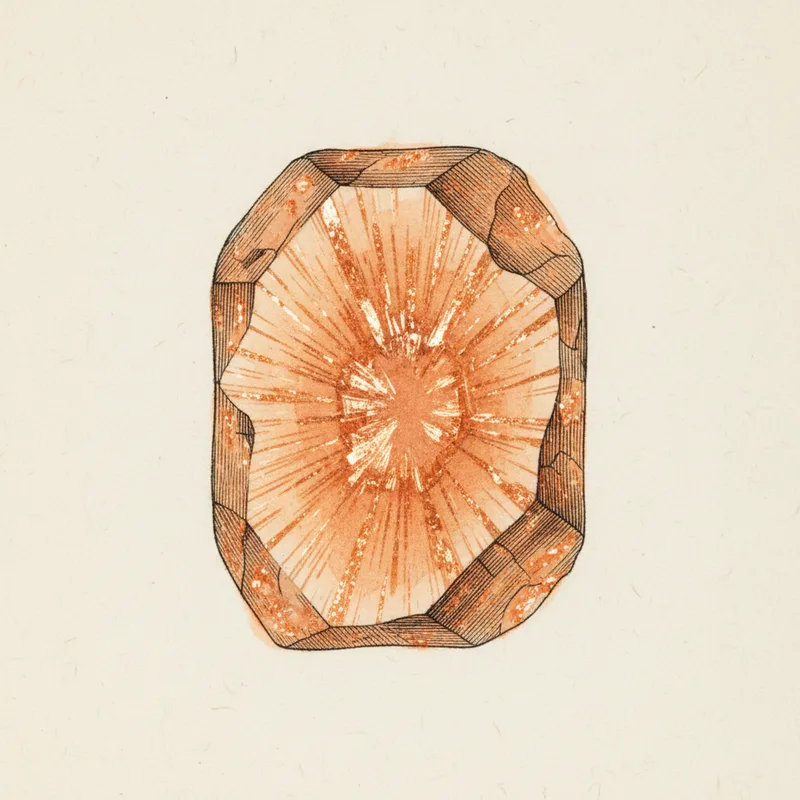
Sunstone
The Stone of Light
Affiliate links. We may earn a commission, at no cost to you.
Quick Facts
Formation & Origin
Sunstone is a feldspar variety defined by its aventurescent shimmer - a spangled, metallic reflection caused by tiny plate-like inclusions within the crystal. Two different types of sunstone exist with different mechanisms.
Traditional sunstone (from India and Norway) is oligoclase feldspar containing microscopic hematite or goethite platelets that create a warm, coppery glitter. Oregon sunstone is a labradorite feldspar that contains tiny copper platelets - actual metallic copper frozen inside the crystal. Oregon material can be transparent and faceted, and the copper produces colors ranging from pale yellow through orange and red to deep green.
Oregon's sunstone deposits formed in basaltic lava flows approximately 15 million years ago. Copper-bearing labradorite crystallized within the lava, and the copper separated as microscopic platelets during cooling. The best Oregon sunstones show a phenomenon called schiller - a brilliant metallic flash from the copper inclusions that can be almost hypnotic when the stone is rotated.
Identification Guide
Sunstone is identified by its aventurescent shimmer - the metallic, glittering effect visible within the stone. Oregon sunstone shows copper schiller (metallic flashes), while Indian/Norwegian sunstone shows hematite aventurescence (warm sparkle).
Distinguish from goldstone (man-made glass with copper flecks - too uniform and sparkly), aventurine quartz (green with fuchsite flecks, not feldspar), and plain carnelian (no shimmer). The metallic flash effect in genuine sunstone is its most distinctive feature.
Spotting Fakes
Goldstone - a man-made glass containing copper crystals - is the most common sunstone substitute. Goldstone is easy to identify: it has an unnaturally uniform distribution of coppery sparkles, feels warmer than natural stone, and often comes in blue and green varieties (natural sunstone doesn't). The sparkle in goldstone is also more intense and uniform than in natural sunstone. Genuine Oregon sunstone with strong copper schiller is valuable and should come from a reputable dealer with locality information.
Some links in this post go to Amazon and Etsy. Crystal Almanac earns a commission from qualifying purchases at no extra cost to you. Tools recommended here are ones we would use ourselves to run the tests described - the recommendation comes first, the link is downstream of it.
Cultural & Metaphysical Traditions
Presented as cultural traditions, not scientific evidence
In Norse mythology, sunstone was believed to help Viking navigators find the sun on cloudy days (some scholars think this refers to a calcite crystal used for polarization, not feldspar sunstone). In Greek tradition, sunstone represented the sun god Helios and was believed to bring good fortune and vitality. Oregon sunstone is the state gemstone of Oregon. Modern practitioners associate it with joy, leadership, and personal power.
Metaphysical and “healing” associations are cultural traditions, not medical advice or scientific fact. Crystals are not a substitute for professional medical care.
Where It's Found
Copper-bearing, world's finest gem sunstone
Traditional oligoclase sunstone with hematite
Classic aventurescent oligoclase
Some copper-bearing material emerging
Price Guide
Good to Know
Scratch test: At hardness 6.5, Sunstone resists scratching from a knife but can be scratched by quartz. Best for pendants and earrings rather than rings.
Global supply: Found in 4 notable locations worldwide, from United States to Tanzania.
Heft test: Sunstone has average mineral density (2.65). It feels about as heavy as you'd expect from a stone its size.
Common Questions
What is the chemical formula of Sunstone?
The chemical formula of Sunstone is NaAlSi₃O₈ to CaAl₂Si₂O₈ (with Cu).
What is Sunstone's Mohs hardness?
Sunstone has a Mohs hardness of 6.5 on the 1 to 10 Mohs scale, hard enough to scratch glass but softer than quartz.
Is Sunstone a mineral?
Yes. Sunstone is a naturally occurring mineral (Feldspar Group) with a definite chemical composition and an ordered crystal structure.
Care & Safety
The water, salt, and sunlight questions people actually ask before cleansing or displaying sunstone, answered from its hardness (Mohs 6.5) and chemistry (NaAlSi₃O₈ to CaAl₂Si₂O₈ (with Cu)).
Can Sunstone go in water?
Only briefly. A quick rinse under running water is fine for sunstone, but do not let it soak or sit submerged. At Mohs 6.5 it is tough enough for a rinse but not for a long soak. Dry it thoroughly afterward.
Can Sunstone go in salt water?
No. Sunstone can take a brief fresh-water rinse and nothing more, and salt water is harder on it both ways: corrosive while wet, then abrasive as the salt dries into crystals. Salt also accelerates corrosion of copper-bearing minerals like sunstone. If it does meet salt water, rinse it with fresh water and dry it promptly.
Sources & References
The mineralogical and gemological data on this page is drawn from and can be cross-checked against these external references.
- WikipediaSunstone on Wikipedia
- WebmineralOligoclase mineral data (Webmineral)
- Handbook of MineralogyOligoclase (Handbook of Mineralogy, PDF)
- GIASunstone in the GIA Gem Encyclopedia
Explore More
Feldspar Group
The Creative Collection
Contains actual metallic copper. The internal fire is associated with creative warmth, enthusiasm, and leadership in artistic pursuits.
The Abundance Collection
Contains actual copper. The warm metallic shimmer is associated with solar energy, leadership, and attracting success.
The Manifestation Collection
Contains actual copper and catches light like a tiny sun. Associated with leadership, warmth, and the solar energy that turns intention into movement.
The Confidence Collection
The Viking's directional stone. Contains actual copper that catches light from within. Associated with leadership, warmth, and the kind of confidence that inspires rather than intimidates.
Lion's Gate Portal 2026: Crystals for August 8
Leo Season Crystals 2026: Stones for Confidence
Is My Sunstone Real? How to Spot Goldstone Glass
Mohs Hardness Scale
See where Sunstone sits on the scale
Crystal Care Guide
Water safety, sunlight, and handling tips
Save This Stone

Keep this sunstone reference handy. Save the card to a Pinterest board and the profile is one tap away.
Save to PinterestNewsletter
Something shiny, now and then
A stone worth knowing, or a fake worth spotting, every so often. No spam.