Stilbite
The Dream Stone
Affiliate links. We may earn a commission, at no cost to you.
Quick Facts
Formation & Origin
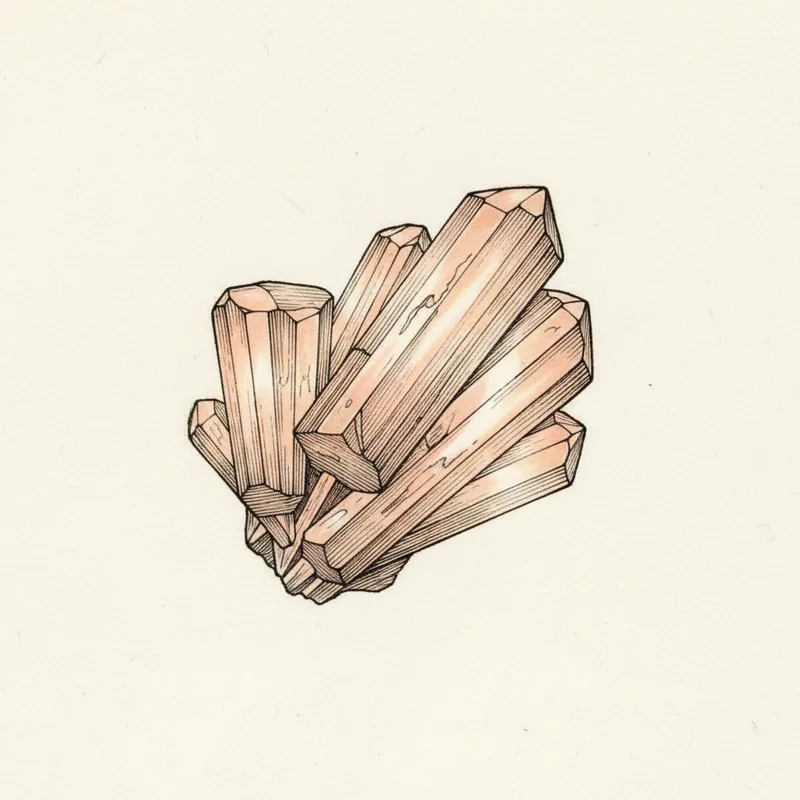
Stilbite is a common zeolite mineral that forms in volcanic rock cavities from low-temperature hydrothermal solutions. Its crystal habit is its most recognizable feature - stilbite grows as flattened, bow-tie shaped crystal aggregates with a distinctive sheaf-like or wheat-bundle appearance.
The peach-pink color that makes Indian stilbite so popular comes from trace amounts of iron and manganese. White and colorless stilbite is more common globally, but the warm salmon-pink Indian material has dominated the collector market since large-scale production began in the late 20th century.
Stilbite often occurs alongside apophyllite, scolecite, and other zeolites in the Deccan Trap basalts. These cavities can contain multiple zeolite species growing together, creating multi-mineral specimens of considerable beauty and educational value.
Identification Guide
Stilbite is identified by its distinctive bow-tie or sheaf-like crystal aggregates, pearly luster on cleavage faces, and zeolite associations. At hardness 3.5-4, it's quite soft. The flattened, fan-shaped crystal habit is unique among common minerals.
Distinguish from heulandite (similar zeolite but tabular/coffin-shaped crystals rather than sheaf-shaped), calcite (different crystal forms, fizzes in acid), and baryte (much denser, different crystal habit). Stilbite's wheat-sheaf form is essentially diagnostic.
Spotting Fakes
Stilbite is abundant and affordable from Indian sources, making faking unnecessary. The main practical concern is fragility - stilbite aggregates are delicate and easily damaged. Some specimens are stabilized with clear adhesive at stress points. Quality factors include color intensity (deeper pink is more valued), crystal definition, and the aesthetics of the overall specimen composition. Multi-mineral specimens with stilbite, apophyllite, and scolecite together command premiums.
Some links in this post go to Amazon and Etsy. Crystal Almanac earns a commission from qualifying purchases at no extra cost to you. Tools recommended here are ones we would use ourselves to run the tests described - the recommendation comes first, the link is downstream of it.
Cultural & Metaphysical Traditions
Presented as cultural traditions, not scientific evidence
Stilbite is one of the most popular zeolites in crystal healing, associated with dreaming, intuition, and gentle emotional support. Its soft pink color and gentle energy make it a favorite for bedside placement. Practitioners use it for lucid dreaming, accessing dream wisdom, and calming an overactive mind. The bow-tie crystal form is interpreted as connecting the physical and spiritual realms.
Metaphysical and “healing” associations are cultural traditions, not medical advice or scientific fact. Crystals are not a substitute for professional medical care.
Where It's Found
World's finest specimens, massive production
Classic European locality
Historic American zeolite locality
Good quality specimens
Price Guide
Good to Know
Scratch test: At hardness 3.5, Stilbite can be scratched with a copper coin. Handle gently and keep away from harder stones in your collection.
Global supply: Found in 4 notable locations worldwide, from India to Australia.
Heft test: With a specific gravity of 2.15, Stilbite feels lighter than most minerals. This lightness can help identify it.
Common Questions
What is the chemical formula of Stilbite?
The chemical formula of Stilbite is NaCa₄(Si₂₇Al₉)O₇₂·28H₂O.
What is Stilbite's Mohs hardness?
Stilbite has a Mohs hardness of 3.5 on the 1 to 10 Mohs scale, soft enough to scratch with a copper coin.
Is Stilbite a mineral?
Yes. Stilbite is a naturally occurring mineral (Zeolite Group) with a definite chemical composition and an ordered crystal structure.
Care & Safety
The water, salt, and sunlight questions people actually ask before cleansing or displaying stilbite, answered from its hardness (Mohs 3.5) and chemistry (NaCa₄(Si₂₇Al₉)O₇₂·28H₂O).
Can Stilbite go in water?
Not recommended. Stilbite can react with water, draw in moisture, or break down when it gets wet, so skip the rinse. Wipe it with a dry or barely damp cloth and dry it right away.
Can Stilbite go in salt water?
No. Stilbite is best kept away from water altogether, and salt water is the harsher version of that problem: the dissolved salt is corrosive while the stone is wet, then leaves gritty crystals behind in cracks and crevices as it dries.
Sources & References
The mineralogical and gemological data on this page is drawn from and can be cross-checked against these external references.
- WikipediaStilbite on Wikipedia
- WebmineralStilbite mineral data (Webmineral)
Explore More
Save This Stone

Keep this stilbite reference handy. Save the card to a Pinterest board and the profile is one tap away.
Save to PinterestNewsletter
Something shiny, now and then
A stone worth knowing, or a fake worth spotting, every so often. No spam.