Scolecite
The Stone of Inner Peace
Affiliate links. We may earn a commission, at no cost to you.
Quick Facts
Formation & Origin
Scolecite is a calcium-bearing zeolite mineral that crystallizes in volcanic rock cavities from low-temperature hydrothermal fluids. It forms alongside other zeolites (stilbite, heulandite) and apophyllite in the same Deccan Trap basalts of India that produce world-class specimens of many cavity minerals.
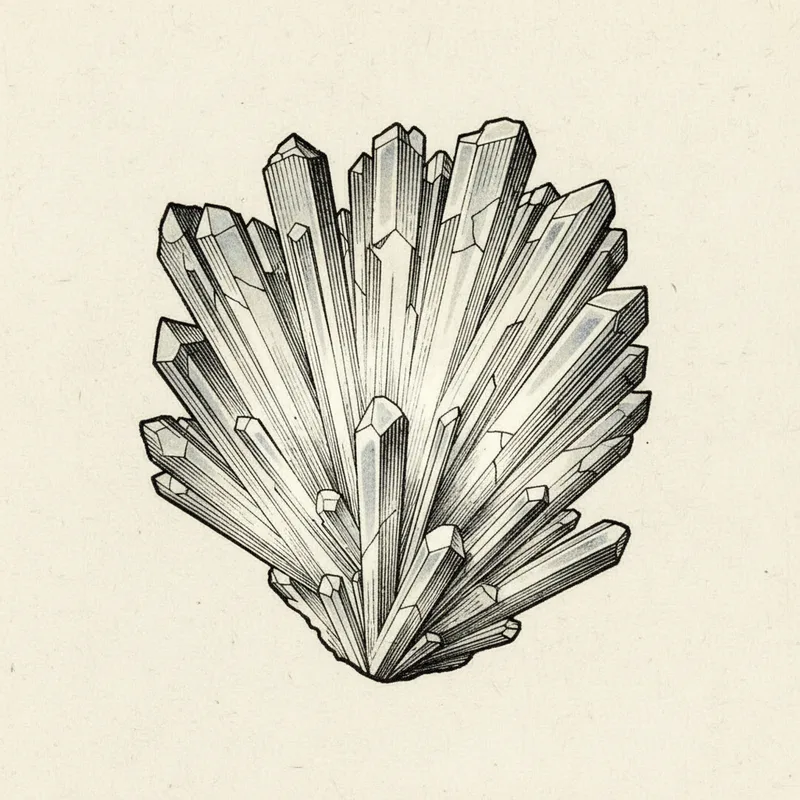
Scolecite's crystal habit is its defining feature - long, slender, acicular (needle-like) crystals that grow in radiating sprays and fans. The finest specimens from India show hundreds of delicate white needles radiating outward from a central point like frozen fireworks. These sprays can reach 20+ centimeters across and are among the most visually dramatic mineral specimens in the zeolite family.
The name comes from the Greek 'skolex' meaning worm - when heated, scolecite curls up like a worm due to the loss of water from its crystal structure (a process called intumescence).
Identification Guide
Scolecite is identified by its acicular crystal habit (long, thin needles), radiating or spray formation, and monoclinic symmetry. At hardness 5-5.5, it's moderately soft. The silky luster on crystal faces and the delicate needle habit are diagnostic.
Distinguish from natrolite (similar needle habit but orthorhombic, square cross-section), mesolite (intermediate composition, similar habit), and aragonite (carbonate, fizzes in acid, different associations). Scolecite needles have a slightly flattened cross-section visible under magnification.
Spotting Fakes
Scolecite is affordable and distinctive enough that faking isn't practical. The main concern is fragility - the delicate needle sprays are extremely breakable. Many specimens have repaired or reinforced bases. Handle with extreme care. Some sellers market natrolite or mesolite as scolecite - these are closely related but distinct minerals. For serious collectors, proper identification requires careful examination of crystal symmetry.
Some links in this post go to Amazon and Etsy. Crystal Almanac earns a commission from qualifying purchases at no extra cost to you. Tools recommended here are ones we would use ourselves to run the tests described - the recommendation comes first, the link is downstream of it.
Cultural & Metaphysical Traditions
Presented as cultural traditions, not scientific evidence
Scolecite has become popular in the crystal healing community for meditation and sleep support. Its gentle white needle sprays are associated with peaceful energy, lucid dreaming, and connection to higher consciousness. Practitioners often place it near the bed for restful sleep. The radiating needle habit is interpreted as energy flowing outward in all directions, making it a stone for sending healing intentions.
Metaphysical and “healing” associations are cultural traditions, not medical advice or scientific fact. Crystals are not a substitute for professional medical care.
Where It's Found
World's finest spray and fan specimens
Classic locality, fine needles
Some quality material
Price Guide
Good to Know
Scratch test: At hardness 5.5, Scolecite resists scratching from a knife but can be scratched by quartz. Best for pendants and earrings rather than rings.
Global supply: Found in 3 notable locations worldwide, from India to Brazil.
Heft test: With a specific gravity of 2.27, Scolecite feels lighter than most minerals. This lightness can help identify it.
Common Questions
What is the chemical formula of Scolecite?
The chemical formula of Scolecite is CaAl₂Si₃O₁₀·3H₂O.
What is Scolecite's Mohs hardness?
Scolecite has a Mohs hardness of 5.5 on the 1 to 10 Mohs scale, hard enough to scratch glass but softer than quartz.
Is Scolecite a mineral?
Yes. Scolecite is a naturally occurring mineral (Zeolite Group) with a definite chemical composition and an ordered crystal structure.
Care & Safety
The water, salt, and sunlight questions people actually ask before cleansing or displaying scolecite, answered from its hardness (Mohs 5.5) and chemistry (CaAl₂Si₃O₁₀·3H₂O).
Can Scolecite go in water?
Not recommended. Scolecite can react with water, draw in moisture, or break down when it gets wet, so skip the rinse. Wipe it with a dry or barely damp cloth and dry it right away.
Can Scolecite go in salt water?
No. Scolecite is best kept away from water altogether, and salt water is the harsher version of that problem: the dissolved salt is corrosive while the stone is wet, then leaves gritty crystals behind in cracks and crevices as it dries.
Sources & References
The mineralogical and gemological data on this page is drawn from and can be cross-checked against these external references.
- WikipediaScolecite on Wikipedia
- WebmineralScolecite mineral data (Webmineral)
- Handbook of MineralogyScolecite (Handbook of Mineralogy, PDF)
Related Minerals
Zeolite commonly found growing with scolecite
Another basalt cavity mineral, often co-occurs
Similar needle habit, different symmetry
Intermediate zeolite between scolecite and natrolite
Explore More
Zeolite Group
The Meditation Collection
The radiating needle sprays provide a mandala-like visual structure for meditation focus.
The Sleep Collection
The zeolite with radiating needle sprays like frozen fireworks. Associated with deep peace and inner journey during sleep. Its structure resembles mandalas - a visual meditation object at the bedside.
Best Crystals for Meditation: A Science-First Guide
Mohs Hardness Scale
See where Scolecite sits on the scale
Crystal Care Guide
Water safety, sunlight, and handling tips
Save This Stone

Keep this scolecite reference handy. Save the card to a Pinterest board and the profile is one tap away.
Save to PinterestNewsletter
Something shiny, now and then
A stone worth knowing, or a fake worth spotting, every so often. No spam.