Sphene (Titanite)
More Fire Than Diamond
Affiliate links. We may earn a commission, at no cost to you.
Quick Facts
Formation & Origin
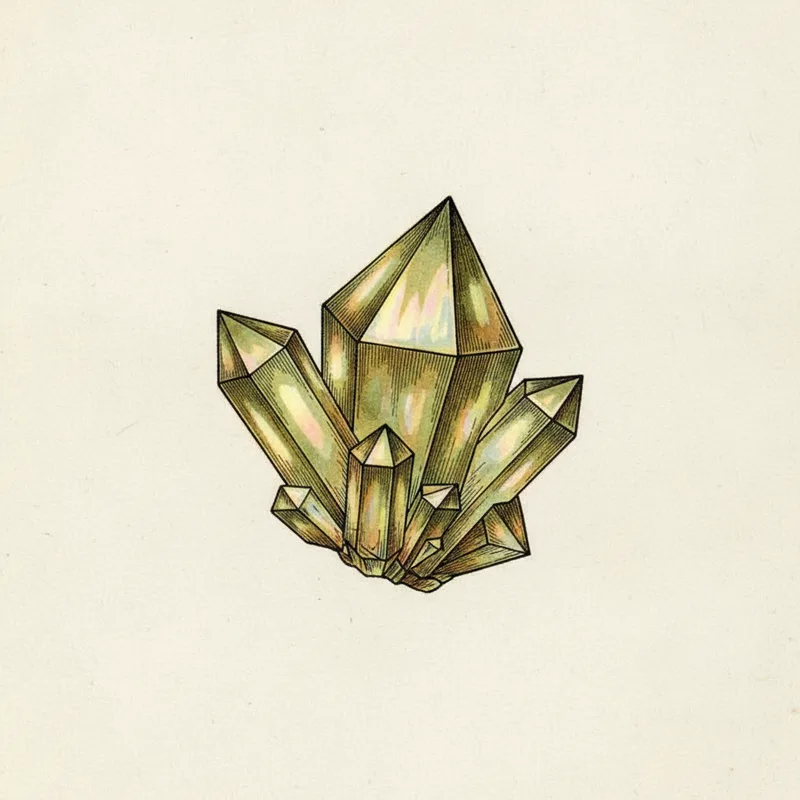
Sphene, the gem name for titanite, is a calcium titanium silicate (CaTiSiO₅), a nesosilicate mineral renowned for dispersion (fire) exceeding that of diamond. Sphene (titanite) crystallizes in a wide range of geological environments, but gem-quality material forms primarily in Alpine-type fissures and metamorphic rocks. In these settings, calcium and titanium-bearing fluids infiltrate fractures in gneiss and schist at temperatures between 400 and 600°C, precipitating monoclinic crystals with the characteristic wedge shape that gives the mineral its name (Greek sphenos, meaning wedge).
The chrome green variety, the most valuable for gems, gets its color from Cr³⁺ substituting for titanium in the crystal lattice. Yellow and brown tones come from Fe³⁺ and Fe²⁺ iron substitution. The exceptional dispersion (0.051, compared to diamond's 0.044) means that a well-cut sphene throws more spectral fire than a diamond of the same size. This optical property results from the high refractive index (1.84-2.11) and strong birefringence.
Sphene also forms as an accessory mineral in granite, syenite, and diorite, where small crystals are common but rarely gem quality. The metamorphic and hydrothermal environments that produce large, clean crystals are geologically specific, which keeps gem-grade sphene genuinely rare despite the mineral itself being widespread.
Identification Guide
Sphene's adamantine luster and intense fire are distinctive. Well-cut stones flash rainbow spectral colors that exceed diamond. The wedge-shaped crystal habit (flattened, pointed crystals) is diagnostic in rough specimens. Strong birefringence causes visible doubling of back facets when viewed through the table of a cut stone, a reliable identification feature.
Distinguish from peridot (orthorhombic, less fire, higher hardness 6.5-7), demantoid garnet (isometric, no birefringence, singly refractive), and chrysoberyl (higher hardness 8.5, orthorhombic). Sphene's relatively low hardness (5-5.5) means it scratches more easily than most jewelry gems, which limits its use despite its beauty.
Spotting Fakes
Sphene is rarely faked because demand is mostly from collectors who know what they're looking for. However, green CZ and synthetic sphene do exist. Check for birefringence (doubling of back facets visible through a loupe). Natural sphene almost always contains inclusions visible under magnification. Perfectly clean stones at low prices warrant suspicion. The strong fire should show spectral colors, not the flat flash of glass or CZ.
Some links in this post go to Amazon and Etsy. Crystal Almanac earns a commission from qualifying purchases at no extra cost to you. Tools recommended here are ones we would use ourselves to run the tests described - the recommendation comes first, the link is downstream of it.
Cultural & Metaphysical Traditions
Presented as cultural traditions, not scientific evidence
Crystal practitioners associate sphene with mental clarity, creative visualization, and enhanced learning. Its exceptional fire is linked in modern crystal traditions to illumination and intellectual brilliance. The mineral's ability to split white light into spectral colors is interpreted as a metaphor for revealing hidden aspects of a situation.
Metaphysical and “healing” associations are cultural traditions, not medical advice or scientific fact. Crystals are not a substitute for professional medical care.
Where It's Found
Finest gem-quality chrome green crystals
Yellow-green faceting material
Large transparent crystals in alpine veins
Classic European locality, brown crystals
Orange and golden brown specimens
Price Guide
Good to Know
Scratch test: At hardness 5.5, Sphene (Titanite) resists scratching from a knife but can be scratched by quartz. Best for pendants and earrings rather than rings.
Global supply: Found in 5 notable locations worldwide, from Madagascar to Mexico.
Heft test: Sphene (Titanite) has average mineral density (3.48-3.60). It feels about as heavy as you'd expect from a stone its size.
Common Questions
What is the chemical formula of Sphene (Titanite)?
The chemical formula of Sphene (Titanite) is CaTiSiO₅.
What is Sphene (Titanite)'s Mohs hardness?
Sphene (Titanite) has a Mohs hardness of 5.5 on the 1 to 10 Mohs scale, hard enough to scratch glass but softer than quartz.
Is Sphene (Titanite) a mineral?
Yes. Sphene (Titanite) is a naturally occurring mineral (Silicate Mineral (Nesosilicate)) with a definite chemical composition and an ordered crystal structure.
Care & Safety
The water, salt, and sunlight questions people actually ask before cleansing or displaying sphene (titanite), answered from its hardness (Mohs 5.5) and chemistry (CaTiSiO₅).
Can Sphene (Titanite) go in water?
Yes. Sphene (Titanite) is not water-soluble and durable enough (Mohs 5.5), so a rinse or a quick wash with mild soap is no problem, cleanse it in water freely if that is your practice. A long soak does nothing for it either way, so skip that, and dry the stone afterward.
Can Sphene (Titanite) go in salt water?
Not recommended, even though sphene (titanite) itself is hard and not water-soluble. Salt is both corrosive and mildly abrasive: it can dull a polished surface, attack metal settings, and crystallize inside small fractures as the stone dries. A quick dip will not destroy sphene (titanite), but rinse it with fresh water afterward and dry it. For routine cleaning, plain water is the kinder choice.
Sources & References
The mineralogical and gemological data on this page is drawn from and can be cross-checked against these external references.
- WikipediaTitanite on Wikipedia
- WebmineralTitanite mineral data (Webmineral)
- Handbook of MineralogyTitanite (Handbook of Mineralogy, PDF)
Explore More
Save This Stone
%3A%20More%20Fire%20Than%20Diamond.%20However%2C%20green%20CZ%20and%20synthetic%20sphene%20do%20exist.%20Meaning%2C%20properties%20%26%20how%20to%20spot%20fakes%20at%20Crystal%20Almanac.)
Keep this sphene (titanite) reference handy. Save the card to a Pinterest board and the profile is one tap away.
Save to PinterestNewsletter
Something shiny, now and then
A stone worth knowing, or a fake worth spotting, every so often. No spam.