Quick Facts
Formation & Origin
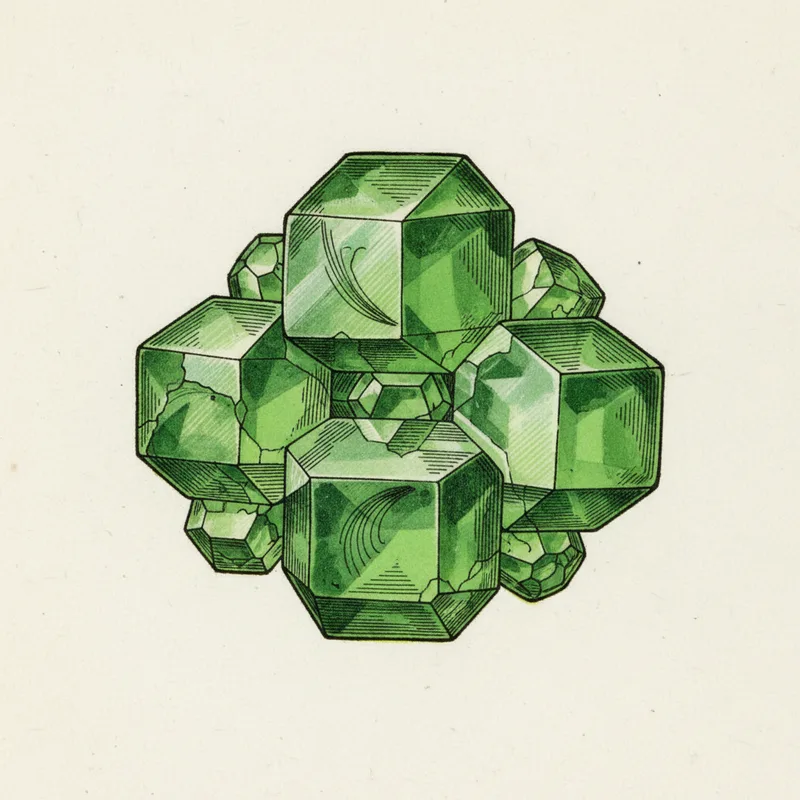
Demantoid is the green gem variety of andradite garnet, a calcium-iron silicate that crystallizes in serpentinized ultramafic rocks and skarns. The Russian Ural deposits formed when chromium-bearing chromite grains were partially altered during the serpentinization of peridotite. Hot, chemically active fluids mobilized calcium, iron, and silicon into cavities, where andradite crystallized around relict chromite cores.
The trademark green color comes from trace chromium (Cr³⁺) substituting into the garnet structure. Stones colored by iron alone tend toward yellowish or brownish green and are sometimes sold as 'topazolite'. True emerald-green demantoid requires chromium, which is why the chromite-rich Russian deposits produce the most saturated colors.
Russian material commonly contains byssolite (a fibrous chrysotile asbestos variety) growing outward from a central chromite crystal, forming delicate golden filaments known as 'horsetail' inclusions. These are diagnostic for Ural-origin demantoid and are prized rather than penalized. Namibian and Madagascan demantoid lacks horsetails but often exceeds Russian material in clarity and size.
Identification Guide
Demantoid is identified by its extraordinary dispersion of 0.057, higher than diamond's 0.044, which gives faceted stones visible rainbow flashes of fire. Its refractive index (1.880-1.889) is one of the highest of any gem garnet. Specific gravity runs 3.82-3.85, and the stone is singly refractive as expected for a cubic mineral.
Horsetail inclusions (radiating golden byssolite fibers around a dark chromite center) are diagnostic for Russian Ural origin and visible under 10x magnification. Namibian stones typically show thin fluid inclusions or are clean. The adamantine luster (from which the name 'demantoid', Dutch for 'diamond-like', is derived) distinguishes it from other green garnets.
Among natural look-alikes, emerald, chrome diopside, and peridot are all doubly refractive, while demantoid is singly refractive. That one optical test, combined with demantoid's far stronger fire, separates it from every common green substitute.
Spotting Fakes
The most common substitutes are synthetic green garnets: YAG (yttrium aluminum garnet) and GGG (gadolinium gallium garnet), both produced since the 1960s. Natural demantoid fluoresces weakly or not at all under shortwave UV, while synthetic YAG often fluoresces strongly orange or yellow. Tsavorite garnet is a natural green stone often confused with demantoid but has a lower refractive index (1.740 vs 1.88) and lacks horsetail inclusions.
Glass imitations show gas bubbles and swirl marks under a 10x loupe and lack demantoid's high dispersion. Because demantoid is singly refractive, a polariscope test alone will not separate it from glass or synthetic garnets, so a refractometer reading is essential. Any stone sold as 'Russian demantoid' should show horsetail inclusions under magnification. Certificates from GIA, SSEF, or Gübelin confirming Ural origin add significant value.
Some demantoid is gently heat treated to reduce brownish tones. The treatment is stable but should be disclosed by the seller, and a lab report from a reputable gemological laboratory is worth the cost on any expensive stone.
Some links in this post go to Amazon and Etsy. Crystal Almanac earns a commission from qualifying purchases at no extra cost to you. Tools recommended here are ones we would use ourselves to run the tests described - the recommendation comes first, the link is downstream of it.
Cultural & Metaphysical Traditions
Presented as cultural traditions, not scientific evidence
Demantoid rose to fame in the late 1800s when it became a favorite of the Russian imperial court and featured in Fabergé jewelry. Crystal practitioners associate its green fire with vitality, creative courage, and manifestation, connecting the heart chakra to the solar plexus. Traditional Russian lore considered it a stone of abundance and loyalty, often exchanged between close friends.
Metaphysical and “healing” associations are cultural traditions, not medical advice or scientific fact. Crystals are not a substitute for professional medical care.
Where It's Found
Historic source since 1868, only origin with diagnostic horsetail inclusions
Modern source since the mid-1990s, clean stones with vivid color
Discovered 2009, often larger stones but lacks horsetail inclusions
Smaller modern source producing yellowish-green material
Price Guide
Good to Know
Scratch test: At hardness 6.5, Demantoid Garnet resists scratching from a knife but can be scratched by quartz. Best for pendants and earrings rather than rings.
Global supply: Found in 4 notable locations worldwide, from Russia to Iran.
Heft test: Demantoid Garnet has a specific gravity of 3.82-3.85 - noticeably heavier than quartz. You'll feel the density when you pick it up.
Common Questions
What is the chemical formula of Demantoid Garnet?
The chemical formula of Demantoid Garnet is Ca₃Fe₂(SiO₄)₃.
What is Demantoid Garnet's Mohs hardness?
Demantoid Garnet has a Mohs hardness of 6.5 on the 1 to 10 Mohs scale, hard enough to scratch glass but softer than quartz.
Is Demantoid Garnet a mineral?
Yes. Demantoid Garnet is a naturally occurring mineral (Garnet Group (Andradite)) with a definite chemical composition and an ordered crystal structure.
Care & Safety
The water, salt, and sunlight questions people actually ask before cleansing or displaying demantoid garnet, answered from its hardness (Mohs 6.5) and chemistry (Ca₃Fe₂(SiO₄)₃).
Can Demantoid Garnet go in water?
Yes. Demantoid Garnet is not water-soluble and durable enough (Mohs 6.5), so a rinse or a quick wash with mild soap is no problem, cleanse it in water freely if that is your practice. A long soak does nothing for it either way, so skip that, and dry the stone afterward.
Can Demantoid Garnet go in salt water?
Not recommended, even though demantoid garnet itself is hard and not water-soluble. Salt is both corrosive and mildly abrasive: it can dull a polished surface, attack metal settings, and crystallize inside small fractures as the stone dries. Demantoid Garnet's iron content also makes rust staining likely if salt residue sits on the surface. A quick dip will not destroy demantoid garnet, but rinse it with fresh water afterward and dry it. For routine cleaning, plain water is the kinder choice.
Sources & References
The mineralogical and gemological data on this page is drawn from and can be cross-checked against these external references.
- WikipediaDemantoid on Wikipedia
- WebmineralAndradite mineral data (Webmineral)
- Handbook of MineralogyAndradite (Handbook of Mineralogy, PDF)
- GIADemantoid Garnet in the GIA Gem Encyclopedia
Explore More
Save This Stone

Keep this demantoid garnet reference handy. Save the card to a Pinterest board and the profile is one tap away.
Save to PinterestNewsletter
Something shiny, now and then
A stone worth knowing, or a fake worth spotting, every so often. No spam.