Septarian
The Dragon Stone
Affiliate links. We may earn a commission, at no cost to you.
Quick Facts
Formation & Origin
Septarian is a concretion rather than a single mineral, a nodule of sedimentary rock whose internal cracks have been filled by calcite and aragonite (CaCO₃) veins. Septarian nodules formed 50-70 million years ago when volcanic activity killed marine life, which sank to the seafloor and decomposed. The decomposition produced chemical reactions in the surrounding sediment that caused mud to compact into hard, ball-shaped concretions. As the concretions dried, they contracted and cracked internally, creating the characteristic angular crack patterns.
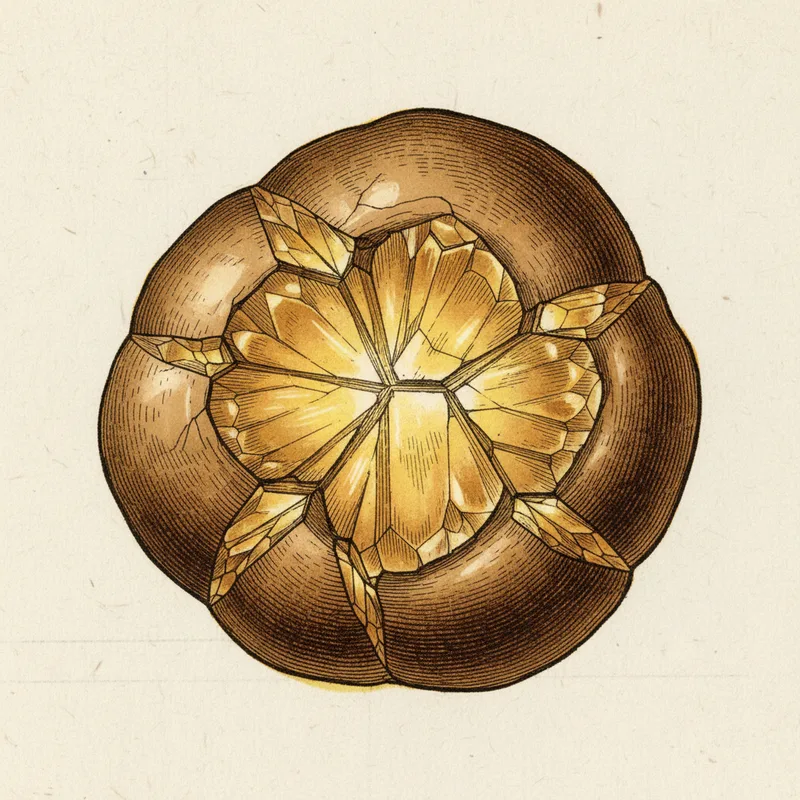
Over time, mineral-rich groundwater percolated through these internal cracks, depositing golden calcite crystals in the fissures and brown aragonite along the crack walls. The result is a three-part stone: gray limestone/mudstone exterior, brown aragonite crack walls, and bright yellow calcite crystal fills. When cut and polished, the contrast between these three components creates the distinctive dragon-scale or turtle-shell pattern.
The name 'septarian' comes from the Latin 'septum' meaning partition - referring to the internal walls that divide the nodule into chambers. The Moeraki Boulders on New Zealand's South Island coast are giant septarian concretions up to 2 meters in diameter, eroding from coastal cliffs.
Identification Guide
Septarian is immediately recognizable when cut - the angular pattern of yellow calcite veins in brown aragonite within gray mudstone creates a unique appearance no other stone replicates. The calcite veins may contain visible crystal terminations.
Distinguish from dragon blood jasper (green and red, completely different composition), turtle jasper (marketing name for various patterned stones), and artificial resin-filled stones. Genuine septarian's calcite veins respond to acid (fizzing confirms carbonate).
Spotting Fakes
Septarian is affordable enough that faking isn't worthwhile. The main concerns are quality variation (some nodules have dramatic patterns while others are dull) and whether the polish is genuine or coated with resin. Some septarian specimens are stabilized with resin to fill porous areas - this is a practical treatment for display purposes. The calcite veins should be genuinely crystalline (showing crystal faces in unpolished areas).
Some links in this post go to Amazon and Etsy. Crystal Almanac earns a commission from qualifying purchases at no extra cost to you. Tools recommended here are ones we would use ourselves to run the tests described - the recommendation comes first, the link is downstream of it.
Cultural & Metaphysical Traditions
Presented as cultural traditions, not scientific evidence
Septarian's resemblance to dragon scales earned it the trade name 'dragon stone' in the crystal market. Modern practitioners associate it with grounding, patience, and public speaking (the calcite component is connected to communication). In Malagasy tradition, septarian nodules are considered lucky and are placed in homes for protection. The multi-mineral composition is interpreted as representing the integration of different aspects of self.
Metaphysical and “healing” associations are cultural traditions, not medical advice or scientific fact. Crystals are not a substitute for professional medical care.
Where It's Found
Primary commercial source, exceptional quality
Large nodules, classic specimens
Good quality material
Famous giant septarian concretions
Price Guide
Good to Know
Scratch test: At hardness 4, Septarian can be scratched with a copper coin. Handle gently and keep away from harder stones in your collection.
Global supply: Found in 4 notable locations worldwide, from Madagascar to New Zealand.
Heft test: Septarian has average mineral density (2.60-2.80). It feels about as heavy as you'd expect from a stone its size.
Common Questions
What is the chemical formula of Septarian?
The chemical formula of Septarian is Variable (CaCO₃ calcite + aragonite + limestone).
What is Septarian's Mohs hardness?
Septarian has a Mohs hardness of 4 on the 1 to 10 Mohs scale, which a steel knife will scratch.
Is Septarian a mineral?
Not a single mineral. Septarian is a mixture of more than one mineral rather than one mineral species.
Care & Safety
The water, salt, and sunlight questions people actually ask before cleansing or displaying septarian, answered from its hardness (Mohs 4) and chemistry (Variable (CaCO₃ calcite + aragonite + limestone)).
Can Septarian go in water?
Only briefly. A quick rinse under running water is fine for septarian, but do not let it soak or sit submerged. At Mohs 4 it is tough enough for a rinse but not for a long soak. Dry it thoroughly afterward.
Can Septarian go in salt water?
No. Septarian can take a brief fresh-water rinse and nothing more, and salt water is harder on it both ways: corrosive while wet, then abrasive as the salt dries into crystals. If it does meet salt water, rinse it with fresh water and dry it promptly.
Sources & References
The mineralogical and gemological data on this page is drawn from and can be cross-checked against these external references.
- WikipediaConcretion on Wikipedia
Related Minerals
The yellow crystal veins filling the cracks
The brown lining of the crack walls
The gray mudstone matrix
The geological process that formed the nodule
Explore More
Save This Stone

Keep this septarian reference handy. Save the card to a Pinterest board and the profile is one tap away.
Save to PinterestNewsletter
Something shiny, now and then
A stone worth knowing, or a fake worth spotting, every so often. No spam.