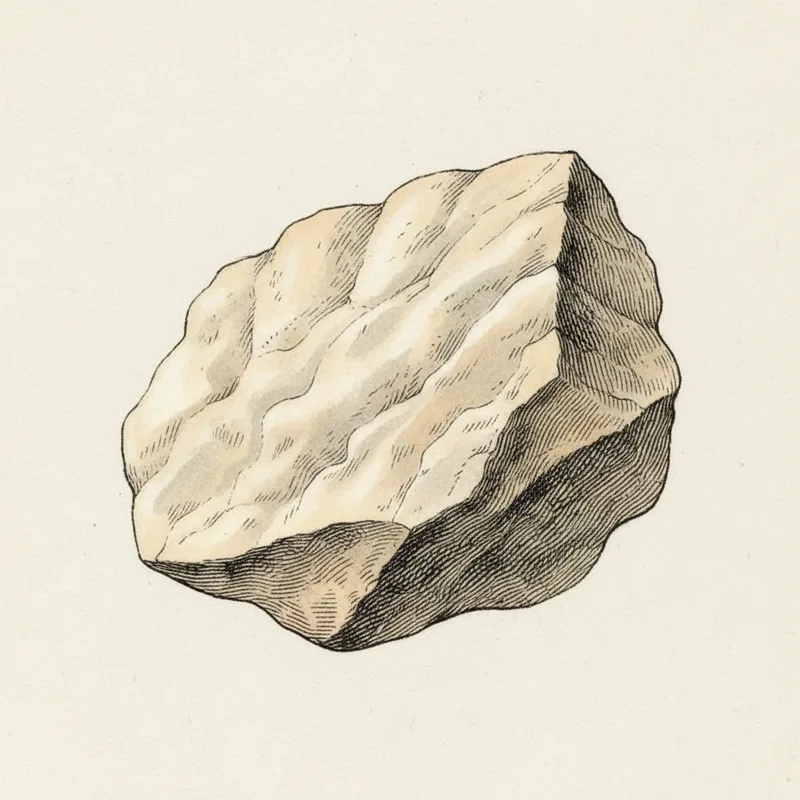
Limestone
The Fossil Record
Affiliate links. We may earn a commission, at no cost to you.
Quick Facts
Formation & Origin
Limestone is the Earth's biological archive. Most limestone forms from the accumulated shells, skeletons, and remains of marine organisms: corals, foraminifera, mollusks, and crinoids. When these organisms die, their calcium carbonate shells settle on the seafloor and gradually compact into rock.
This means every piece of limestone was once alive. A limestone building block may contain millions of individual microscopic shells. Fossiliferous limestone preserves visible shells and marine life, making it a direct window into ancient oceans. The Great Pyramids of Giza are built from Eocene limestone roughly 40-50 million years old.
Limestone is also the parent rock of marble (metamorphosed limestone), cave formations (dissolved and redeposited limestone), and karst landscapes (sinkholes, caves, and underground rivers formed by limestone dissolution).
Identification Guide
Limestone is identified by its light color (cream, tan, gray), fine-grained texture, visible fossils (often), and vigorous effervescence in dilute hydrochloric acid. Hardness around 3. Often breaks along fossil boundaries or bedding planes.
Distinguish from marble (recrystallized, sugary texture, no fossils), dolomite (slower acid reaction), sandstone (gritty texture, no acid reaction), and chalk (extremely fine-grained, soft, white limestone variety).
Spotting Fakes
Limestone is too common and inexpensive to fake. The main confusion is with dolomite, which looks similar but reacts more slowly with acid (only effervesces in warm or powdered form). In the building trade, limestone and marble are sometimes used interchangeably for softer decorative stones.
Some links in this post go to Amazon and Etsy. Crystal Almanac earns a commission from qualifying purchases at no extra cost to you. Tools recommended here are ones we would use ourselves to run the tests described - the recommendation comes first, the link is downstream of it.
Cultural & Metaphysical Traditions
Presented as cultural traditions, not scientific evidence
Limestone carries the accumulated energy of millions of years of marine life. Crystal practitioners associate it with patience, understanding cycles of growth, and connecting with ancestral or ancient wisdom. Fossils within limestone are considered especially powerful for past-life work and understanding deep time.
Metaphysical and “healing” associations are cultural traditions, not medical advice or scientific fact. Crystals are not a substitute for professional medical care.
Where It's Found
One of the most abundant sedimentary rocks
Iconic chalk (a type of limestone)
The Great Pyramids are built of limestone blocks
Major limestone regions
Price Guide
Good to Know
Scratch test: At hardness 3, Limestone can be scratched with a copper coin. Handle gently and keep away from harder stones in your collection.
Global supply: Found in 4 notable locations worldwide, from Worldwide to United States.
Heft test: With a specific gravity of 2.3-2.7, Limestone feels lighter than most minerals. This lightness can help identify it.
Common Questions
What is the chemical formula of Limestone?
The chemical formula of Limestone is CaCO₃ (primarily calcite).
What is Limestone's Mohs hardness?
Limestone has a Mohs hardness of 3 on the 1 to 10 Mohs scale, soft enough to scratch with a copper coin.
Is Limestone a mineral?
Not quite. Limestone is a rock (a naturally occurring mixture of minerals), not a single mineral species.
Care & Safety
The water, salt, and sunlight questions people actually ask before cleansing or displaying limestone, answered from its hardness (Mohs 3) and chemistry (CaCO₃ (primarily calcite)).
Can Limestone go in water?
Not recommended. At Mohs 3, limestone is soft enough that water can slowly dull, etch, or wear down the surface, so a water cleanse does more harm than good here. Reach for a dry cloth instead.
Can Limestone go in salt water?
No. Limestone is best kept away from water altogether, and salt water is the harsher version of that problem: the dissolved salt is corrosive while the stone is wet, then leaves gritty crystals behind in cracks and crevices as it dries.
Sources & References
The mineralogical and gemological data on this page is drawn from and can be cross-checked against these external references.
- WikipediaLimestone on Wikipedia
Related Minerals
Metamorphosed limestone
The mineral limestone is made of
Extremely fine-grained white limestone
Explore More
Rocks & Multi-Mineral Composites
Libra Season Crystals 2026: Stones for Balance
How Crystals Form: Pegmatite, Hydrothermal, Sedimentary
Best Crystals for Sleep: What to Know & How to Use
Mohs Hardness Scale
See where Limestone sits on the scale
Crystal Care Guide
Water safety, sunlight, and handling tips
Save This Stone

Keep this limestone reference handy. Save the card to a Pinterest board and the profile is one tap away.
Save to PinterestNewsletter
Something shiny, now and then
A stone worth knowing, or a fake worth spotting, every so often. No spam.