Prasiolite
The Green Amethyst
Affiliate links. We may earn a commission, at no cost to you.
Quick Facts
Formation & Origin
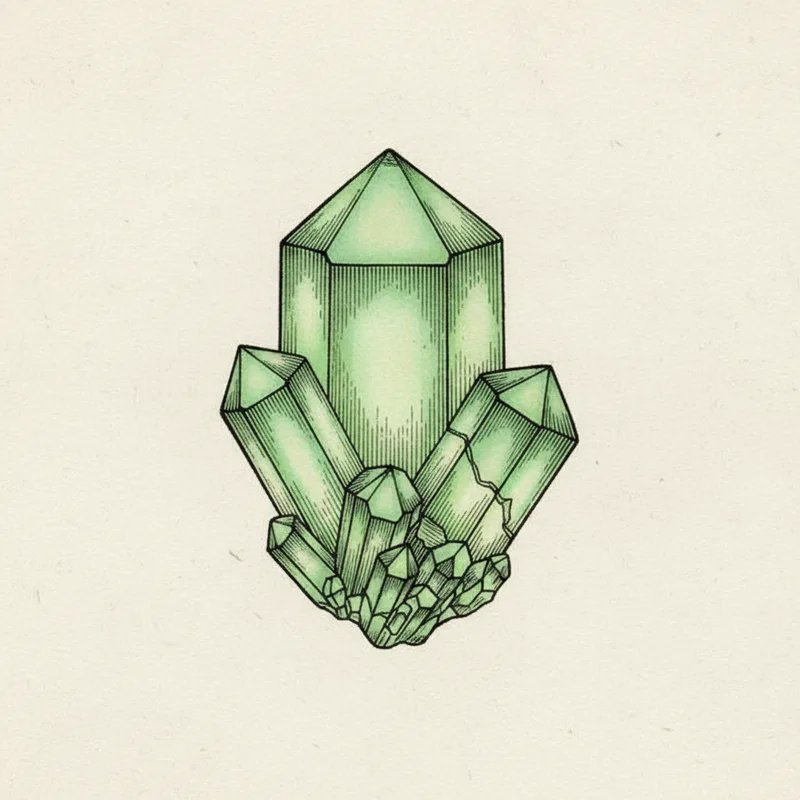
Prasiolite, often sold as green amethyst, is a pale green variety of quartz (SiO₂), nearly all of which is produced by heat-treating natural amethyst. Prasiolite - commonly marketed as 'green amethyst' - is green transparent quartz. Here's the critical fact: virtually all prasiolite on the market is heat-treated amethyst. When amethyst from specific localities (particularly certain Brazilian deposits) is heated to 400-500 degrees Celsius, the iron color centers that produce purple shift to produce a pale green instead.
Naturally occurring green quartz is extremely rare. The few known localities (Poland, Canada, some Arizona material) produce limited quantities. The vast majority of 'prasiolite' and 'green amethyst' in jewelry stores is heated Brazilian amethyst. This treatment is permanent and stable.
The trade name 'green amethyst' is technically incorrect and considered misleading by some gemological organizations - amethyst by definition is purple quartz. The name 'prasiolite' (from Greek 'prason' meaning leek, for the leek-green color) is the proper gemological term. Despite this, 'green amethyst' remains the most common commercial name.
Identification Guide
Prasiolite is identified as transparent green quartz with standard quartz properties - hardness 7, trigonal crystal system, conchoidal fracture. The green is typically pale and slightly grayish.
Distinguish from peridot (different mineral, more vivid yellow-green), green tourmaline (different crystal system, usually deeper green), and green glass (may have bubbles, different specific gravity). The pale, slightly minty green and standard quartz properties are diagnostic.
Spotting Fakes
The biggest 'fake' issue with prasiolite is not identifying the material but understanding the treatment. Almost all prasiolite is heated amethyst - this is legitimate and stable but should be disclosed. If a seller claims 'natural prasiolite' at standard prices, it's almost certainly heated. Genuine natural prasiolite from Poland or Canada would be rare and expensive. Green glass and green synthetic quartz also exist but are distinguishable by standard gemological testing.
Some links in this post go to Amazon and Etsy. Crystal Almanac earns a commission from qualifying purchases at no extra cost to you. Tools recommended here are ones we would use ourselves to run the tests described - the recommendation comes first, the link is downstream of it.
Cultural & Metaphysical Traditions
Presented as cultural traditions, not scientific evidence
Prasiolite's metaphysical tradition combines amethyst's spiritual associations with the heart-chakra energy of green stones. Practitioners consider it a bridge between mind and heart - the purple-to-green transformation through heat treatment is interpreted as representing emotional alchemy. It's used for connecting spiritual insight with compassionate action and for healing emotional wounds through understanding.
Metaphysical and “healing” associations are cultural traditions, not medical advice or scientific fact. Crystals are not a substitute for professional medical care.
Where It's Found
Primary source of heat-treated material
Rare naturally green quartz
Naturally occurring green amethyst
Price Guide
Good to Know
Scratch test: At hardness 7, Prasiolite can scratch glass and steel. It's durable enough for any type of jewelry.
Global supply: Found in 3 notable locations worldwide, from Brazil to Canada.
Heft test: Prasiolite has average mineral density (2.65). It feels about as heavy as you'd expect from a stone its size.
Common Questions
What is the chemical formula of Prasiolite?
The chemical formula of Prasiolite is SiO₂.
What is Prasiolite's Mohs hardness?
Prasiolite has a Mohs hardness of 7 on the 1 to 10 Mohs scale, hard enough to scratch glass and stand up to daily wear.
Is Prasiolite a mineral?
Yes. Prasiolite is a naturally occurring mineral (Quartz Family) with a definite chemical composition and an ordered crystal structure.
Care & Safety
The water, salt, and sunlight questions people actually ask before cleansing or displaying prasiolite, answered from its hardness (Mohs 7) and chemistry (SiO₂).
Can Prasiolite go in water?
Yes. Prasiolite is hard (Mohs 7) and chemically stable, so a rinse or a quick wash with mild soap is no problem, cleanse it in water freely if that is your practice. A long soak does nothing for it either way, so skip that, and dry the stone afterward.
Can Prasiolite go in salt water?
Not recommended, even though prasiolite itself is hard and not water-soluble. Salt is both corrosive and mildly abrasive: it can dull a polished surface, attack metal settings, and crystallize inside small fractures as the stone dries. A quick dip will not destroy prasiolite, but rinse it with fresh water afterward and dry it. For routine cleaning, plain water is the kinder choice.
Sources & References
The mineralogical and gemological data on this page is drawn from and can be cross-checked against these external references.
- WikipediaPrasiolite on Wikipedia
- WebmineralQuartz mineral data (Webmineral)
- Handbook of MineralogyQuartz (Handbook of Mineralogy, PDF)
Explore More
Save This Stone

Keep this prasiolite reference handy. Save the card to a Pinterest board and the profile is one tap away.
Save to PinterestNewsletter
Something shiny, now and then
A stone worth knowing, or a fake worth spotting, every so often. No spam.