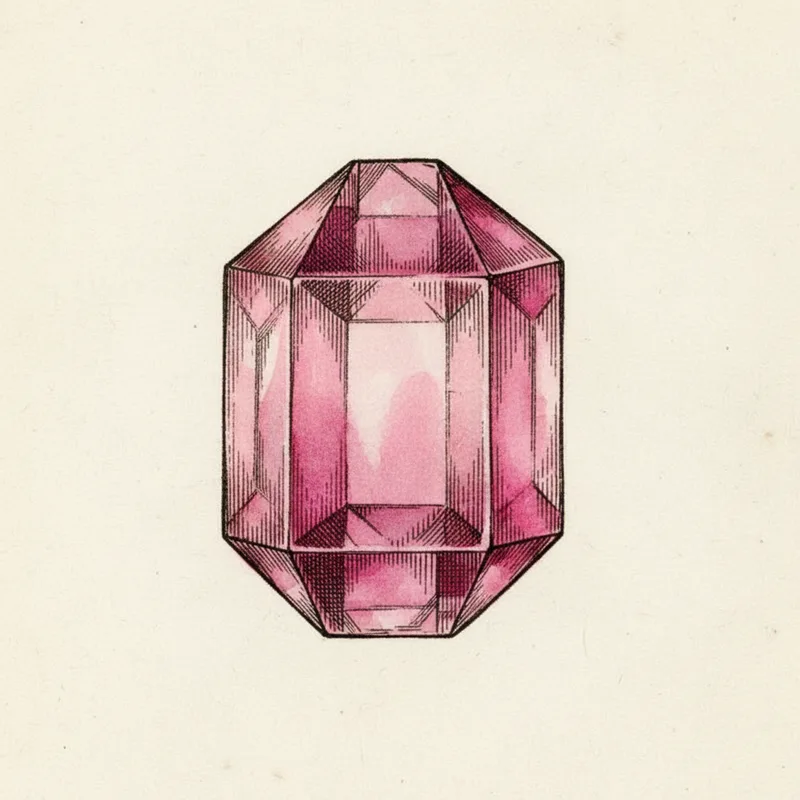
Pink Sapphire
Chromium's Softer Signature
Affiliate links. We may earn a commission, at no cost to you.
Quick Facts
Formation & Origin
Pink sapphire is corundum colored by trace chromium (Cr³⁺) substituting for aluminum in the crystal lattice, at concentrations lower than those that produce ruby. The line between pink sapphire and ruby is one of the most debated calls in gemology. The GIA definition is color-based: ruby is red to slightly purplish red, pink sapphire is light red to pink. Burmese and Thai trade tradition, by contrast, historically called any chromium-colored corundum with dominant red pigment a ruby, which is why older Mogok material labeled ruby would be graded pink sapphire under GIA standards today.
Corundum forms in aluminum-rich, silica-poor environments. Mogok's pink and red corundum crystallized in marble during regional metamorphism of limestones. The marble host is low in iron, which suppresses the fluorescence-killing iron quenching seen in basalt-hosted sources, so Mogok stones show strong red fluorescence that enhances saturation. Madagascar's Ilakaka and Andilamena deposits are alluvial gravels derived from metamorphic and pegmatitic sources, and since 1998 they have produced the bulk of commercial pink sapphire in global circulation.
Iron content matters as much as chromium. Low-iron stones from Mogok and Sri Lanka fluoresce strongly and look vivid. Higher-iron stones from basalt-hosted deposits in Australia or parts of Thailand tend toward darker, more inert pinks with a purple tilt.
Identification Guide
Pink sapphire shows hardness 9, specific gravity 3.98 to 4.00, and refractive index 1.762 to 1.770 with distinct double refraction. Weak to moderate pleochroism appears as purplish pink to orangy pink when rotated under a dichroscope. Chromium-rich stones fluoresce red to orange-red under long-wave UV, a direct diagnostic for corundum against most pink look-alikes.
Color zoning is common, straight or angular bands following the hexagonal crystal structure, best seen with the stone immersed in diiodomethane under diffused light. Silk inclusions of fine rutile needles are characteristic of unheated material. The red to pink boundary versus ruby is subjective but GIA grading places stones with any noticeable pink dilution or peach modifier in the pink sapphire category.
Spotting Fakes
Pink spinel is the most common honest confusion. Spinel and sapphire often occur together in Mogok and Sri Lankan gravels and look nearly identical by eye. Separation is straightforward with tools: spinel is cubic and singly refractive, sapphire is trigonal and doubly refractive, so a polariscope or a 10x loupe check for facet doubling resolves it immediately. Refractive index also separates them cleanly, spinel at 1.712 to 1.720 versus sapphire at 1.762 to 1.770. Specific gravity runs 3.58 to 3.61 for spinel, near 4.00 for sapphire.
Pink topaz has similar color but hardness 8, softer under a standard scratch test against a corundum plate, and shows basal cleavage absent in sapphire. Pink cubic zirconia and glass are singly refractive with no pleochroism and often contain bubbles or swirl structures.
The critical disclosure issue is beryllium diffusion. Near-colorless or pale corundum is heated with beryllium to intensify pink or push it toward padparadscha orange-pink. This treatment must be disclosed and significantly lowers value. Signs include surface-confined color concentrations visible under immersion, and unnaturally saturated pink without matching chromium fluorescence intensity. For any pink sapphire over 1 carat, request a report from GIA, SSEF, Gubelin, or GRS confirming origin and treatment status. Standard heat treatment without diffusion is accepted and common, unheated certified stones command premium prices.
Some links in this post go to Amazon and Etsy. Crystal Almanac earns a commission from qualifying purchases at no extra cost to you. Tools recommended here are ones we would use ourselves to run the tests described - the recommendation comes first, the link is downstream of it.
Cultural & Metaphysical Traditions
Presented as cultural traditions, not scientific evidence
Pink sapphire does not have the deep Vedic or medieval European lineage of blue or yellow sapphire, partly because historically much of what we now call pink sapphire was traded as ruby. Modern Western crystal traditions associate it with compassionate love, emotional resilience after loss, and the kind of strength that stays open rather than closing off. Practitioners often place it with rose quartz and morganite in heart-chakra pairings, using the harder, rarer sapphire as the anchor stone of the trio. It is sometimes given as an engagement or anniversary stone for couples who want a pink gem with sapphire durability, following the example of several high-profile royal and celebrity engagement rings from the 2000s onward.
Metaphysical and “healing” associations are cultural traditions, not medical advice or scientific fact. Crystals are not a substitute for professional medical care.
Where It's Found
Dominant modern source since 1998, wide range of pink saturations
Classic Ceylon pinks, soft color and high clarity, often unheated
Finest hot pinks with marble-host fluorescence, production limited
Warmer peachy pinks, including some padparadscha-adjacent material
Price Guide
Good to Know
Scratch test: At hardness 9, Pink Sapphire can scratch glass and steel. It's durable enough for any type of jewelry.
Global supply: Found in 4 notable locations worldwide, from Madagascar to Tanzania.
Heft test: Pink Sapphire has a specific gravity of 3.98-4.00 - noticeably heavier than quartz. You'll feel the density when you pick it up.
Common Questions
What is the chemical formula of Pink Sapphire?
The chemical formula of Pink Sapphire is Al₂O₃.
What is Pink Sapphire's Mohs hardness?
Pink Sapphire has a Mohs hardness of 9 on the 1 to 10 Mohs scale, hard enough to scratch glass and stand up to daily wear.
Is Pink Sapphire a mineral?
Yes. Pink Sapphire is a naturally occurring mineral (Corundum (Sapphire Variety)) with a definite chemical composition and an ordered crystal structure.
Care & Safety
The water, salt, and sunlight questions people actually ask before cleansing or displaying pink sapphire, answered from its hardness (Mohs 9) and chemistry (Al₂O₃).
Can Pink Sapphire go in water?
Yes. Pink Sapphire is hard (Mohs 9) and chemically stable, so a rinse or a quick wash with mild soap is no problem, cleanse it in water freely if that is your practice. A long soak does nothing for it either way, so skip that, and dry the stone afterward.
Can Pink Sapphire go in salt water?
Not recommended, even though pink sapphire itself is hard and not water-soluble. Salt is both corrosive and mildly abrasive: it can dull a polished surface, attack metal settings, and crystallize inside small fractures as the stone dries. A quick dip will not destroy pink sapphire, but rinse it with fresh water afterward and dry it. For routine cleaning, plain water is the kinder choice.
Sources & References
The mineralogical and gemological data on this page is drawn from and can be cross-checked against these external references.
- WikipediaSapphire on Wikipedia
- WebmineralCorundum mineral data (Webmineral)
- Handbook of MineralogyCorundum (Handbook of Mineralogy, PDF)
- GIAPink Sapphire in the GIA Gem Encyclopedia
Related Minerals
Same mineral, higher chromium produces red
Common honest confusion in same deposits
Pink-orange corundum, closely related color
Explore More
Oxide & Hydroxide Minerals
September Birthstone: Sapphire and Its Many Colors
July Birthstone: Ruby Meaning, Value & Spotting Fakes
Morganite: Meaning, Properties, and How to Spot Fakes
Mohs Hardness Scale
See where Pink Sapphire sits on the scale
Crystal Care Guide
Water safety, sunlight, and handling tips
Save This Stone

Keep this pink sapphire reference handy. Save the card to a Pinterest board and the profile is one tap away.
Save to PinterestNewsletter
Something shiny, now and then
A stone worth knowing, or a fake worth spotting, every so often. No spam.