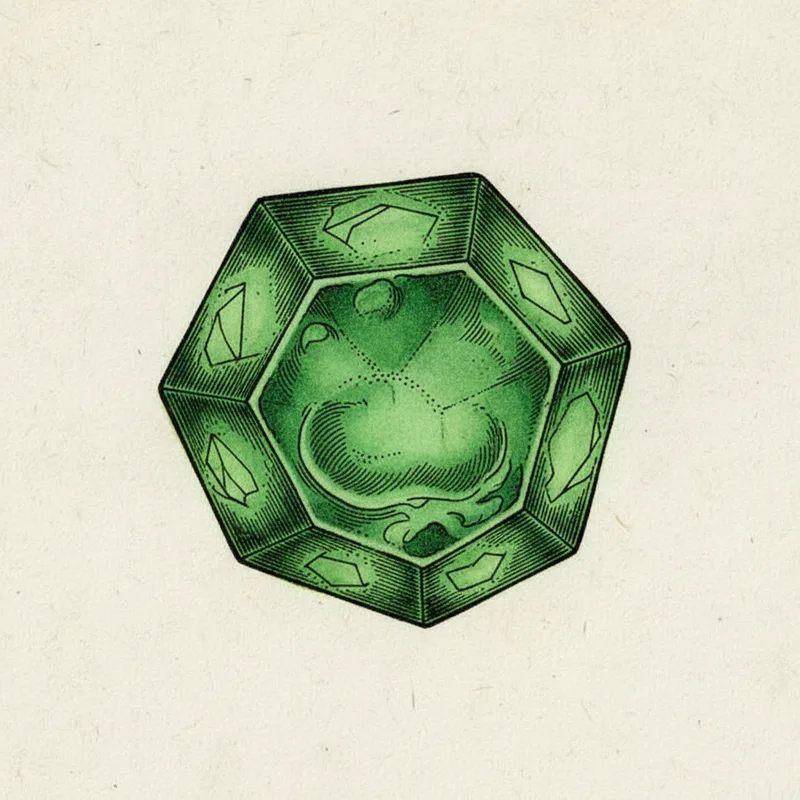
Quick Facts
Formation & Origin
Tsavorite is the vivid green, vanadium- and chromium-colored gem variety of grossular, a calcium aluminum silicate species of the garnet group. Tsavorite forms during regional metamorphism of graphite-bearing, calcium-rich sedimentary rocks at moderate to high pressures and temperatures (500-700°C). The critical ingredient is vanadium (and sometimes chromium), which substitutes for aluminum in the grossular garnet structure to produce the vivid green color.
The crystals grow within metamorphic rocks where graphite acts as a reducing agent, keeping the vanadium in the correct oxidation state for green coloration. Most tsavorite crystals are found in relatively small sizes because the geological conditions that produce them also tend to fracture and break larger crystals during ongoing tectonic activity. Stones over 2 carats are uncommon, and anything over 5 carats is exceptionally rare.
Discovered in 1967 by Scottish gemologist Campbell Bridges in Tanzania, it was later found across the border in Kenya near Tsavo National Park. Tiffany's Henry Platt named it 'tsavorite' and championed its introduction to the gem market in 1974.
Identification Guide
Tsavorite's vivid green color, high refractive index (1.740), and lack of inclusions visible to the naked eye distinguish it from emerald, which almost always has visible inclusions. Under magnification, tsavorite may show graphite crystals and actinolite needles as characteristic inclusions.
Distinguish from chrome diopside (softer, lower refractive index), emerald (lower RI, typically included), peridot (different green tone, double refraction), and chrome tourmaline (different crystal system). Tsavorite is singly refractive as a garnet, which separates it from most green gems.
Spotting Fakes
Green YAG (yttrium aluminum garnet) and green CZ are sometimes sold as tsavorite. A refractometer reading of 1.740 and specific gravity around 3.61 confirms grossular garnet. Lab-created tsavorite does not yet exist commercially, so any genuine tsavorite is natural. The biggest risk is misleading color grading. The most valuable stones are a saturated vivid green without being too dark.
Some links in this post go to Amazon and Etsy. Crystal Almanac earns a commission from qualifying purchases at no extra cost to you. Tools recommended here are ones we would use ourselves to run the tests described - the recommendation comes first, the link is downstream of it.
Cultural & Metaphysical Traditions
Presented as cultural traditions, not scientific evidence
As a green garnet, tsavorite combines the energizing properties attributed to garnets with the heart-chakra associations of green stones. Crystal practitioners consider it a stone of prosperity, vitality, and emotional healing. Its relative rarity and East African origins give it a distinct identity separate from the more ancient garnet traditions.
Metaphysical and “healing” associations are cultural traditions, not medical advice or scientific fact. Crystals are not a substitute for professional medical care.
Where It's Found
Original discovery area, near tanzanite deposits
Namesake locality, Scorpion Mine
Smaller, generally lighter-colored stones
Price Guide
Good to Know
Scratch test: At hardness 7, Tsavorite can scratch glass and steel. It's durable enough for any type of jewelry.
Global supply: Found in 3 notable locations worldwide, from Tanzania to Madagascar.
Heft test: Tsavorite has a specific gravity of 3.61 - noticeably heavier than quartz. You'll feel the density when you pick it up.
Common Questions
What is the chemical formula of Tsavorite?
The chemical formula of Tsavorite is Ca₃Al₂(SiO₄)₃ (with V³⁺/Cr³⁺).
What is Tsavorite's Mohs hardness?
Tsavorite has a Mohs hardness of 7 on the 1 to 10 Mohs scale, hard enough to scratch glass and stand up to daily wear.
Is Tsavorite a mineral?
Yes. Tsavorite is a naturally occurring mineral (Garnet Group (Grossular)) with a definite chemical composition and an ordered crystal structure.
Care & Safety
The water, salt, and sunlight questions people actually ask before cleansing or displaying tsavorite, answered from its hardness (Mohs 7) and chemistry (Ca₃Al₂(SiO₄)₃ (with V³⁺/Cr³⁺)).
Can Tsavorite go in water?
Yes. Tsavorite is hard (Mohs 7) and chemically stable, so a rinse or a quick wash with mild soap is no problem, cleanse it in water freely if that is your practice. A long soak does nothing for it either way, so skip that, and dry the stone afterward.
Can Tsavorite go in salt water?
Not recommended, even though tsavorite itself is hard and not water-soluble. Salt is both corrosive and mildly abrasive: it can dull a polished surface, attack metal settings, and crystallize inside small fractures as the stone dries. A quick dip will not destroy tsavorite, but rinse it with fresh water afterward and dry it. For routine cleaning, plain water is the kinder choice.
Sources & References
The mineralogical and gemological data on this page is drawn from and can be cross-checked against these external references.
- WikipediaTsavorite on Wikipedia
- WebmineralGrossular mineral data (Webmineral)
- Handbook of MineralogyGrossular (Handbook of Mineralogy, PDF)
- GIATsavorite in the GIA Gem Encyclopedia
Explore More
Garnet Group
The Abundance Collection
The vivid green grossular garnet rivaling emerald. Discovered in 1967 and championed by Tiffany's, it represents modern gem-world abundance and the rewards of persistent searching.
Scorpio Season Crystals 2026: Stones for Transformation
Expensive-Looking Crystals You Can Actually Afford
Emerald: The May Birthstone, Properties, and How It's Used
Mohs Hardness Scale
See where Tsavorite sits on the scale
Crystal Care Guide
Water safety, sunlight, and handling tips
Save This Stone
%20and%20green%20CZ%20are%20sometimes%20sold%20as%20tsavorite.%20Meaning%2C%20properties%20%26%20how%20to%20spot%20fakes%20at%20Crystal%20Almanac.)
Keep this tsavorite reference handy. Save the card to a Pinterest board and the profile is one tap away.
Save to PinterestNewsletter
Something shiny, now and then
A stone worth knowing, or a fake worth spotting, every so often. No spam.