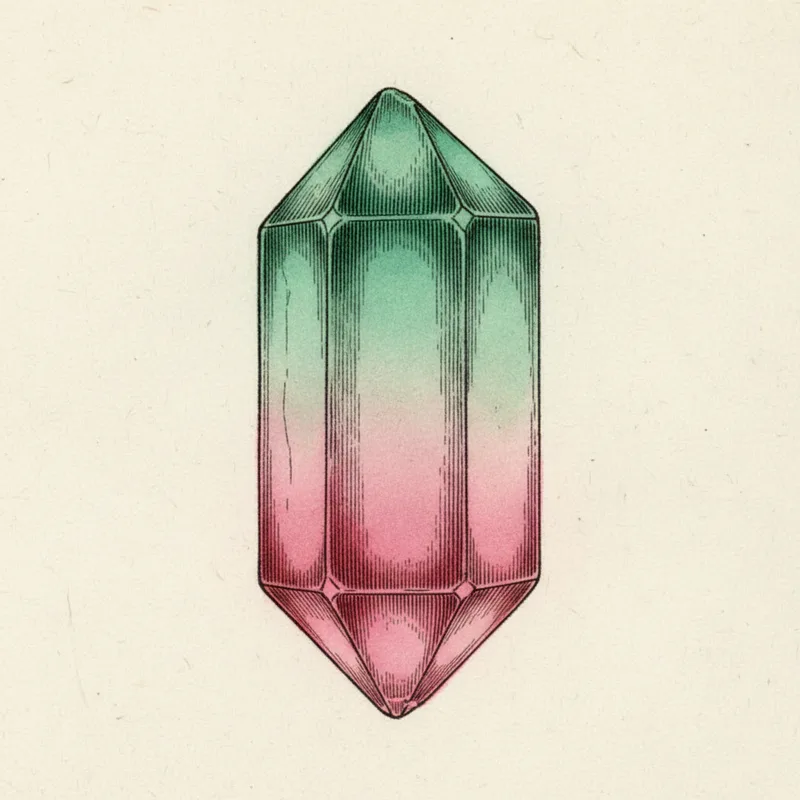
Bi-Color Tourmaline
Elbaite with two color zones
Affiliate links. We may earn a commission, at no cost to you.
Quick Facts
Formation & Origin
Bi-color tourmaline is a variety of elbaite, the lithium-rich tourmaline species, in which a single crystal displays two or more distinct color zones. Bi-color tourmaline crystallizes in the miarolitic pockets of granitic pegmatites during late-stage hydrothermal activity, when residual fluids saturated in boron, lithium, aluminum, and trace transition metals fill open cavities and grow elbaite crystals on pocket walls. The distinctive color zoning records compositional shifts in the hydrothermal fluid as the crystal elongated along its c-axis. Pink to red zones develop when manganese as Mn²⁺ dominates the available chromophores, while green zones form when iron as Fe²⁺ or a combination of iron and manganese controls the coloration. Blue zones reflect higher iron content, and colorless zones mark intervals when chromophore supply dropped. As the pocket fluid evolved through fractional crystallization, temperature changes, or influx of new fluid batches, the element balance shifted and the growing crystal recorded each change as a new color zone. Watermelon tourmaline represents the special case of radial zoning, where a pink core is surrounded by a green rim produced when late-stage fluids rich in iron enveloped an earlier manganese-dominated core. Linear bi-color specimens, with pink and green zones stacked sequentially along the c-axis, are more common and record straightforward temporal changes in pocket chemistry. The sharpness of zone boundaries depends on how rapidly the fluid composition shifted.
Identification Guide
Genuine bi-color tourmaline shows sharp color transitions along or across the c-axis, with the prism faces displaying the characteristic deep longitudinal striations diagnostic of the tourmaline group. Hardness tests at 7.5, and specific gravity sits at 3.06, notably denser than bi-color quartz imitations at 2.65. The trigonal crystal system produces three-fold symmetry in cross section, often appearing as rounded triangular prisms. Strong dichroism is visible in each color zone when viewed with a dichroscope or through polarizing filters, with the color perpendicular to the c-axis differing predictably from the color along it. Natural specimens typically show minor inclusions, growth tubes, or fractures healed with fluid.
Spotting Fakes
Assembled bi-color quartz imitations show a visible glue line at the color boundary, often detectable under a 10x loupe or by immersing the stone in water and watching the seam become more apparent. Heat-treated tourmalines can have their colors modified but cannot produce the truly sharp zone boundaries seen in natural bi-colors, as heat diffuses color gradually rather than creating crisp transitions. Cubic zirconia bi-color assemblies lack tourmaline's characteristic striations and show a lower specific gravity. Check for longitudinal grooves on prism faces, which are a reliable tourmaline signature absent in most fakes. Conduct a dichroism test by rotating the stone under polarized light: each zone of a genuine bi-color should show two distinct colors along different optical axes, with the dichroism patterns differing between the pink and green zones. Refractive index of 1.62 to 1.64 is another diagnostic.
Some links in this post go to Amazon and Etsy. Crystal Almanac earns a commission from qualifying purchases at no extra cost to you. Tools recommended here are ones we would use ourselves to run the tests described - the recommendation comes first, the link is downstream of it.
Cultural & Metaphysical Traditions
Presented as cultural traditions, not scientific evidence
Contemporary crystal tradition associates bi-color tourmaline with balance and integration, with the two colors symbolizing the union of complementary energies. The pink and green watermelon variant is especially linked to heart healing in modern metaphysical writing. Historical use of tourmaline was widespread in ancient Egypt and pre-colonial Sri Lanka, though color zoning was not typically distinguished in those traditions. Native Californian miners in the early twentieth century Pala district gave watermelon tourmaline to the Chinese imperial court, where it was prized as a carving material. These are cultural associations rather than verified physical properties.
Metaphysical and “healing” associations are cultural traditions, not medical advice or scientific fact. Crystals are not a substitute for professional medical care.
Where It's Found
Primary world source for bi-color elbaite, with major production from the Araçuaí and São José da Safira pegmatite districts
Produces distinctive pink-colorless bi-colors with exceptional transparency and sharp zone boundaries
Source of unusual tri-color specimens with pink, green, and colorless zones along a single c-axis
Historic source of fine watermelon and bi-color tourmaline from the Stewart, Tourmaline Queen, and Himalaya mines
Produces rare copper-bearing bi-colors combining neon blue-green with pink zones
Price Guide
Good to Know
Scratch test: At hardness 7.5, Bi-Color Tourmaline can scratch glass and steel. It's durable enough for any type of jewelry.
Global supply: Found in 5 notable locations worldwide, from Minas Gerais to Paraíba.
Heft test: Bi-Color Tourmaline has average mineral density (3.06). It feels about as heavy as you'd expect from a stone its size.
Common Questions
What is the chemical formula of Bi-Color Tourmaline?
The chemical formula of Bi-Color Tourmaline is Na(Li,Al)₃Al₆(BO₃)₃Si₆O₁₈(OH)₄.
What is Bi-Color Tourmaline's Mohs hardness?
Bi-Color Tourmaline has a Mohs hardness of 7.5 on the 1 to 10 Mohs scale, hard enough to scratch glass and stand up to daily wear.
Is Bi-Color Tourmaline a mineral?
Yes. Bi-Color Tourmaline is a naturally occurring mineral (Tourmaline Group (Elbaite)) with a definite chemical composition and an ordered crystal structure.
Care & Safety
The water, salt, and sunlight questions people actually ask before cleansing or displaying bi-color tourmaline, answered from its hardness (Mohs 7.5) and chemistry (Na(Li,Al)₃Al₆(BO₃)₃Si₆O₁₈(OH)₄).
Can Bi-Color Tourmaline go in water?
Yes. Bi-Color Tourmaline is hard (Mohs 7.5) and chemically stable, so a rinse or a quick wash with mild soap is no problem, cleanse it in water freely if that is your practice. A long soak does nothing for it either way, so skip that, and dry the stone afterward.
Can Bi-Color Tourmaline go in salt water?
Not recommended, even though bi-color tourmaline itself is hard and not water-soluble. Salt is both corrosive and mildly abrasive: it can dull a polished surface, attack metal settings, and crystallize inside small fractures as the stone dries. A quick dip will not destroy bi-color tourmaline, but rinse it with fresh water afterward and dry it. For routine cleaning, plain water is the kinder choice.
Sources & References
The mineralogical and gemological data on this page is drawn from and can be cross-checked against these external references.
- WikipediaElbaite on Wikipedia
- WebmineralElbaite mineral data (Webmineral)
- Handbook of MineralogyElbaite (Handbook of Mineralogy, PDF)
- GIABi-Color Tourmaline in the GIA Gem Encyclopedia
Related Minerals
Specific subset of bi-color elbaite with concentric pink core and green rim
Single-color pink to red elbaite, same species without the color zoning
Green elbaite, the monochromatic counterpart to green zones in bi-color
Blue elbaite, occasionally appears as a zone in tri-color specimens
Copper-bearing elbaite, rarely forms bi-colors with pink zones
Explore More
Save This Stone

Keep this bi-color tourmaline reference handy. Save the card to a Pinterest board and the profile is one tap away.
Save to PinterestNewsletter
Something shiny, now and then
A stone worth knowing, or a fake worth spotting, every so often. No spam.