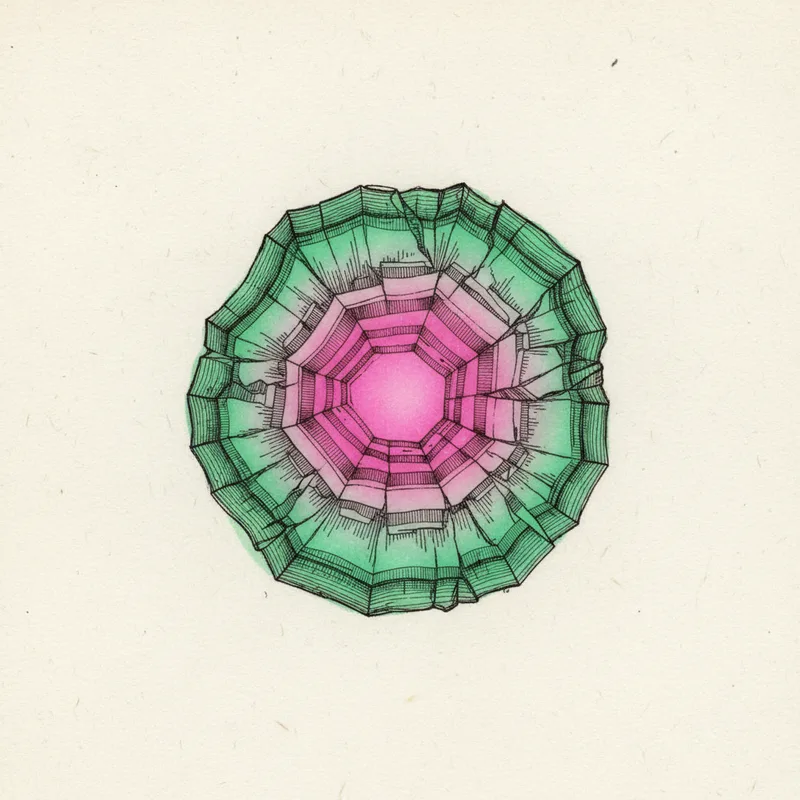
Watermelon Tourmaline
The Dual Heart Stone
Affiliate links. We may earn a commission, at no cost to you.
Quick Facts
Formation & Origin
Watermelon tourmaline is a bicolored variety of elbaite, a lithium-rich tourmaline and complex borosilicate, zoned with a pink core and a green outer rim. Watermelon tourmaline forms when the chemistry of the fluid feeding a growing tourmaline crystal changes during growth. The crystal begins growing with one composition (manganese-rich, producing pink elbaite) and transitions to another (iron or chromium-rich, producing green) - or vice versa. The result is concentric color zoning visible in cross-section: a pink core surrounded by a green rim, resembling a slice of watermelon.
This color transition records real-time changes in the pegmatite fluid chemistry. As the pegmatite crystallizes, the fluid's composition evolves - elements are consumed, new ones become available, pH and temperature shift. Tourmaline's complex borosilicate structure is uniquely sensitive to these changes, incorporating different transition metals at different growth stages.
The finest watermelon tourmalines show a sharp, clean boundary between pink and green zones. Gradual transitions are more common. Slicing the crystal perpendicular to its length (cross-section) produces the classic watermelon appearance, while lengthwise views show bi-color zoning.
Identification Guide
Watermelon tourmaline is identified by its pink-to-green concentric color zoning visible in cross-section, combined with tourmaline's characteristic trigonal crystal form and hardness of 7. The rounded triangular cross-section of tourmaline is visible in sliced specimens.
Distinguish from bi-color fluorite (cubic, softer at 4), dyed quartz (no natural zoning pattern), and assembled stones (two pieces glued together - check for a seam at the color boundary). Genuine watermelon tourmaline's color transition follows the crystal's growth geometry.
Spotting Fakes
Synthetic watermelon tourmaline doesn't exist commercially. The main concerns are: assembled stones (pink and green tourmaline pieces glued together), heavily enhanced material (irradiated to intensify colors), and colored glass. In genuine watermelon tourmaline, the color boundary follows the crystal's growth structure and may show slight irregularity. Assembled stones show a perfectly flat, artificial boundary line. Lab reports confirm natural origin for valuable specimens.
Some links in this post go to Amazon and Etsy. Crystal Almanac earns a commission from qualifying purchases at no extra cost to you. Tools recommended here are ones we would use ourselves to run the tests described - the recommendation comes first, the link is downstream of it.
Cultural & Metaphysical Traditions
Presented as cultural traditions, not scientific evidence
Watermelon tourmaline's pink-and-green combination maps perfectly to heart chakra work in crystal healing - pink represents emotional love and green represents the heart's growth energy. Practitioners consider it one of the most powerful heart-healing stones because it addresses both giving and receiving love simultaneously. The bi-color nature is interpreted as balancing opposing forces, integrating masculine and feminine, and healing emotional wounds while remaining open.
Metaphysical and “healing” associations are cultural traditions, not medical advice or scientific fact. Crystals are not a substitute for professional medical care.
Where It's Found
World's primary source, exceptional quality
Fine bi-color crystals
Good quality material
Classic American locality
Price Guide
Good to Know
Scratch test: At hardness 7, Watermelon Tourmaline can scratch glass and steel. It's durable enough for any type of jewelry.
Global supply: Found in 4 notable locations worldwide, from Brazil to United States.
Heft test: Watermelon Tourmaline has average mineral density (3.06). It feels about as heavy as you'd expect from a stone its size.
Common Questions
What is the chemical formula of Watermelon Tourmaline?
The chemical formula of Watermelon Tourmaline is Na(Li,Al)₃Al₆(BO₃)₃Si₆O₁₈(OH)₄.
What is Watermelon Tourmaline's Mohs hardness?
Watermelon Tourmaline has a Mohs hardness of 7 on the 1 to 10 Mohs scale, hard enough to scratch glass and stand up to daily wear.
Is Watermelon Tourmaline a mineral?
Yes. Watermelon Tourmaline is a naturally occurring mineral (Borosilicate Group) with a definite chemical composition and an ordered crystal structure.
Care & Safety
The water, salt, and sunlight questions people actually ask before cleansing or displaying watermelon tourmaline, answered from its hardness (Mohs 7) and chemistry (Na(Li,Al)₃Al₆(BO₃)₃Si₆O₁₈(OH)₄).
Can Watermelon Tourmaline go in water?
Yes. Watermelon Tourmaline is hard (Mohs 7) and chemically stable, so a rinse or a quick wash with mild soap is no problem, cleanse it in water freely if that is your practice. A long soak does nothing for it either way, so skip that, and dry the stone afterward.
Can Watermelon Tourmaline go in salt water?
Not recommended, even though watermelon tourmaline itself is hard and not water-soluble. Salt is both corrosive and mildly abrasive: it can dull a polished surface, attack metal settings, and crystallize inside small fractures as the stone dries. A quick dip will not destroy watermelon tourmaline, but rinse it with fresh water afterward and dry it. For routine cleaning, plain water is the kinder choice.
Sources & References
The mineralogical and gemological data on this page is drawn from and can be cross-checked against these external references.
- WikipediaElbaite on Wikipedia
- WebmineralElbaite mineral data (Webmineral)
- Handbook of MineralogyElbaite (Handbook of Mineralogy, PDF)
- GIAWatermelon Tourmaline in the GIA Gem Encyclopedia
Explore More
Tourmaline Group
The Love Collection
Pink core + green rim maps to the heart chakra's dual energy: emotional love (pink) and growth (green).
Libra Season Crystals 2026: Stones for Balance
October Birthstones: Opal and Tourmaline
How to Identify a Crystal by Its Mineral Group
Mohs Hardness Scale
See where Watermelon Tourmaline sits on the scale
Crystal Care Guide
Water safety, sunlight, and handling tips
Save This Stone

Keep this watermelon tourmaline reference handy. Save the card to a Pinterest board and the profile is one tap away.
Save to PinterestNewsletter
Something shiny, now and then
A stone worth knowing, or a fake worth spotting, every so often. No spam.