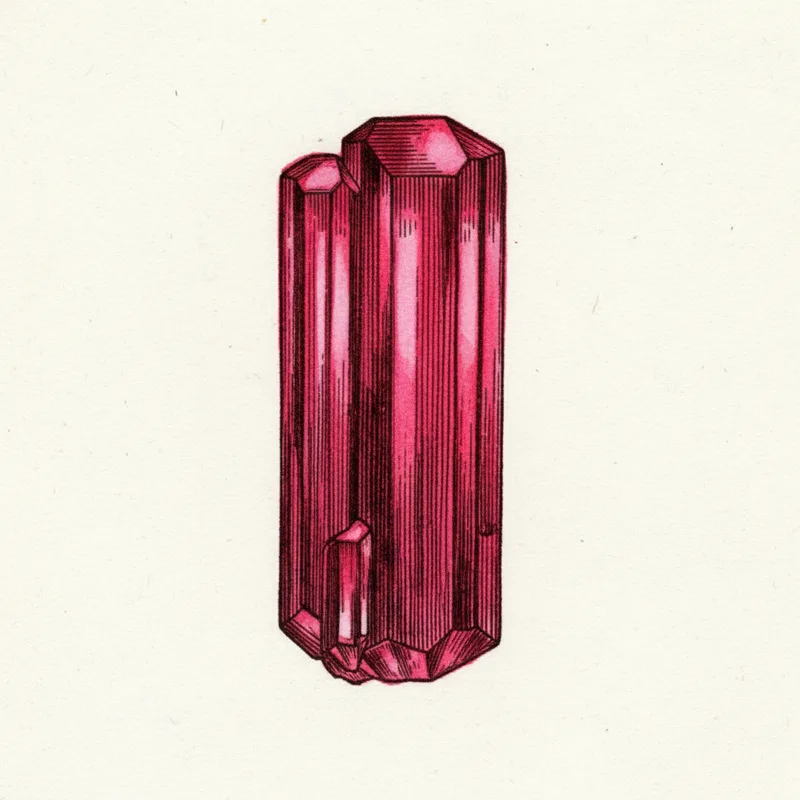
Rubellite
The Red Tourmaline Royalty
Affiliate links. We may earn a commission, at no cost to you.
Quick Facts
Formation & Origin
Rubellite is the red to pink variety of tourmaline (specifically elbaite), colored by manganese and sometimes lithium in the crystal structure. It forms in lithium-rich granitic pegmatites where boron, aluminum, and lithium-bearing fluids create the complex chemistry required for tourmaline crystallization.
The finest rubellite has a saturated red that holds its color in both natural and incandescent light. Many pink tourmalines shift to a brownish or grayish tone under incandescent light, but true rubellite maintains its vivid red. This light-stability test is what separates rubellite from ordinary pink tourmaline in the gem trade.
Rubellite often forms in the same pegmatite pockets as other tourmaline varieties, sometimes in the same crystal (creating watermelon tourmaline). The color change from green to red within a single crystal occurs as the fluid chemistry shifts during growth, with increasing manganese concentration producing the red zones.
Identification Guide
Rubellite is identified as a red to purplish-red tourmaline that maintains its color under different lighting conditions. The trigonal crystal system produces striated, elongated prisms with a distinctive rounded triangular cross-section.
Distinguish from red spinel (isometric, single refractive), ruby (higher RI, greater hardness of 9), rhodolite garnet (isometric, different RI), and pink sapphire (trigonal but different properties). Rubellite shows strong pleochroism: different shades of red when viewed from different angles.
Spotting Fakes
The main concern in the rubellite market is color enhancement. Some pink tourmalines are irradiated to intensify their color toward red. This treatment is stable but should be disclosed. Glass-filled rubellite (similar to lead-glass-filled ruby) is increasingly common, especially in lower-price stones. Check for internal flash effects under magnification, which indicate glass filling. Synthetic tourmaline exists but is not commercially significant.
Some links in this post go to Amazon and Etsy. Crystal Almanac earns a commission from qualifying purchases at no extra cost to you. Tools recommended here are ones we would use ourselves to run the tests described - the recommendation comes first, the link is downstream of it.
Cultural & Metaphysical Traditions
Presented as cultural traditions, not scientific evidence
Rubellite is considered the most emotionally intense tourmaline variety in crystal healing. Practitioners associate it with deep love, emotional courage, and healing the heart from grief or betrayal. Its red color connects it to passionate energy, while its tourmaline nature provides the protective properties attributed to the tourmaline family.
Metaphysical and “healing” associations are cultural traditions, not medical advice or scientific fact. Crystals are not a substitute for professional medical care.
Where It's Found
Classic source for fine rubellite
Vivid red-pink crystals
Excellent gem-quality material
Deep red crystals
Price Guide
Good to Know
Scratch test: At hardness 7.5, Rubellite can scratch glass and steel. It's durable enough for any type of jewelry.
Global supply: Found in 4 notable locations worldwide, from Brazil to Afghanistan.
Heft test: Rubellite has average mineral density (3.01-3.11). It feels about as heavy as you'd expect from a stone its size.
Common Questions
What is the chemical formula of Rubellite?
The chemical formula of Rubellite is Na(Li,Al)₃Al₆(BO₃)₃Si₆O₁₈(OH)₄.
What is Rubellite's Mohs hardness?
Rubellite has a Mohs hardness of 7.5 on the 1 to 10 Mohs scale, hard enough to scratch glass and stand up to daily wear.
Is Rubellite a mineral?
Yes. Rubellite is a naturally occurring mineral (Tourmaline Group (Elbaite)) with a definite chemical composition and an ordered crystal structure.
Care & Safety
The water, salt, and sunlight questions people actually ask before cleansing or displaying rubellite, answered from its hardness (Mohs 7.5) and chemistry (Na(Li,Al)₃Al₆(BO₃)₃Si₆O₁₈(OH)₄).
Can Rubellite go in water?
Yes. Rubellite is hard (Mohs 7.5) and chemically stable, so a rinse or a quick wash with mild soap is no problem, cleanse it in water freely if that is your practice. A long soak does nothing for it either way, so skip that, and dry the stone afterward.
Can Rubellite go in salt water?
Not recommended, even though rubellite itself is hard and not water-soluble. Salt is both corrosive and mildly abrasive: it can dull a polished surface, attack metal settings, and crystallize inside small fractures as the stone dries. A quick dip will not destroy rubellite, but rinse it with fresh water afterward and dry it. For routine cleaning, plain water is the kinder choice.
Sources & References
The mineralogical and gemological data on this page is drawn from and can be cross-checked against these external references.
- WikipediaElbaite on Wikipedia
- WebmineralElbaite mineral data (Webmineral)
- Handbook of MineralogyElbaite (Handbook of Mineralogy, PDF)
- GIARubellite in the GIA Gem Encyclopedia
Explore More
Tourmaline Group
The Love Collection
The red tourmaline of deep, passionate love. Maintains its vivid red in any light - associated with love that doesn't shift or fade with changing circumstances.
October Birthstones: Opal and Tourmaline
How Crystals Form: Pegmatite, Hydrothermal, Sedimentary
Expensive-Looking Crystals You Can Actually Afford
Mohs Hardness Scale
See where Rubellite sits on the scale
Crystal Care Guide
Water safety, sunlight, and handling tips
Save This Stone
%20is%20increasingly%20common%2C%20especially%20in%20lower-price%20stones.%20Meaning%2C%20properties%20%26%20how%20to%20spot%20fakes%20at%20Crystal%20Almanac.)
Keep this rubellite reference handy. Save the card to a Pinterest board and the profile is one tap away.
Save to PinterestNewsletter
Something shiny, now and then
A stone worth knowing, or a fake worth spotting, every so often. No spam.