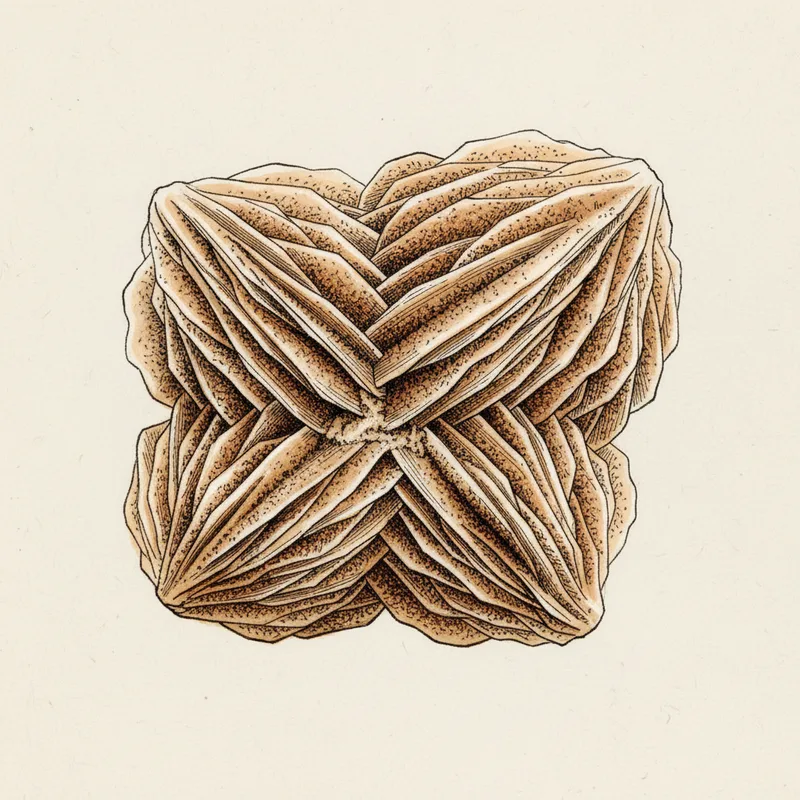
Desert Rose
The Sand Flower
Affiliate links. We may earn a commission, at no cost to you.
Quick Facts
Formation & Origin
Desert rose is the name for rosette-shaped crystal clusters of gypsum (a hydrated calcium sulfate) or baryte (a barium sulfate) that form in arid, sandy settings. Desert roses are rosette-shaped crystal clusters that form in arid, sandy environments when evaporating groundwater deposits gypsum (selenite) or baryte around sand grains. The crystals grow in flat, radiating blades that resemble the petals of a rose, incorporating sand grains into their structure as they grow.
The formation process requires specific conditions: a shallow water table that fluctuates with seasons, sandy soil, and dissolved calcium or barium sulfate in the groundwater. As water evaporates during dry seasons, the dissolved minerals crystallize around sand particles, building up petal-like blades over time.
Desert roses made of selenite (gypsum) are the most common - these are relatively soft (hardness 2) and lightweight. Desert roses made of baryte are much heavier (SG 4.48 vs 2.32) and somewhat harder. The baryte variety is the state crystal of Oklahoma, where spectacular specimens occur in Permian-age red sandstone.
Identification Guide
Desert roses are identified by their distinctive flower-like rosette form, sandy surface texture (sand grains trapped in crystal), and either lightweight feel (selenite) or notably heavy feel (baryte). The rosette habit is unmistakable.
Distinguish selenite desert roses from baryte desert roses by weight - baryte is nearly twice as dense. Both types have sandy surfaces and rosette forms. True desert roses are never glass-smooth; the incorporated sand grains give them a rough, granular texture.
Spotting Fakes
Desert roses are abundant and inexpensive, so faking is unnecessary. The main caution is that selenite desert roses are extremely fragile - they can crumble if handled roughly. Baryte roses are more durable. Some sellers market concrete-cast or plaster roses as natural - genuine desert roses have real sand grains embedded throughout (visible under magnification) and crystal structure visible on blade edges. Desert roses should never be immersed in water (especially selenite varieties, which can dissolve).
Some links in this post go to Amazon and Etsy. Crystal Almanac earns a commission from qualifying purchases at no extra cost to you. Tools recommended here are ones we would use ourselves to run the tests described - the recommendation comes first, the link is downstream of it.
Cultural & Metaphysical Traditions
Presented as cultural traditions, not scientific evidence
In North African and Middle Eastern traditions, desert roses are considered gifts from the spirits of the desert and are placed in homes for protection and prosperity. Bedouin cultures have collected them for centuries. In modern crystal healing, their flower-like form connects them to growth, patience, and flourishing in difficult conditions (blooming in the desert as metaphor). They're also associated with clarity of purpose and releasing self-imposed limitations.
Metaphysical and “healing” associations are cultural traditions, not medical advice or scientific fact. Crystals are not a substitute for professional medical care.
Where It's Found
Large, dramatic specimens
Classic rose formations, major source
Commercial quantities
Oklahoma state crystal (baryte rose)
Price Guide
Good to Know
Scratch test: At hardness 2, Desert Rose can be scratched with a fingernail. This is a display specimen, not a wearable stone.
Global supply: Found in 4 notable locations worldwide, from Mexico to United States.
Heft test: With a specific gravity of 2.32 (selenite) or 4.48 (baryte), Desert Rose feels lighter than most minerals. This lightness can help identify it.
Common Questions
What is the chemical formula of Desert Rose?
The chemical formula of Desert Rose is CaSO₄·2H₂O (selenite) or BaSO₄ (baryte).
What is Desert Rose's Mohs hardness?
Desert Rose has a Mohs hardness of 2 on the 1 to 10 Mohs scale, soft enough to scratch with a fingernail.
Is Desert Rose a mineral?
Yes. Desert Rose is a naturally occurring mineral (Sulfate Group (Selenite/Baryte variety)) with a definite chemical composition and an ordered crystal structure.
Care & Safety
The water, salt, and sunlight questions people actually ask before cleansing or displaying desert rose, answered from its hardness (Mohs 2) and chemistry (CaSO₄·2H₂O (selenite) or BaSO₄ (baryte)).
Can Desert Rose go in water?
No, never. A selenite variety. Water-soluble and extremely fragile. Never expose to moisture.
Can Desert Rose go in salt water?
No, never. Desert rose is a sand-included gypsum (selenite) formation, water-soluble and extremely fragile. Salt water dissolves the crystal blades and destroys the rosette. Keep it completely dry.
Sources & References
The mineralogical and gemological data on this page is drawn from and can be cross-checked against these external references.
- WikipediaDesert rose (crystal) on Wikipedia
- WebmineralGypsum mineral data (Webmineral)
- Handbook of MineralogyGypsum (Handbook of Mineralogy, PDF)
Related Minerals
The gypsum mineral that forms most desert roses
The heavier mineral that forms some desert roses
The mineral species selenite belongs to
Similar sand-incorporated crystal formation
Explore More
Save This Stone

Keep this desert rose reference handy. Save the card to a Pinterest board and the profile is one tap away.
Save to PinterestNewsletter
Something shiny, now and then
A stone worth knowing, or a fake worth spotting, every so often. No spam.