Pargasite
Calcium Sodium Magnesium Amphibole
Affiliate links. We may earn a commission, at no cost to you.
Quick Facts
Formation & Origin
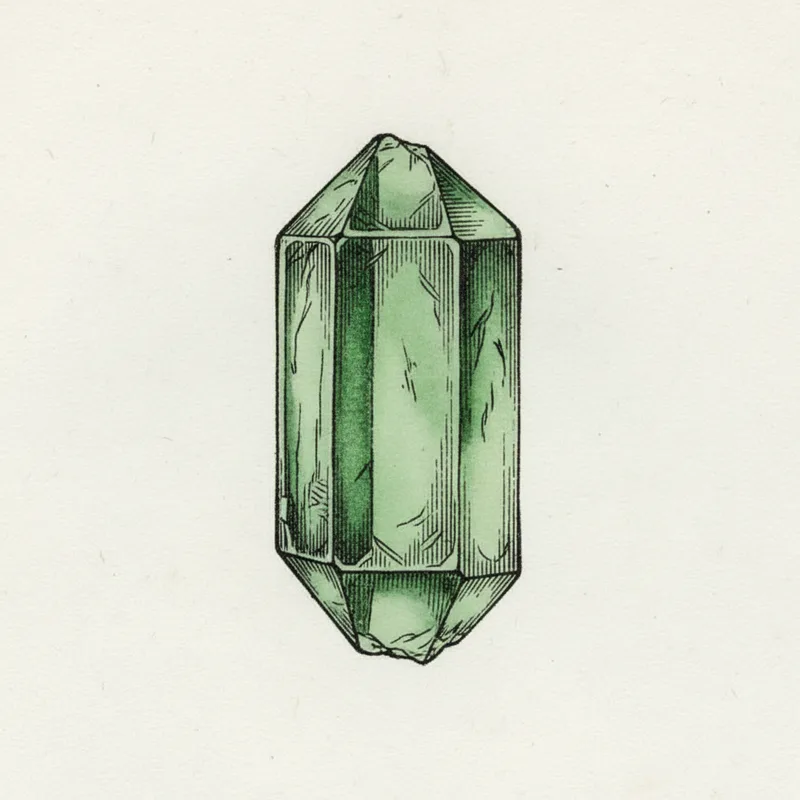
Pargasite is a calcium sodium magnesium silicate of the amphibole group, a complex hydrous mineral that crystallizes in green to brown-green prisms. Pargasite forms during contact metamorphism when granitic or syenitic magmas intrude impure dolomitic limestones. The heat and fluid interaction between silica-rich melts and carbonate-bearing country rock generates the calcium, sodium, magnesium, and aluminum proportions needed for amphibole crystallization. The Pargas district in Finland, the 1814 type locality, is the textbook example of this marble-granite contact aureole setting. The premier gem source at Kukh-i-Lal in Tajikistan's Pamir Mountains produces exceptional transparent crystals from a spinel-bearing marble skarn, where pargasite crystallizes alongside ruby-red spinel and yellow clinohumite from the same metamorphic event. Myanmar's Mogok valley hosts pargasite in ruby-bearing marbles formed under similar conditions. Crystals typically occur as stubby prismatic forms with the diagnostic 124 degree amphibole cleavage angles.
Identification Guide
Pargasite shows vivid green to blue-green color in gem-quality material, driven by Fe²⁺ and Fe³⁺ substitution in the amphibole structure. Gem crystals from Tajikistan are typically 1-3 carat faceted stones with refractive index 1.61-1.63 and biaxial negative optic character. The diagnostic feature is amphibole cleavage at 124 and 56 degrees, visible on broken surfaces, which distinguishes pargasite from pyroxenes with their 90 degree cleavage. Specific gravity of 3.04-3.17 is moderate for the amphibole group. Hardness of 5-6 is softer than quartz. Crystals are prismatic and monoclinic, often with rhombic cross-sections. Streak is white to faintly greenish. Vitreous luster on crystal faces, pearly on cleavage surfaces.
Spotting Fakes
Tsavorite garnet is the most common confusion at retail level since both produce vivid green faceted stones. Tsavorite has much higher refractive index of 1.73-1.75 and is singly refractive, while pargasite is doubly refractive with visible birefringence doubling on facet junctions under a 10x loupe. Emerald can be confused at surface glance but has much higher RI and a distinctive chromium absorption spectrum visible with a handheld spectroscope. Peridot shares similar RI range but has no cleavage, while pargasite's perfect 124 degree amphibole cleavage is diagnostic and visible on any broken edge. Green glass imitations lack cleavage entirely and show gas bubbles or swirl marks under magnification. Synthetic pargasite is not produced commercially, so any stone sold as pargasite should be natural. Verify Tajik provenance with locality documentation, since Kukh-i-Lal material commands premium pricing.
Some links in this post go to Amazon and Etsy. Crystal Almanac earns a commission from qualifying purchases at no extra cost to you. Tools recommended here are ones we would use ourselves to run the tests described - the recommendation comes first, the link is downstream of it.
Cultural & Metaphysical Traditions
Presented as cultural traditions, not scientific evidence
A relatively obscure stone in metaphysical circles due to its rarity, pargasite has been adopted by some collectors as a stone of disciplined growth and structural integrity, reflecting its formation in the high-pressure contact zones between granite and limestone. Modern practitioners associate the green amphibole with heart-centered focus and the grounded persistence required for long-term projects. Traditional lapidary literature treated pargasite primarily as a collector and gem curiosity rather than a magical material.
Metaphysical and “healing” associations are cultural traditions, not medical advice or scientific fact. Crystals are not a substitute for professional medical care.
Where It's Found
Premier gem-quality locality producing transparent faceted-grade crystals in marble skarns alongside spinel and clinohumite
Type locality described in 1814, the classic marble-granite contact aureole where the mineral was first named
Occurs in ruby-bearing marbles, often intergrown with spinel and pale blue apatite
Produces brownish-green opaque to translucent prismatic crystals
Alkaline intrusion locality producing dark green crystals in syenite
Price Guide
Good to Know
Scratch test: At hardness 6, Pargasite resists scratching from a knife but can be scratched by quartz. Best for pendants and earrings rather than rings.
Global supply: Found in 5 notable locations worldwide, from Kukh-i-Lal to Greenland.
Heft test: Pargasite has average mineral density (3.04-3.17). It feels about as heavy as you'd expect from a stone its size.
Common Questions
What is the chemical formula of Pargasite?
The chemical formula of Pargasite is NaCa₂(Mg,Fe)₄Al(Si₆Al₂)O₂₂(OH)₂.
What is Pargasite's Mohs hardness?
Pargasite has a Mohs hardness of 6 on the 1 to 10 Mohs scale, hard enough to scratch glass but softer than quartz.
Is Pargasite a mineral?
Yes. Pargasite is a naturally occurring mineral (Amphibole Group) with a definite chemical composition and an ordered crystal structure.
Care & Safety
The water, salt, and sunlight questions people actually ask before cleansing or displaying pargasite, answered from its hardness (Mohs 6) and chemistry (NaCa₂(Mg,Fe)₄Al(Si₆Al₂)O₂₂(OH)₂).
Can Pargasite go in water?
Yes. Pargasite is not water-soluble and durable enough (Mohs 6), so a rinse or a quick wash with mild soap is no problem, cleanse it in water freely if that is your practice. A long soak does nothing for it either way, so skip that, and dry the stone afterward.
Can Pargasite go in salt water?
Not recommended, even though pargasite itself is hard and not water-soluble. Salt is both corrosive and mildly abrasive: it can dull a polished surface, attack metal settings, and crystallize inside small fractures as the stone dries. Pargasite's iron content also makes rust staining likely if salt residue sits on the surface. A quick dip will not destroy pargasite, but rinse it with fresh water afterward and dry it. For routine cleaning, plain water is the kinder choice.
Sources & References
The mineralogical and gemological data on this page is drawn from and can be cross-checked against these external references.
- WikipediaPargasite on Wikipedia
- WebmineralPargasite mineral data (Webmineral)
- Handbook of MineralogyPargasite (Handbook of Mineralogy, PDF)
Related Minerals
Closely related amphibole end-member, often confused in hand specimen
Calcium amphibole forming in similar metamorphic environments
Iron-rich amphibole sharing formation conditions
Co-occurs at Kukh-i-Lal and Mogok in ruby-spinel-pargasite marble assemblages
Associated mineral in Pamir marble skarn deposits
Explore More
Save This Stone

Keep this pargasite reference handy. Save the card to a Pinterest board and the profile is one tap away.
Save to PinterestNewsletter
Something shiny, now and then
A stone worth knowing, or a fake worth spotting, every so often. No spam.