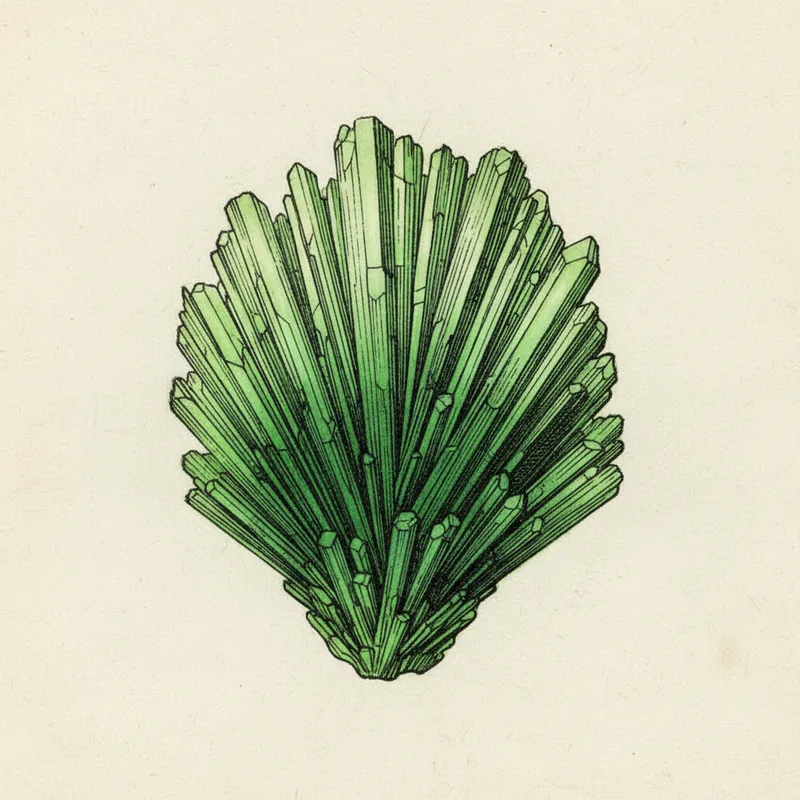
Actinolite
The Ray Stone
Affiliate links. We may earn a commission, at no cost to you.
Quick Facts
Formation & Origin
Actinolite is a member of the amphibole mineral group that forms during metamorphism of mafic (magnesium and iron-rich) rocks at moderate temperatures and pressures. It's a key indicator mineral of the greenschist metamorphic facies, representing conditions of approximately 300-500°C.
The mineral forms a solid solution series with tremolite (the magnesium-rich end member). When actinolite grows as densely interlocking microscopic fibers, the result is nephrite jade, one of the toughest natural materials. In other habits, it forms elongated prismatic crystals, sometimes radiating sprays, and occasionally fibrous aggregates.
The name comes from the Greek 'aktinos' (ray) and 'lithos' (stone), referring to its common radiating crystal habit. Note: fibrous actinolite is a form of asbestos (actinolite asbestos) and should not be disturbed in its fibrous form. Crystal specimens are safe to handle normally.
Identification Guide
Actinolite is identified by its dark green color, elongated prismatic to bladed crystal habit, two cleavage directions at approximately 56 and 124 degrees (characteristic of amphiboles), and association with metamorphic rocks.
Distinguish from epidote (pistachio green, different cleavage angle), hornblende (darker, different composition), and chrome diopside (single good cleavage, pyroxene). The double cleavage at approximately 56/124 degrees is the most reliable amphibole identifier.
Spotting Fakes
Actinolite crystal specimens are not commonly faked. The main issues are: (1) confusion with other green amphiboles or pyroxenes, and (2) marketing fibrous actinolite as a metaphysical stone when it should be handled carefully. Nephrite jade (which is fibrous actinolite-tremolite) is frequently faked with serpentine or dyed quartzite, but this is addressed under the nephrite entry.
Some links in this post go to Amazon and Etsy. Crystal Almanac earns a commission from qualifying purchases at no extra cost to you. Tools recommended here are ones we would use ourselves to run the tests described - the recommendation comes first, the link is downstream of it.
Cultural & Metaphysical Traditions
Presented as cultural traditions, not scientific evidence
Actinolite is considered a shield stone in crystal healing, associated with protecting the energy body and maintaining healthy boundaries. Its status as the raw material of nephrite jade connects it to jade's long tradition of wisdom and moral virtue. Practitioners use it for aligning actions with values and building resilience. NOTE: Avoid fibrous specimens for handling. Crystal specimens are safe.
Metaphysical and “healing” associations are cultural traditions, not medical advice or scientific fact. Crystals are not a substitute for professional medical care.
Where It's Found
Classic locality for crystal specimens
Nephrite jade deposits (fibrous actinolite)
Nephrite jade from actinolite-tremolite
Crystal specimens and cat's eye material
Price Guide
Good to Know
Scratch test: At hardness 5.5, Actinolite resists scratching from a knife but can be scratched by quartz. Best for pendants and earrings rather than rings.
Global supply: Found in 4 notable locations worldwide, from Austria to Madagascar.
Heft test: Actinolite has average mineral density (3.00-3.44). It feels about as heavy as you'd expect from a stone its size.
Common Questions
What is the chemical formula of Actinolite?
The chemical formula of Actinolite is Ca₂(Mg,Fe²⁺)₅Si₈O₂₂(OH)₂.
What is Actinolite's Mohs hardness?
Actinolite has a Mohs hardness of 5.5 on the 1 to 10 Mohs scale, hard enough to scratch glass but softer than quartz.
Is Actinolite a mineral?
Yes. Actinolite is a naturally occurring mineral (Amphibole Group (Silicate)) with a definite chemical composition and an ordered crystal structure.
Care & Safety
The water, salt, and sunlight questions people actually ask before cleansing or displaying actinolite, answered from its hardness (Mohs 5.5) and chemistry (Ca₂(Mg,Fe²⁺)₅Si₈O₂₂(OH)₂).
Can Actinolite go in water?
Yes. Actinolite is not water-soluble and durable enough (Mohs 5.5), so a rinse or a quick wash with mild soap is no problem, cleanse it in water freely if that is your practice. A long soak does nothing for it either way, so skip that, and dry the stone afterward.
Can Actinolite go in salt water?
Not recommended, even though actinolite itself is hard and not water-soluble. Salt is both corrosive and mildly abrasive: it can dull a polished surface, attack metal settings, and crystallize inside small fractures as the stone dries. Actinolite's iron content also makes rust staining likely if salt residue sits on the surface. A quick dip will not destroy actinolite, but rinse it with fresh water afterward and dry it. For routine cleaning, plain water is the kinder choice.
Sources & References
The mineralogical and gemological data on this page is drawn from and can be cross-checked against these external references.
- WikipediaActinolite on Wikipedia
- WebmineralActinolite mineral data (Webmineral)
- Handbook of MineralogyActinolite (Handbook of Mineralogy, PDF)
Explore More
Save This Stone

Keep this actinolite reference handy. Save the card to a Pinterest board and the profile is one tap away.
Save to PinterestNewsletter
Something shiny, now and then
A stone worth knowing, or a fake worth spotting, every so often. No spam.