Quick Facts
Formation & Origin
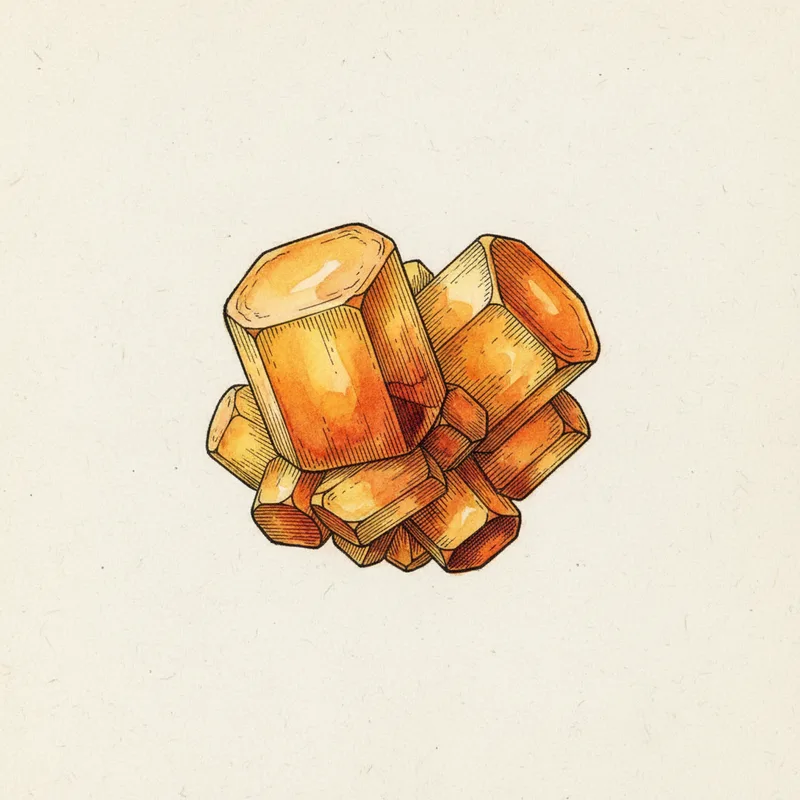
Clinohumite is a magnesium silicate mineral of the humite group (Mg₉(SiO₄)₄(F,OH)₂), valued in its rare transparent orange form as a collector gem. Clinohumite belongs to the humite group, a family of magnesium-rich silicates with the generalized formula nMg₂SiO₄ · Mg(F,OH)₂. It forms in contact metamorphic settings where dolomitic limestones are intruded by granitic or alkaline magmas, and boron, fluorine, and hydroxyl-rich fluids migrate through the carbonate host rock. The reaction between these fluids and the magnesium-bearing carbonates produces clinohumite alongside spinel, pargasite, phlogopite, and chondrodite.
The Kukh-i-Lal deposit in the Pamir Mountains of Tajikistan formed this way during the Cenozoic collision that built the Pamir-Karakoram range. Clinohumite crystallizes in monoclinic prismatic crystals within white marble skarns, often associated with red spinel and deep blue lazurite in the same outcrop. Though the mineral was first described from Mount Vesuvius in 1876, gem-quality transparent material was unknown until Soviet geologists surveyed the Pamir deposit in the 1980s.
The vivid orange color comes from a Fe²⁺ to Ti⁴⁺ intervalence charge transfer, the same optical mechanism that produces blue in sapphire but shifted to the orange part of the spectrum by the different host crystal structure. Trace chromium can push the hue toward red.
Identification Guide
Clinohumite's diagnostic signature is its unusually high birefringence of 0.034, among the highest of any transparent gem. Under a loupe, faceted stones show obvious doubling of the back facet edges, a test that rules out the most common confusables. Refractive index runs 1.629 to 1.674, specific gravity 3.17 to 3.35.
Pleochroism is distinct: rotating a faceted stone shows a shift from pale yellow through golden orange to deeper reddish orange on different axes. Under longwave UV some specimens fluoresce a weak yellow, though this is not reliable across all material. The monoclinic crystal system produces a slightly oblique extinction angle under crossed polars. Facet-grade Pamir gems over 1 carat are exceptional, with most commercial stones falling between 0.3 and 0.8 carats.
Spotting Fakes
Clinohumite is most often confused with spessartine garnet and hessonite garnet, which share the orange color range. The key separation is optical character. Both garnets are singly refractive isotropic stones, while clinohumite is strongly anisotropic and doubly refractive. A polariscope check or simple loupe examination of facet doubling settles the question in seconds.
Heat-treated hessonite and synthetic orange spinel are occasionally sold as clinohumite substitutes at lower prices. Synthetic spinel is isotropic and lacks pleochroism. Mandarin garnet from Namibia can approach clinohumite's color but again shows no birefringence. Because clinohumite is obscure enough that casual buyers rarely seek it, most material sold under the name is genuine, but always request gemological paperwork for any purchase over $500. Verify the stone came from the Kukh-i-Lal Pamir locality if paying premium Pamir prices, as Tanzanian material is legitimate clinohumite but trades at a significant discount.
Some links in this post go to Amazon and Etsy. Crystal Almanac earns a commission from qualifying purchases at no extra cost to you. Tools recommended here are ones we would use ourselves to run the tests described - the recommendation comes first, the link is downstream of it.
Cultural & Metaphysical Traditions
Presented as cultural traditions, not scientific evidence
As a modern gem with no deep historical tradition, clinohumite carries relatively new metaphysical associations. Contemporary crystal practitioners connect its warm orange-gold fire to creative vitality, confidence, and the alchemy of personal transformation. The stone's association with the Pamir Mountains, sometimes called the Roof of the World, has led to its use in meditation practices focused on clarity of purpose and elevated perspective. Because transparent crystals remain rare and valuable, clinohumite is usually reserved as a collector's talisman rather than an everyday stone.
Metaphysical and “healing” associations are cultural traditions, not medical advice or scientific fact. Crystals are not a substitute for professional medical care.
Where It's Found
Premier source, only locality yielding facet-grade gems over 1 carat
Type locality, described 1876 in volcanic ejecta blocks
Small alluvial finds, mostly under 1 carat
Minor occurrence in skarn assemblages
Price Guide
Good to Know
Scratch test: At hardness 6, Clinohumite resists scratching from a knife but can be scratched by quartz. Best for pendants and earrings rather than rings.
Global supply: Found in 4 notable locations worldwide, from Tajikistan to Russia.
Heft test: Clinohumite has average mineral density (3.17-3.35). It feels about as heavy as you'd expect from a stone its size.
Common Questions
What is the chemical formula of Clinohumite?
The chemical formula of Clinohumite is Mg₉(SiO₄)₄(F,OH)₂.
What is Clinohumite's Mohs hardness?
Clinohumite has a Mohs hardness of 6 on the 1 to 10 Mohs scale, hard enough to scratch glass but softer than quartz.
Is Clinohumite a mineral?
Yes. Clinohumite is a naturally occurring mineral (Humite Group Silicate) with a definite chemical composition and an ordered crystal structure.
Care & Safety
The water, salt, and sunlight questions people actually ask before cleansing or displaying clinohumite, answered from its hardness (Mohs 6) and chemistry (Mg₉(SiO₄)₄(F,OH)₂).
Can Clinohumite go in water?
Yes. Clinohumite is not water-soluble and durable enough (Mohs 6), so a rinse or a quick wash with mild soap is no problem, cleanse it in water freely if that is your practice. A long soak does nothing for it either way, so skip that, and dry the stone afterward.
Can Clinohumite go in salt water?
Not recommended, even though clinohumite itself is hard and not water-soluble. Salt is both corrosive and mildly abrasive: it can dull a polished surface, attack metal settings, and crystallize inside small fractures as the stone dries. A quick dip will not destroy clinohumite, but rinse it with fresh water afterward and dry it. For routine cleaning, plain water is the kinder choice.
Sources & References
The mineralogical and gemological data on this page is drawn from and can be cross-checked against these external references.
- WikipediaClinohumite on Wikipedia
- WebmineralClinohumite mineral data (Webmineral)
- Handbook of MineralogyClinohumite (Handbook of Mineralogy, PDF)
Related Minerals
Sister humite group mineral, similar formation
Magnesium silicate cousin, peridot variety
Common Pamir skarn associate, red gem co-occurs
Save This Stone

Keep this clinohumite reference handy. Save the card to a Pinterest board and the profile is one tap away.
Save to PinterestNewsletter
Something shiny, now and then
A stone worth knowing, or a fake worth spotting, every so often. No spam.