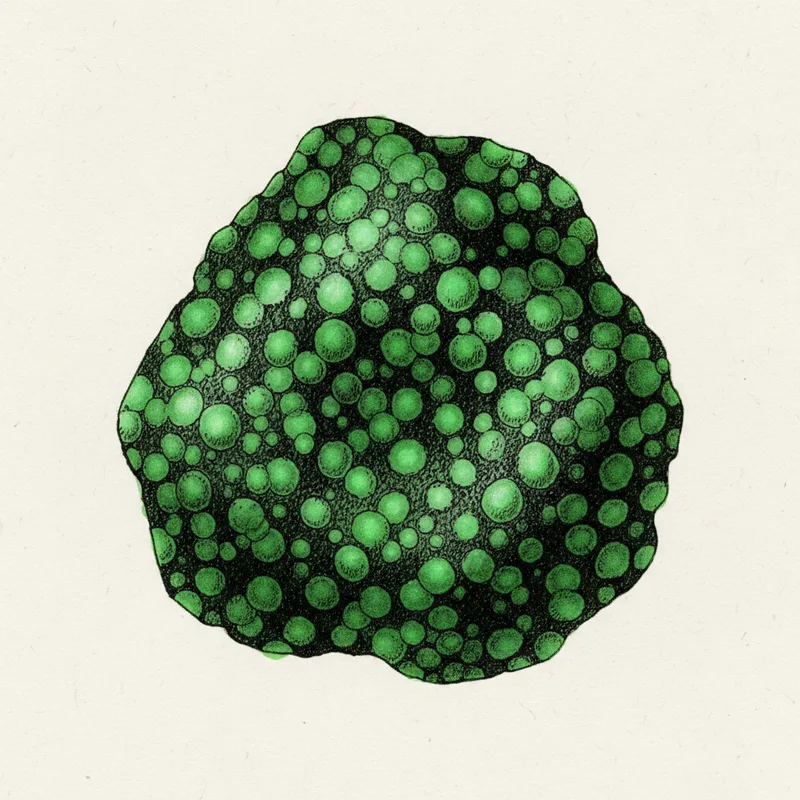
Nebula Stone
The Cosmic Pattern
Affiliate links. We may earn a commission, at no cost to you.
Quick Facts
Formation & Origin
Nebula stone is an extremely rare volcanic rock discovered in the 1990s by Ron and Karen Nurnberg. The exact locality is kept secret (somewhere in Mexico), and the Nurnbergs control virtually the entire supply. This makes nebula stone one of the most geographically restricted collectible rocks.
The stone's distinctive feature is its green orbicular (eye-like) patterns against a dark matrix - the orbs are composed of a unique combination of quartz, aegirine, riebeckite, and anorthoclase feldspar. The spherical patterns formed through a rare process where multiple minerals crystallized radially outward from nucleation points within the volcanic rock, creating green 'nebulae' against the dark groundmass.
What makes nebula stone genuinely unusual from a geological perspective is the specific mineral combination in its orbs - the coexistence of these particular minerals in spherulitic form within a single volcanic rock is essentially unique to this one deposit.
Identification Guide
Nebula stone is identified by its dark green-black matrix with distinctive lighter green orbicular (eye-like) patterns. At hardness 6-7, it's moderately hard and takes a good polish. The orbs typically range from a few millimeters to about 1 centimeter.
Distinguish from ocean jasper (more colorful, more varied orb colors), kambaba jasper (similar dark green with circles, but different mineral composition - fossilized algae), and serpentine with eye patterns. Nebula stone's specific dark-on-dark green pattern with sharply defined orbs is distinctive.
Spotting Fakes
Because of controlled supply, most nebula stone on the market is genuine. The main concern is kambaba jasper or other orbicular rocks being sold under the nebula stone name at inflated prices. Genuine nebula stone has a specific mineral composition verifiable by testing, and its orbs have a distinctive clarity and definition. The controlled supply also means prices are relatively standardized.
Some links in this post go to Amazon and Etsy. Crystal Almanac earns a commission from qualifying purchases at no extra cost to you. Tools recommended here are ones we would use ourselves to run the tests described - the recommendation comes first, the link is downstream of it.
Cultural & Metaphysical Traditions
Presented as cultural traditions, not scientific evidence
Nebula stone's cosmic appearance (the orbs genuinely resemble galactic nebulae) has made it a favorite for practitioners working with connection to universal consciousness and cosmic energy. Its rarity and mysterious origin add to its perceived power. Modern practitioners associate it with awakening to one's purpose, connecting to the vastness of existence, and grounding cosmic awareness into practical action.
Metaphysical and “healing” associations are cultural traditions, not medical advice or scientific fact. Crystals are not a substitute for professional medical care.
Where It's Found
The only known source, location undisclosed
Price Guide
Good to Know
Scratch test: At hardness 6.5, Nebula Stone resists scratching from a knife but can be scratched by quartz. Best for pendants and earrings rather than rings.
Global supply: Found at only one location on Earth - Mexico. Supply is inherently limited.
Heft test: Nebula Stone has average mineral density (2.80). It feels about as heavy as you'd expect from a stone its size.
Common Questions
What is the chemical formula of Nebula Stone?
The chemical formula of Nebula Stone is Variable (quartz + aegirine + riebeckite + anorthoclase + arfvedsonite).
What is Nebula Stone's Mohs hardness?
Nebula Stone has a Mohs hardness of 6.5 on the 1 to 10 Mohs scale, hard enough to scratch glass but softer than quartz.
Is Nebula Stone a mineral?
Not quite. Nebula Stone is a rock (a naturally occurring mixture of minerals), not a single mineral species.
Care & Safety
The water, salt, and sunlight questions people actually ask before cleansing or displaying nebula stone, answered from its hardness (Mohs 6.5) and chemistry (Variable (quartz + aegirine + riebeckite + anorthoclase + arfvedsonite)).
Can Nebula Stone go in water?
Yes. Nebula Stone is not water-soluble and durable enough (Mohs 6.5), so a rinse or a quick wash with mild soap is no problem, cleanse it in water freely if that is your practice. A long soak does nothing for it either way, so skip that, and dry the stone afterward.
Can Nebula Stone go in salt water?
Not recommended, even though nebula stone itself is hard and not water-soluble. Salt is both corrosive and mildly abrasive: it can dull a polished surface, attack metal settings, and crystallize inside small fractures as the stone dries. A quick dip will not destroy nebula stone, but rinse it with fresh water afterward and dry it. For routine cleaning, plain water is the kinder choice.
Sources & References
The mineralogical and gemological data on this page is drawn from and can be cross-checked against these external references.
- WikipediaRhyolite on Wikipedia
Explore More
Save This Stone

Keep this nebula stone reference handy. Save the card to a Pinterest board and the profile is one tap away.
Save to PinterestNewsletter
Something shiny, now and then
A stone worth knowing, or a fake worth spotting, every so often. No spam.